The Only Asset Guaranteeing Me a Positive Real Return Right Now
A 3.80% APY looks like a win on paper, but running the real numbers reveals that most savers are quietly losing purchasing power every month. One overlooked corner of the Treasury market offers something savings accounts cannot: a contractual guarantee…

This post may contain links from our sponsors and affiliates, and Flywheel Publishing may receive compensation for actions taken through them.

I moved $25,000 into a SoFi Checking and Savings account paying 3.80% APY. On the statement it looks like a win. But, after federal tax and current inflation, it is a slow loss. The only asset I can point to right now that is contractually guaranteed to beat inflation is a Treasury Inflation-Protected Security, and the market has it priced as if inflation is going to fall much further than it actually has. Here is the arithmetic, built from scratch. I am not a financial advisor, but I am showing my work and hope it helps you make better money choices.
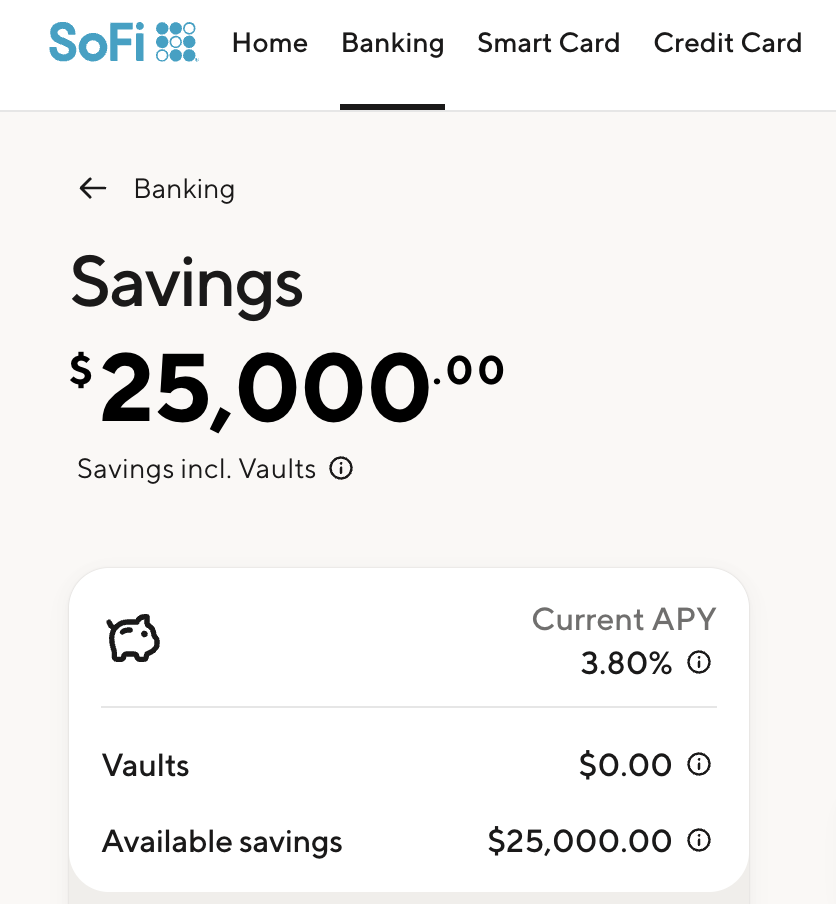
All yields and rates in this piece are variable and current as of August 20, 2026. Treasury, TIPS, and Fed figures come from the Federal Reserve’s H.15 Selected Interest Rates release. Inflation is the June 2026 core PCE reading.
Why 3.80% Is Actually a Negative Return
Bank interest is taxed as ordinary income at the federal level. Use a 32% marginal bracket as an illustration. At a 32% federal marginal rate, a 3.80% APY becomes 2.58% after tax, which is 3.80% * .68.
Now the inflation hurdle. Core PCE, the Federal Reserve’s preferred inflation gauge, is running at 3.3% as of the June 2026 reading. Subtract that from 2.58% and the real after-tax return on savings is roughly minus 0.72%. The statement shows interest earned. Purchasing power is shrinking.
Cash still has a job. Liquidity matters, an emergency fund matters, and my $25,000 is not moving. Calling that money an investment is a stretch when the real return is negative before state tax. And to be clear, I do not regret moving $25,000 into the savings account because if it was sitting in my ordinary bank, the loss would be significantly higher! SoFi’s 3.8% yield is among the best available today, and comes with easy integration in their crypto, and investing services. It also is liquid in a way other investments, like TIPS are not.
How TIPS Actually Work
The principal of a Treasury Inflation-Protected Security is adjusted with CPI, so the face value grows with inflation. The coupon is paid on the adjusted principal, so each semiannual interest payment rises with inflation too. At maturity the investor receives the greater of the adjusted principal or the original par, so deflation cannot pull the return of capital below face value.
When you see a TIPS yield, it is a real yield, a return above whatever inflation turns out to be over the life of the bond. It is a contract with the United States Treasury.
Real Yields on Offer Right Now
The TIPS real-yield curve is positive across every maturity. The 5-year yields 2.05% real. The 10-year yields 2.35% real. The 20-year yields 2.73% real. The 30-year yields 2.95% real.
A 10-year TIPS locks in a 2.35% return above CPI for a decade, guaranteed by the Treasury if held to maturity. The savings account cannot promise that for a single day, because the APY can be lowered any time the bank decides.
Breakeven Is Where the Trade Gets Sharp
The 10-year nominal Treasury yields 4.69%. The 10-year TIPS yields 2.35% real. The gap between the two, roughly 2.34%, is the inflation rate at which the two bonds produce the same total return over a decade. Bond traders call it breakeven inflation.
Core PCE is currently running 3.3%. The market is pricing 10-year inflation at roughly 2.34%. The bond market is priced for inflation to fall by nearly a full percentage point from where it actually sits, and to stay there for ten straight years.
If inflation runs hotter than 2.34% on average over the next decade, TIPS beat the nominal Treasury. If inflation runs at exactly 2.34%, they tie. If inflation collapses well below target and stays there, the nominal wins. Given that inflation has not yet returned to the Fed’s 2% target and is currently well above the breakeven, TIPS look like the better side of that trade.
What This Exercise Actually Shows
My $25,000 stays in the SoFi account because that money’s job is to be there when I need it. Cash has to give up a little real value to do that job.
The larger point is different. Money with a longer horizon should not sit in savings, because the same arithmetic that produces minus 0.72% for one year compounds into a serious hole over ten. TIPS at a 2.35% real yield, with the market priced for a decade of subdued inflation that has not actually arrived, are the cleanest inflation-beating trade I can identify right now.
Contact [email protected] for any questions or corrections.
Austin Smith is a financial publisher with over two decades of experience as an investor, analyst, and advisor. He covers stocks, ETFs, Artificial intelligence and personal finance for 24/7 Wall St. Previously, he spent over a decade at The Motley Fool as a senior editor for Fool.com, portfolio advisor for Millionacres, and launched The Ascent to help reader take control of their personal finances.
His work has been featured on Fool.com, NPR, CNBC, USA Today, Yahoo Finance, MSN, AOL, Marketwatch, and many other publications. He is as an advisor to private companies, and co-hosts The AI Investor Podcast with Eric Bleeker.
When not looking for investment opportunities, he can be found skiing, running, or playing soccer with his children. Learn more about Austin's investment approach here.