Why I’m Still Not Putting My $25,000 in a 30-Year Treasury Paying 5.23%
A 30-year Treasury is paying well above what any savings account offers right now, and the math on extra income looks almost too clean to pass up. So why does the arithmetic actually argue for walking away?

This post may contain links from our sponsors and affiliates, and Flywheel Publishing may receive compensation for actions taken through them.

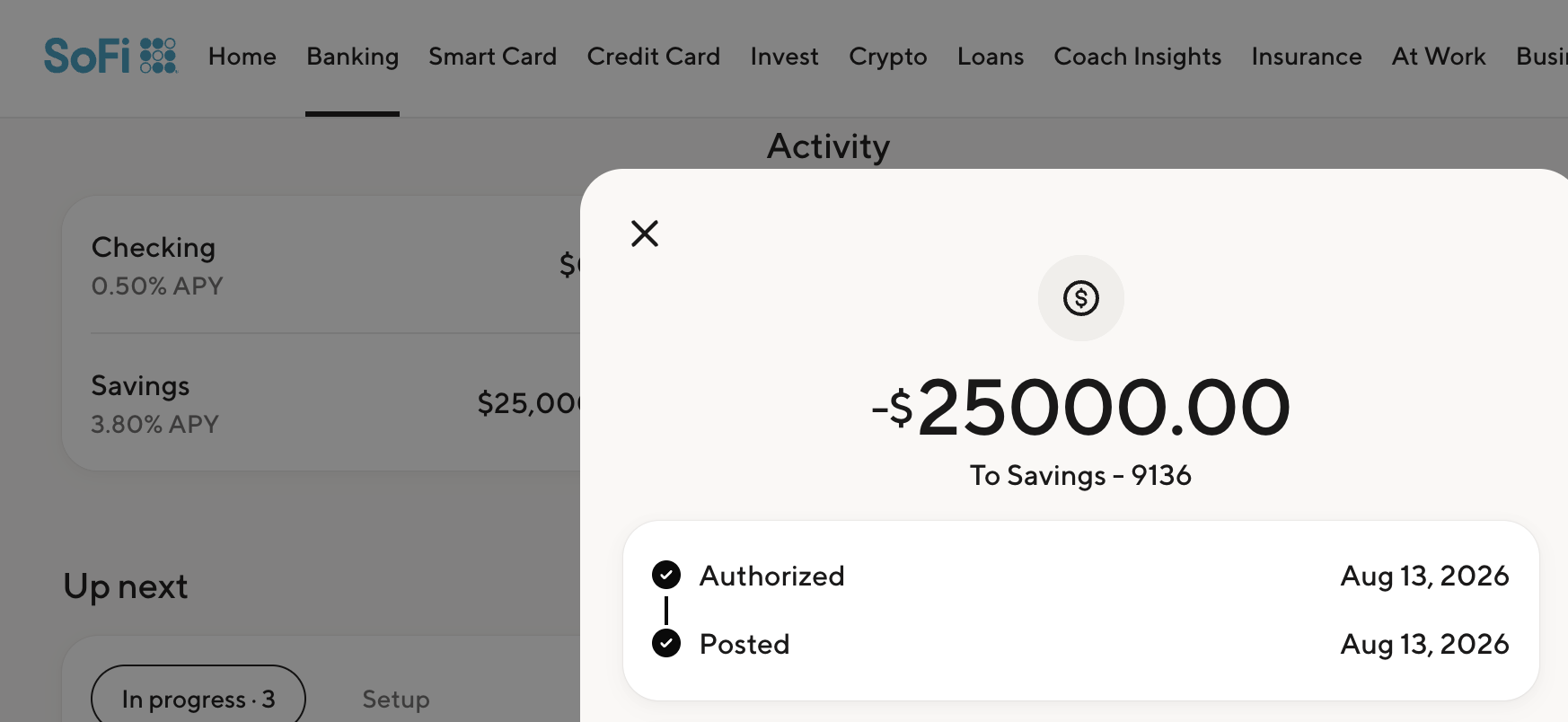
A 30-year Treasury is paying 5.23% while my savings account is only paying 3.80%. On a $25,000 balance, that is $1,308 a year in the bond against $950 in the savings account, an extra $358 for doing nothing but ticking a different box. I am not taking it.
Why 143 Basis Points Looks Like Free Money
The 30-year Treasury at 5.23% sits well above the 20-year at 5.20% and the 10-year at 4.69%, paying 143 basis points more than a leading online savings account. The spread against my savings APY works out to 143 basis points, or roughly $358 a year on $25,000. Over a decade, that gap compounds into real money. Treasury and Fed figures come from the Federal Reserve’s H.15 Selected Interest Rates release.
If the choice were only about income, the bond wins. The choice involves more than income.
What Duration Actually Measures
A 30-year Treasury has roughly 15 years of duration. Duration measures how much a bond’s price moves when yields move. Multiply duration by the change in yield, and you get the approximate percentage price change in the opposite direction.
If long yields rise 100 basis points from here, a 30-year Treasury falls on the order of 15%. On a $25,000 face position, that is roughly $3,750 of paper loss. Duration is an approximation, and the same math cuts the other way. A 100 basis point decline in yields would produce a gain of similar size.
Arithmetic That Settles It for Me
The income advantage over my savings account is about $358 a year. The price move from a 100 basis point rise in long yields is on the order of $3,750. One adverse move erases roughly four years of the yield pickup. That is what term premium is: compensation for accepting price risk.
If I held the bond for 30 years without touching it, interim price swings would be paper only. The problem is this $25,000 is not 30-year money. It is liquidity, cash that needs to be there when I need it, at close to face value, on short notice. Paying a 15-year duration price for a 3-year purpose is a mismatch, regardless of the coupon.
Why the Risk Is Not Hypothetical
Long-end yields have climbed since midsummer. The 10-year touched 4.75% on July 31, 2026, and readings in the 4.6% to 4.7% range have been the rule through August. The 30-year has traded between 5.17% and 5.31% in the last three weeks alone.
Heavy Treasury issuance to fund elevated federal deficits, a large calendar of AI-related corporate debt competing for the same buyers, and a shrinking cohort of natural long-duration holders have all pressed against the long end. That is exactly the environment where a 100 basis point move is not academic.
Where 5.23% for 30 Years Is Actually Defensible
An investor deliberately locking in a long income stream, matching a known long-dated liability, or funding retirement income they will draw for decades is a different case. That investor does not care about interim price swings because they never intend to sell. For them, 5.23% compounding for thirty years, with the full faith and credit of the U.S. Treasury behind it, is defensible. Long Treasuries are a bad fit for liquidity money.
My $25,000 is liquidity money. So it stays at 3.80%, earning less on the ticket and much more on the fit.
Contact [email protected] for any questions or corrections.
Austin Smith is a financial publisher with over two decades of experience as an investor, analyst, and advisor. He covers stocks, ETFs, Artificial intelligence and personal finance for 24/7 Wall St. Previously, he spent over a decade at The Motley Fool as a senior editor for Fool.com, portfolio advisor for Millionacres, and launched The Ascent to help reader take control of their personal finances.
His work has been featured on Fool.com, NPR, CNBC, USA Today, Yahoo Finance, MSN, AOL, Marketwatch, and many other publications. He is as an advisor to private companies, and co-hosts The AI Investor Podcast with Eric Bleeker.
When not looking for investment opportunities, he can be found skiing, running, or playing soccer with his children. Learn more about Austin's investment approach here.