Treasury Bills vs. High-Yield Savings: Which Actually Pays Retirees More After Taxes?

This post may contain links from our sponsors and affiliates, and Flywheel Publishing may receive compensation for actions taken through them.

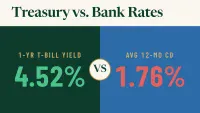
Which one pays a retiree more depends mostly on the state you live in. In the November 12, 2026 auctions, the 13-week Treasury bill averaged 4.21% and the 52-week bill averaged 4.52%. Treasury bill interest is free of state and local income tax. Savings account interest is taxed by your state. So in a high-tax state, a T-bill can leave you with more money than a savings account that advertises a slightly higher rate. In a state with no income tax, you can compare the two headline rates directly.
Yields kept moving after those auctions. On the Treasury par yield curve dated November 19, 2026, the 3-month maturity stood at 4.34% and the 1-year at 4.62%. The top of the Federal Reserve’s target range was 4.00%[1] on the same day. The Fed raised it from 3.75%[1] on September 16, 2026. Minutes from the Fed’s last meeting, released this week, show that almost all officials expect more rate hikes (Bloomberg, November 18, 2026).
How T-Bills and High-Yield Savings Accounts Work
A Treasury bill is a short-term loan to the U.S. government. You buy it for less than its face value and get the full face value back when it matures. The gap between the two is your interest. Your rate is locked in on the day you buy.
Maturities run from a few weeks to one year. You can hold the bill until it matures, or sell it early through a brokerage at whatever the market will pay that day. T-bills are backed by the full faith and credit of the U.S. government, which makes them about as safe as cash gets.
A high-yield savings account works like any savings account, but it usually pays several times what a traditional bank savings account does. Online banks tend to lead here. The rate is variable, so the bank can raise or lower it whenever it chooses. You can withdraw money at any time without losing any interest. Accounts at insured banks are covered by FDIC insurance up to the standard limit per depositor, per bank, per ownership category.
How State Tax Can Change the Answer
The federal treatment is the same for both. The tax code counts interest as gross income under 26 U.S.C. § 61(a)(4)[2], whether the interest comes from a bank or from the Treasury. The IRS states that interest from Treasury bills, notes and bonds "is subject to federal income tax but is exempt from all state and local income taxes"[3]. Savings account interest gets no such break. Your state taxes it as ordinary income.
That exemption is worth the most to retirees in states with high income tax rates, such as California, New York, New Jersey and Oregon. There, every dollar of bank interest gives up a slice to the state, while the same dollar of T-bill interest keeps it. The higher your state bracket, the higher a savings rate has to be to come out even with a T-bill. In states with no income tax, such as Florida, Texas, Nevada and Tennessee, the exemption is worth nothing and the higher posted rate wins. Retirees in states with moderate rates should compare the two carefully using their own state bracket. In those states the difference often comes down to a few dollars.
The exemption has one limit retirees often miss. T-bill interest is still federal income, so it still counts toward the formula that decides how much of your Social Security benefit is taxed. Any interest, whether from a CD, a savings account or a bill, raises your taxable income and can push more Social Security benefits into the taxable zone[4].
Why Flexibility Matters When Rates Are Rising
A savings account lets you reach your money the same day, and its rate can rise along with the market. A T-bill locks your rate until it matures. Selling one early in a rising-rate market can mean taking a lower price than you paid. The last few weeks show how fast short-term yields can move. The 1-year par yield was 4.38% on November 2, 2026 and 4.62% on November 19.
If the Fed keeps raising rates, money locked in a 52-week bill earns the old rate for the whole year. Shorter bills reduce that problem because they come due and can be reinvested quickly. A bank, on the other hand, has no obligation to raise your savings rate when the Fed does, and some banks are slow to do it. A savings account gives you the option to move. A T-bill gives you a guaranteed rate. When rates are climbing, keeping part of your cash flexible costs you very little.
Matching Each One to When You Need the Money
Many retirees use both, based on when they will spend the money. The savings account holds money you might need at any moment, like an emergency fund, a surprise medical bill or a month of spending as a cushion. T-bills hold money you will need on a known date, such as a property tax bill due in six months, a car you plan to buy next spring or next year’s travel budget.
Some retirees go a step further and stagger bills so one matures every month or every quarter. That way part of the money comes free on a regular schedule and gets reinvested at whatever rates are then. Inflation is the other thing to watch. Prices for households headed by someone 62 or older rose 0.2%[5] in the month ending October 2026, measured by the Bureau of Labor Statistics research index for older Americans. Cash should earn enough to keep up with those costs, or you are falling behind.
Which Option Fits Which Retiree
T-bills suit retirees in high-tax states with money they won’t need until a known date and who are comfortable buying through TreasuryDirect or a brokerage. High-yield savings suits retirees in states with no income tax, people who want one simple account and anyone whose spending is hard to predict. Most retirees with both kinds of needs end up keeping some money in each. The best first step is to look up your state’s income tax bracket before you compare rates.
Treasury Bill and Savings Tax Questions Retirees Ask
Do I owe federal tax on Treasury bill interest?
Yes. The Treasury and your brokerage report it to the IRS, and it is taxed at ordinary federal income tax rates, just like bank interest. Only state and local income taxes are waived.
Does the state exemption apply inside an IRA?
No, it effectively disappears. Money in a traditional IRA is taxed when you withdraw it as ordinary distributions, no matter what the IRA held. Inside a retirement account, the tax edge of a T-bill over savings goes away.
Are T-bills safer than an FDIC-insured savings account?
Both are very safe. T-bills are a direct obligation of the U.S. government with no limit on coverage. Bank deposits are protected up to FDIC limits, so very large balances may need to be spread across more than one bank or ownership category.
Do Treasury money market funds get the same state tax break?
Sometimes, and partly. Many states exempt the share of a fund’s income that comes from U.S. government securities, but the rules differ by state. Check your fund’s year-end tax statement and your state’s instructions.
How do CDs compare?
The national average 12-month CD paid 1.81%[4] as of November 1, 2026, according to the FDIC. That is well below the short-term T-bill yields above. CD interest is also fully taxable by your state, and cashing out early usually costs you a penalty.
Contact [email protected] for any questions or corrections.
Austin Smith is a financial publisher with over two decades of experience as an investor, analyst, and advisor. He covers stocks, ETFs, Artificial intelligence and personal finance for 24/7 Wall St. Previously, he spent over a decade at The Motley Fool as a senior editor for Fool.com, portfolio advisor for Millionacres, and launched The Ascent to help reader take control of their personal finances.
His work has been featured on Fool.com, NPR, CNBC, USA Today, Yahoo Finance, MSN, AOL, Marketwatch, and many other publications. He is as an advisor to private companies, and co-hosts The AI Investor Podcast with Eric Bleeker.
When not looking for investment opportunities, he can be found skiing, running, or playing soccer with his children. Learn more about Austin's investment approach here.