The 4.52% Benchmark Every Saver Should Check Before Accepting Their Bank’s Rate

This post may contain links from our sponsors and affiliates, and Flywheel Publishing may receive compensation for actions taken through them.
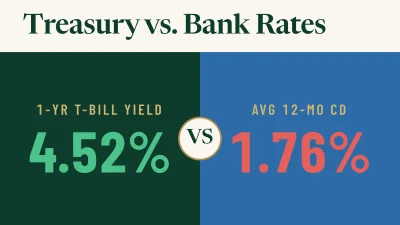
As of November 12, 2026, the U.S. government’s one-year Treasury bill yielded 4.52%. By the next trading day, November 13, 2026, it was 4.55%. That yield is the best measure you have for cash you can leave alone for a year. Banks that pay far less than that keep the difference.
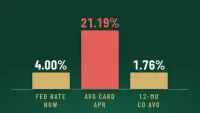
Here is how wide that difference can get. Across all banks, the FDIC’s average rate on a 12-month CD was 1.76%[1] in October 2026. It shows the average across all banks, and many banks pay more. Still, a saver making the average gives up 2.76 percentage points compared with the one-year bill.
What a Treasury Bill Is and Why Its Yield Sets the Bar for Cash
A Treasury bill is a short-term loan you make to the federal government. The IRS lists bills as having maturities of 4, 8, 13, 26, or 52 weeks. They are sold at a discount in $100 increments. You pay less than face value and get the full face value back at maturity, and the gap between the two is your interest.
Three things make the bill yield a clean benchmark. The government backs it. It trades every day in a deep open market, so the price shows real demand. It locks in a rate for a fixed period. That lets you compare it directly with a CD or a savings account.
Bill yields also track the central bank’s moves. The high end of the Fed’s target range was at 4.00%[2] on November 13, 2026, up from 3.75% in September. Shorter bills paid less than the one-year bill. The three-month bill yielded 4.21% on November 12. The one-year bill has also moved up fast, from 4.38% on November 2. That rise came as a Treasury selloff sped up and traders began expecting more Fed rate hikes.
How to Compare Your Bank’s APY With a Treasury Yield
APY, or annual percentage yield, is what a bank account pays over a year once compounding is included. The Treasury bill yield is your yearly return. You get it by buying the bill at auction price and holding it until it comes due. You can put the two numbers side by side and compare them directly.
Consider this example. Put $10,000 in a one-year bill at 4.52% and you making ~$452 before taxes. The same money at the average CD rate of 1.76%[1] making $176. That is $276 less on the same cash over the same year.
Taxes give the bill another edge. The IRS has clear rules here. Interest from Treasury bills, notes, and bonds is subject to federal income tax but is exempt from all state and local income taxes. You get the amount on Form 1099-INT in box 3. Interest from a savings account or CD is taxed by Washington and usually by your state as well.
Say you live in a state with a 5% income tax (a made-up example). A bank account would need to pay ~4.76% to match a 4.52% bill after state tax. If your state has no income tax, compare the two rates straight across.
Watch how long each rate holds. A savings account rate can change any day, while a bill’s yield is fixed until maturity, much like a CD.
Why Banks Get Away With Paying Less
Banks pay what they have to, and most savers never ask for more, so money sits in the savings account linked to your checking account for years. The rate gets cut, and nobody moves the money, so every dollar that stays put is cheap funding for the bank.
Look at the other side of the bank’s business. The average interest rate on card debt was 21.19%[3] as of August 2026. A bank that pays depositors a fraction of the Treasury yield and charges borrowers that much making a wide spread. Low deposit rates are part of the business model.
Pressure only comes when savers leave. Banks that want deposits, often online banks with fewer branches to pay for, offer rates much closer to the Treasury benchmark. Banks that don’t need your money count on you staying where you are.
Where Treasury Bills Fit in Your Cash Plan
You can buy bills two ways. TreasuryDirect, the government’s own site, sells them at auction with no fees. Your brokerage account works too. It lets you buy at auction or on the open market and holds your bills next to your other investments.
Hold a bill to maturity and you get the full face value back. The IRS says you generally report this interest income when the bill is paid at maturity. If you want access to funds sooner, you can sell the bill through a brokerage at the market price. That price could be lower than what you paid if yields have gone up since you bought. TreasuryDirect has no way to sell early, so you would have to move the bill to a broker first.
A simple setup places your emergency fund in an FDIC-insured savings account, where you can reach it right away. Funds set aside for a known date, such as a tax bill or tuition, go into bills scheduled to comes due when you need them. Series I savings bonds are another choice. Their composite rate is 5.51% for bonds issued from November 2026 through April 2027. The catch is that you can’t cash them in during the first year.
Check Your Own Rate Against the Benchmark Today
Log in to your bank and find the APY on your savings account and any CDs, then compare it with the latest one-year bill yield, which Treasury releases every business day. Adjust for state tax if your state has an income tax. If your rate falls well short of the benchmark, you are paying the bank to hold your money. Moving it is the fix.
Frequently Asked Questions
Is a Treasury Bill Safer Than a Savings Account?
Both are very safe. The federal government backs a bill directly. A savings account is FDIC-insured. It is protected up to the coverage limit for each depositor, at each bank, in each ownership category. Above that limit, a bill gives you more protection.
Why Does the One-Year Bill Pay More Than the Three-Month Bill?
Investors want extra yield to lock their money up longer, and right now markets expect rates to stay high. On November 12, the one-year bill paid 4.52% and the three-month bill paid 4.21%.
When Do I Pay Tax on Treasury Bill Interest?
Usually in the year the bill comes due. You pay federal income tax on the interest, and you owe no state or local income tax on it.
Can a Savings Account Ever Beat a Treasury Bill?
Yes. Some banks paying high rates for deposits match or beat bill yields for a while. Their rates float, though, so check the account against the benchmark every few months.
What Happens If I Need My Money Before the Bill Matures?
You sell it on the open market through a brokerage. You get whatever the market pays that day, which may be more or less than what you paid.
Contact [email protected] for any questions or corrections.
Austin Smith is a financial publisher with over two decades of experience as an investor, analyst, and advisor. He covers stocks, ETFs, Artificial intelligence and personal finance for 24/7 Wall St. Previously, he spent over a decade at The Motley Fool as a senior editor for Fool.com, portfolio advisor for Millionacres, and launched The Ascent to help reader take control of their personal finances.
His work has been featured on Fool.com, NPR, CNBC, USA Today, Yahoo Finance, MSN, AOL, Marketwatch, and many other publications. He is as an advisor to private companies, and co-hosts The AI Investor Podcast with Eric Bleeker.
When not looking for investment opportunities, he can be found skiing, running, or playing soccer with his children. Learn more about Austin's investment approach here.