Retirees Are Heading Back to Work. At 63, a $40,000 Job Could Cost Him $7,220 in Social Security Checks in 2027 Before His Benefit Rises Later
A retiree takes a job expecting extra cash, then Social Security stops mailing his checks for months. Those missing payments aren't necessarily gone, but the catch is how long he may wait to come out ahead.

This post may contain links from our sponsors and affiliates, and Flywheel Publishing may receive compensation for actions taken through them.
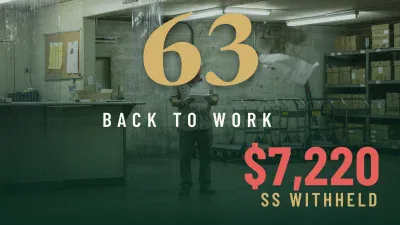
Take a 63-year-old who claimed Social Security early and in 2027 takes a $40,000 job, expecting his paycheck to sit on top of his monthly benefit. Then Social Security starts holding his checks back, and the number on the notice is $7,220.
Plenty of retirees end up in his position. They go back to work to cover higher costs, stay active or rebuild savings, only to discover that earning too much before full retirement age (FRA) can temporarily stop their Social Security checks. The surprise is that those missing checks aren’t necessarily lost for good. Social Security has a way of making up for them later, though it can take years to come out ahead.
How a $40,000 Paycheck Turns Into a $7,220 Holdback
If you haven’t reached FRA by year-end 2027, the earnings limit is $25,560. For every $2 you earn above that line, Social Security withholds $1 in benefits.
His salary clears the limit by $14,440, so half of that amount, $7,220, gets withheld.
Social Security collects this by holding back entire monthly checks, usually starting in January. Say his benefit is $2,000 a month. To cover the full amount, the agency keeps four checks, which adds up $8,000. Once his earnings for the year are reconciled, it sends back the extra $780.
Withheld Money Comes Back as a Bigger Check
For anyone born in 1960 or later, the age when Social Security pays full retirement benefits is 67. When our retiree reaches it, Social Security recalculates his benefit and gives him credit for the months it withheld. His monthly check increases from that point forward, although he doesn’t receive the withheld money back in a lump sum.
Say he started at 62. Claiming 60 months early cut his check by 30%.
Getting credit for four withheld months puts him in the same spot as someone who started 56 months early. That reduction is about 28%.
On his check, that difference is worth about $48 more a month. At that rate, he needs roughly 13 years past FRA to make up the $7,220 withheld, placing the break-even point near age 80. Annual cost-of-living raises, like the 3.6% increase for 2027, apply to the larger check as well, so the payback can come a little sooner.
That leaves him with a cash-flow problem: can he pay his bills for four months without a Social Security check? If not, he needs a plan before those payments stop in January.
Taxes and His Earnings Record Both Shift
The paycheck also changes how his benefits are taxed. The IRS starts with one-half of his benefits and adds his other income. For a single filer, once that total passes $34,000, up to 85% of benefits can be taxed. His $40,000 salary is already past that line by itself, so more of the benefits he actually receives could be taxable.
The job can help him, too. Every year, Social Security looks at new earnings. If his latest year is one of his highest, it recalculates his benefit and backdates the raise to the following January. If his $40,000 replaces a low-earning year on his record, his check goes up for good, on top of the credit for withheld months.
Two Pieces of the Puzzle to Solve Before Accepting the Offer
Start with the choice most difficult to reverse. If he began benefits within the last 12 months, he can withdraw his application with Form SSA-521. He would repay what he received and resume later at a higher amount. He gets this option only once in a lifetime, and only during that first year. After the window closes, the reduction for claiming early mostly stays in place.
Next, remember that the earnings test has an end date. In the year he turns 67, a higher earnings limit applies, and Social Security withholds just $1 for every $3 above it. Once he reaches FRA, there is no limit at all. A job that looks expensive at 63 can look very different at 67 (phasing out of work carries four tax traps of its own, which we walked through in a free semi-retirement guide).
Your birth month, earnings history, and household budget can each change these numbers, so before you sign an offer letter, run your own figures through your Social Security account.
Contact [email protected] for any questions or corrections.
Gerelyn Terzo is the author of dividend investing handbook "Dividend Investing Strategies: How to Have Your Cake & Eat It Too." A veteran financial journalist, she covers agri-finance for outlets like Global AgInvesting and the broader stock market and personal finance for 24/7 Wall Street. She began at CNBC and later helped launch Fox Business in New York. Gerelyn currently resides in Woodland Park, Colorado and dabbles in nature photography as a hobby.