He Was Shocked His Wife Had Just $80,000 Saved Against His $2.2 Million. Social Security Can Pay Her Up to Half His Full Benefit
Her 401(k) looks thin next to his $2.2 million, but Social Security keeps a separate set of books. One claiming choice she makes at 62 could cost her thousands every year for the rest of her life.

This post may contain links from our sponsors and affiliates, and Flywheel Publishing may receive compensation for actions taken through them.
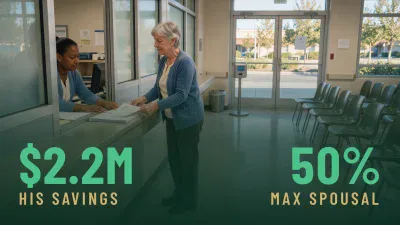
A 64-year-old husband recently told MarketWatch he was surprised to learn that his 61-year-old wife has less than $80,000 in her 401(k). His retirement and investment accounts hold about $2.2 million. She worked part-time and helped raise their family.
Gaps like this are common when one spouse steps back from full-time work, and they can be misleading because her 401(k) shows only part of the retirement income she can count on. Social Security keeps its own records, and there, being married to a high earner may be worth more than her account balance suggests.
The question is whether she should claim at 62 while he waits until 70, letting them pull less from savings. Two Social Security rules matter here:
- How much she can collect. Her spousal benefit tops out at 50% of his full retirement benefit, no matter how long he waits to claim.
- When she can collect it. He generally must file before she can receive spousal benefits. If she starts her own check at 62, that early cut stays with her even after she qualifies for a spousal top-up.
Half His Benefit Is Smaller Than Most Couples Assume
An eligible spouse can receive up to half of the worker’s primary insurance amount. That’s the monthly benefit he would get if he claimed at his normal retirement age. Only that one figure counts. His 401(k), his net worth and any bigger check he gets by waiting until 70 don’t change it.
Suppose his benefit at full retirement age (FRA) is $3,000 a month. She could collect up to $1,500 in spousal benefits. Even if he waits until 70 and gets a bigger check, her maximum stays at $1,500. His decision to delay doesn’t increase her spousal benefit.
Her Claiming Age Is the Lever That Lasts for Life
At 61, she generally can’t file for an age-based spousal benefit yet. The earliest she can start is age 62, and her husband usually must already have filed for his own retirement or disability benefit.
If her normal retirement age is 67, claiming at the earliest age cuts her maximum spousal benefit to 32.5% of his primary insurance amount.
If her husband had already filed when she turned 62, that would mean $975 a month instead of $1,500. The $525 monthly gap adds up to $6,300 a year, and the early-claiming cut stays with her.
Annual cost-of-living raises make the gap bigger, because each raise is a percentage of the amount she locked in. The 2026 increase was 2.8% and the 2027 increase is 3.6%. For most people on Medicare, the standard Part B premium of $202.90 a month in 2026 also comes out of the check before it arrives.
The age gap helps here. She is three years younger, so if he waits until 70 to file, she’ll be 67 when spousal benefits become available. She can collect the full spousal amount if she hasn’t already claimed her own retirement benefit early.
But if she starts collecting her own retirement benefit at 62 while he waits until 70, that early cut doesn’t disappear when she becomes eligible for spousal benefits. She can receive a top-up once he files, but her own check remains smaller for life.
Why Two Social Security Checks Never Stack
If her part-time years give her a retirement benefit of her own, Social Security pays that first. It then adds a spousal top-up if half his primary insurance amount is larger. Say her own benefit at FRA is $800. If she waits until then to claim, she gets $800 plus a $700 top-up, for a total of $1,500. Claiming her own benefit earlier would change that calculation.
His Claiming Age Sets Her Widow’s Check
For a couple planning together, whose name is on each account matters less than the household total. The $2.2 million can cover living costs while they wait for larger retirement checks.
Those savings matter most for his claiming decision, because it sets what she would get if he dies first. A surviving spouse can receive up to 100% of the late spouse’s benefit after reaching the standard age for survivor benefits. That’s based on the check he actually receives, including any increase from waiting. Delaying doesn’t change her spousal check, but it raises her potential widow’s check for the rest of her life. With a three-year age gap, she could be living on that check for many years.
What to Settle Before Either of You Files
Start by pulling both Social Security statements and comparing her own estimate with half of his primary insurance amount. That one comparison shows whether her record or his will set her check. It also shows whether her own part-time earnings add anything.
Then think of her claiming age as the decision that’s hardest to undo. Waiting until her normal retirement age gets her the full half, and his own timing can raise the survivor benefit she may someday rely on.
Birth dates, work records and health can all change the math, so do the calculation before either of you files.
Contact [email protected] for any questions or corrections.
Gerelyn Terzo is the author of dividend investing handbook "Dividend Investing Strategies: How to Have Your Cake & Eat It Too." A veteran financial journalist, she covers agri-finance for outlets like Global AgInvesting and the broader stock market and personal finance for 24/7 Wall Street. She began at CNBC and later helped launch Fox Business in New York. Gerelyn currently resides in Woodland Park, Colorado and dabbles in nature photography as a hobby.