How the Goodyear Blimp Became America’s Greatest Marketing Invention
Courtesy The Goodyear Tire & Rubber CompanyWho doesn’t like a blimp? The soft, pillowy things just look friendly, whether looking down on a sporting event or just slowly flying around with an advertising message plastered on the sides. For that…

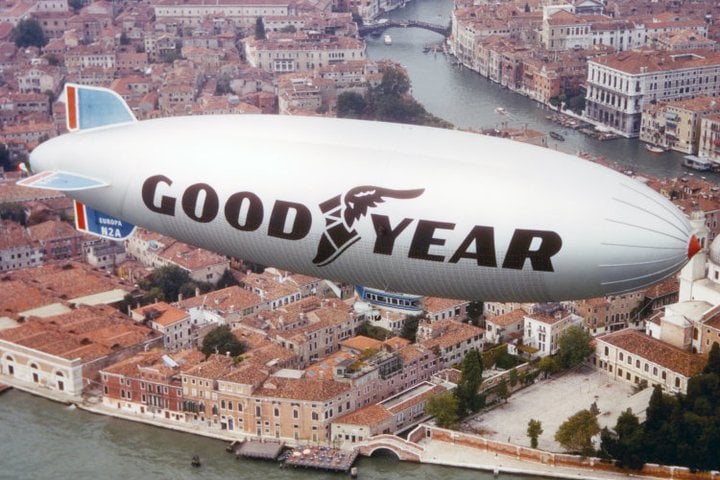 Who doesn’t like a blimp? The soft, pillowy things just look friendly, whether looking down on a sporting event or just slowly flying around with an advertising message plastered on the sides. For that reason alone, blimps may be the best marketing tool ever devised.
The archetype, of course, is the Goodyear blimp. The first Goodyear blimp took to the skies in 1925 and The Goodyear Tire & Rubber Co. (NASDAQ: GT) now owns a U.S. fleet of three, which the company hangars in California, Ohio and Florida. A fourth is based in China.
Another familiar blimp fleet is owned by MetLife Inc. (NYSE: MET), which also has a permanent U.S. fleet of three.
Blimps, which are inflatable, helium-filled bags, only cost about $5 million to make. Of course, Goodyear also employs three crews of 16 to fly and maintain them. And that does not include storage facilities or the trucks and other ground support vehicles to move the blimp and its crew to different locations.
Goodyear’s 87-year history of using blimps to market the company would seem to suggest that the company considers it a good investment. Goodyear and its original blimp maker, German firm Luftschifftbau Zeppelin, planned to use the first blimps as advertising vehicles, as well as offering them for rent or sale. (By the way, that is the same company that built the Hindenburg.) These days, Goodyear is only used for advertising.
Is it worth the expense? Let’s say that the total cost of operating a blimp for a year is also around $5 million. That likely would cover the cost of the crew, maintenance and fuel. A 30-second ad during the Super Bowl broadcast cost $4 million this year. How many times does the Goodyear blimp get mentioned during the game? Even if only once, the cost of operating the blimp just fell 80%.
According to the company, the blimps contribute to name-recognition and goodwill. More than 60 million Americans see the Goodyear blimps first-hand every year, and many millions more see them on TV broadcasts. Goodyear’s website points out that people are excited at seeing the blimp and that they are able to recall exactly when and where they saw it. This is, of course, according to independent research.
That kind of recall is worth pure gold to companies and, even if someone is watching an event on TV, a plug or two for the blimp’s owner is free.
Blimp marketing must be working very well for Goodyear because the company is replacing its blimps with rigid-framed zeppelins, which cost about $21 million each. The first zeppelin is expected to be in the air next spring, but the company plans to continue referring to the airships as blimps. As the company’s head of airship operations told ABC, “It’s not technically a blimp, but most people don’t know or care. To them, it’s the Goodyear Blimp, and we’re fine with that.”
Contact [email protected] for any questions or corrections.
Paul Ausick has been writing for 247Wallst.com for more than a decade. He has written extensively on investing in the energy, defense, and technology sectors. In a previous life, he wrote technical documentation and managed a marketing communications group in Silicon Valley.
He has a bachelor's degree in English from the University of Chicago and now lives in Montana, where he fishes for trout in the summer and stays inside during the winter.