Iran May Have Found a New Way to Threaten Trump’s Economy — And It’s Not Oil
The stock market has spent much of 2026 acting like geopolitical risk is just background noise. The S&P 500 keeps pushing toward record highs, AI spending remains red hot, and investors have largely shrugged off the widening conflict involving Iran.…

The stock market has spent much of 2026 acting like geopolitical risk is just background noise. The S&P 500 keeps pushing toward record highs, AI spending remains red hot, and investors have largely shrugged off the widening conflict involving Iran. But what if Tehran found a pressure point far more dangerous than oil tankers?
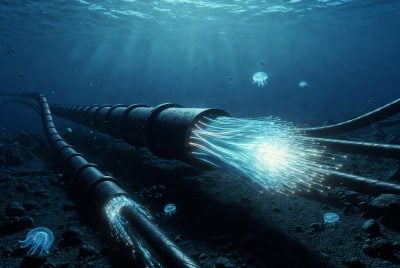
That’s the question investors may soon need to answer. Reports circulating through Iranian Revolutionary Guard-linked media outlets suggest Iran is exploring ways to assert control over the undersea internet cables running through the Strait of Hormuz — a move that could threaten digital commerce, AI infrastructure, and trillions of dollars in financial activity directly tied to President Trump’s economy.
Iran May Be Targeting the World’s Digital Arteries
Most investors understand the Strait of Hormuz matters because roughly 20% of global oil shipments pass through it, according to the U.S. Energy Information Administration. But surprisingly, the strait also carries a huge portion of the world’s internet infrastructure.
TeleGeography estimates about 17% of global internet traffic moves through subsea cables crossing the region. Meanwhile, industry data cited by Reuters shows between 95% and 99% of internet traffic serving Gulf states depends on those cable systems. Following the conflict onset in February 2026, Iran has imposed a near-total closure over the strait, significantly raising the risk profile for these “digital arteries.”
That just shows how the modern economy runs through Hormuz in more ways than one.
IRGC-affiliated media reports suggest Iran could begin treating those cables as sovereign infrastructure assets. The proposals reportedly include:
- Requiring permits for cable repairs
- Charging transit or maintenance fees
- Giving Iranian firms oversight authority
- Demanding technical participation in cable management
- Potentially restricting emergency repair access during conflicts
Granted, Iran does not “own” the cables outright. Most are operated by multinational consortiums involving telecom companies and hyperscale cloud providers. But Iran could attempt to assert jurisdiction over waters near its coastline or use military pressure to enforce compliance.
That changes the risk calculation for investors.
Why Wall Street Should Care About 17% of Internet Traffic
At first glance, 17% may not sound catastrophic. After all, the internet reroutes traffic constantly. But the economic importance of these cables goes far beyond browsing speeds or streaming videos.
According to the U.S. Treasury Department and SWIFT banking data, more than $10 trillion in daily financial transactions rely on subsea cable connectivity globally. Large portions of Middle East-to-Europe and Asia-to-Europe data routes pass through Hormuz-linked systems.
Microsoft (NASDAQ:MSFT | MSFT Price Prediction), Alphabet‘s (NASDAQ:GOOG)(NASDAQ:GOOGL) Google, and Amazon (NASDAQ:AMZN) have collectively committed billions of dollars toward AI infrastructure. New reports for May 2026 suggest total hyperscaler capex could hit $700 billion this year, doubling 2025 levels. These investments depend heavily on uninterrupted cable connectivity.
Here’s what those companies have recently committed:
| Company | Regional AI/Data Center Commitments (2026) |
| Microsoft | $120B+ investment; $80B Azure order backlog |
| Alphabet | $175B-$185B total capex with Qatar/Saudi expansion |
| Amazon | $200B projected capex for global data center sprawl |
These firms are not investing in the Gulf for fun. They’re building AI hubs designed to connect Europe, Asia, and Africa through low-latency infrastructure.
If Iran inserts itself into cable operations, it creates a new geopolitical choke point. This matters because AI is one of the biggest pillars supporting Trump’s bull market. Nvidia (NASDAQ:NVDA) alone has added trillions in market value since 2023. The rally assumes global data movement remains seamless.
Trump and Global Counter-Measures
President Trump has repeatedly warned Iran against threatening commercial shipping lanes. This resolve was codified in the Strategic Subsea Cables Act introduced in March 2026, which empowers the White House to sanction individuals damaging digital infrastructure.
Global responses have followed suit, with the European Commission allocating €347 million this year specifically for subsea security. Possible escalation responses include:
- Expanded sanctions targeting Iranian telecom entities
- U.S. naval escorts for repair ships
- Cyber retaliation against Iranian infrastructure
- Secondary sanctions against firms complying with Iranian rules
Oil prices already remain elevated, with Brent crude trading near $103 as of May 12, 2026. If tensions expand into internet infrastructure, markets may begin pricing in a wider disruption to global commerce. Unlike oil, there is no “Strategic Fiber Reserve” to buffer a digital collapse.
Higher prices feed inflation, while digital bottlenecks slow trade and cloud computing. Together, they create a stagflationary setup—weaker growth combined with rising costs—that could pressure the very technology stocks driving the current rally.
Key Takeaway
In short, Iran’s interest in asserting control over subsea internet cables is no longer an obscure theory; it is a developing digital chokepoint. The Strait of Hormuz now threatens trillions in financial flows and billions in AI investments.
If Trump responds forcefully, investors could face another surge in oil prices and fresh volatility across technology markets. The biggest risk is that global markets suddenly realize how fragile the digital backbone of the economy really is.
Editor’s Note: This article has been updated as of May 12, 2026, to include current Brent crude pricing of $103 and recent 2026 capital expenditure forecasts for major hyperscalers. It also integrates new legislative context regarding the Strategic Subsea Cables Act and global security investments from the European Commission.
Contact [email protected] for any questions or corrections.
After two decades of patrolling the dark corners of suburbia as a police officer, Rich Duprey hung up his badge and gun to begin writing full time about stocks and investing. For the past 20 years, he’s been cruising the markets looking for companies to lock up as long-term holdings in a portfolio while writing extensively on the broad sectors of consumer goods, technology, and industrials. Because his experience isn’t from the typical financial analyst track, Rich is able to break down complex topics into understandable and useful action points for the average investor. His writings have appeared on The Motley Fool, InvestorPlace, Yahoo! Finance, Money Morning, and, of course, 24/7 Wall St. He has been featured in both U.S. and international publications, including MarketWatch, Financial Times, Forbes, Fast Company, and USA Today.