Silver Just Hit $100. Time to Sell Hecla Mining?
Silver prices breached the $100 per ounce mark for the first time ever today climbing nearly 4% in morning trading to hit $100.10. The metal has delivered a tremendous run over the past two years, with gains of over 226%…


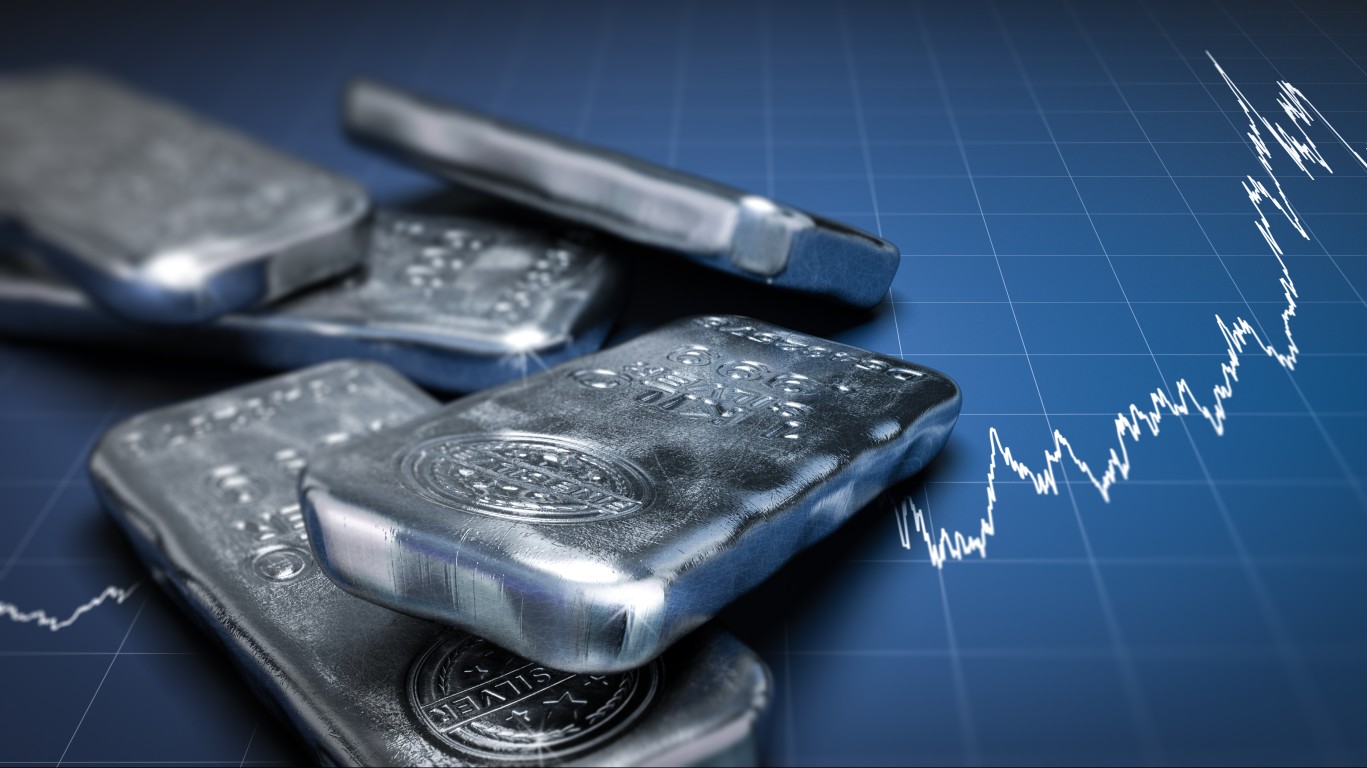
Silver prices breached the $100 per ounce mark for the first time ever today climbing nearly 4% in morning trading to hit $100.10. The metal has delivered a tremendous run over the past two years, with gains of over 226% since early 2024, far outpacing gold’s 64% rise in 2025 alone. Gold, currently at $4,959 per ounce, appears poised to break through $5,000 soon.
However, some analysts warn that silver is extremely overbought after its parabolic move, with indicators like deviation from its 200-day moving average signaling potential pullbacks. Roukaya Ibrahim, chief strategist at BCA Research, notes the rally’s magnitude is hard to justify by fundamentals, driven by speculative frenzy and the fear of missing out (FOMO) buying.
If a downturn materializes, should investors sell shares of Hecla Mining (NYSE:HL), the largest primary silver producer in the U.S. and Canada?
What’s Been Fueling Silver’s Dramatic Climb?
Silver’s surge from 2024 to 2026 stems from explosive industrial demand, persistent supply deficits, and macroeconomic shifts. Key drivers include the solar industry’s usage, which jumped to 25% of total demand, electric vehicle growth requiring 20% more silver last year for components like sensors and wiring, and AI-driven data centers boosting electronics use.
Geopolitical tensions, such as U.S. threats over Greenland and Iran, amplified safe-haven flows, while Federal Reserve rate cuts and a weakening dollar supported commodity prices. Analysts like those at Bank of America forecast silver hitting $170 an ounce, citing structural deficits and green tech demand. Citigroup targets $110 by the end of the year, driven by COMEX inventory drops of more than 70% since 2020. Overall, projections range from $90 to $120 in a base case and $150 to $170 in bull scenarios, with some even eyeing $300 by year-end.
Silver’s Emerging Safe-Haven Status
Silver has not traditionally been viewed as a pure safe-haven asset like gold, given its 58% industrial usage tying it to economic cycles. However, amid 2026’s uncertainties — including tariff threats and global debt — investors are treating it more like one, bolstered by its accessible price point compared to gold.
This shift, combined with reserve diversification by emerging market central banks, could continue if aversion to risk persists. Analysts point out silver’s dual role amplifies its gains in risk-on phases but risks sharper correction if manufacturing slows. It’s worth noting the Institute for Supply Management’s Manufacturing PMI for December fell 0.3 points to 47.9, marking the 10th consecutive month of contraction and the lowest level of 2025.
Ibrahim highlights silver’s overbought signals, with real-term deviations nearing levels that preceded past pullbacks. Much of the rally prices in hedging against currency debasement and turmoil, but inflation hasn’t escalated, and the dollar is stabilizing. High prices may curb demand, while the gold/silver ratio suggests relative underperformance.
Silver has historically traded at 1/20th the price of gold; today it’s 1/50th the price. Yet at the start of the year it stood at 1/60th the price, and a year ago it was at 1/90th. There is an argument for it to expand or contract, and even BCA maintains a long-term bullish view based on silver’s macro backdrop.
Hecla Mining’s Boost from High Prices
Hecla Mining’s shares have risen 66% year-to-date and are up 482% over the past 12 months, fueled by silver’s rally. In the third quarter, Hecla reported record revenue of $409.5 million, up 67% year-over-year, with net income of $100.6 million or $0.15 per share. Silver production reached 4.6 million ounces at all-in sustaining costs of $11.01 per ounce and negative $2.03 cash costs after by-products. Its Greens Creek mine produced 2.3 million ounces of silver, Lucky Friday 1.3 million, and Keno Hill 0.9 million, with all mines generating positive free cash flow. Hecla was able to repay its revolver, reducing leverage to 0.3x, and tightened 2025 guidance for lower costs.
Hecla’s stock is, of course, sensitive to silver prices, as the metal drove 48% of Q3 revenue. A tumble could pressure margins if costs rise or output dips. However, diversification into gold (37% revenue), lead, and zinc provides it a buffer. Long mine lives at key operations, low debt, and $148 million in operating cash flow offer resilience. Investments like Lucky Friday’s cooling project within the next few months and an exploration permit for Polaris for this year enhance Hecla’s future output.
Key Takeaway
I’d recommend investors hold onto their Hecla Mining shares rather than sell. While silver’s potential overbought status risks short-term corrections, strong industrial demand from solar, EVs, and AI, plus a growing safe-haven appeal as geopolitical risks continue, support further gains in 2026.
Hecla’s robust financial results, diversified revenue streams, and its low leverage position set up the miner to benefit from any upside while weathering downside volatility. Considering silver’s rally may very well have legs suggests Hecla Mining remains a solid investment.
Contact [email protected] for any questions or corrections.
After two decades of patrolling the dark corners of suburbia as a police officer, Rich Duprey hung up his badge and gun to begin writing full time about stocks and investing. For the past 20 years, he’s been cruising the markets looking for companies to lock up as long-term holdings in a portfolio while writing extensively on the broad sectors of consumer goods, technology, and industrials. Because his experience isn’t from the typical financial analyst track, Rich is able to break down complex topics into understandable and useful action points for the average investor. His writings have appeared on The Motley Fool, InvestorPlace, Yahoo! Finance, Money Morning, and, of course, 24/7 Wall St. He has been featured in both U.S. and international publications, including MarketWatch, Financial Times, Forbes, Fast Company, and USA Today.