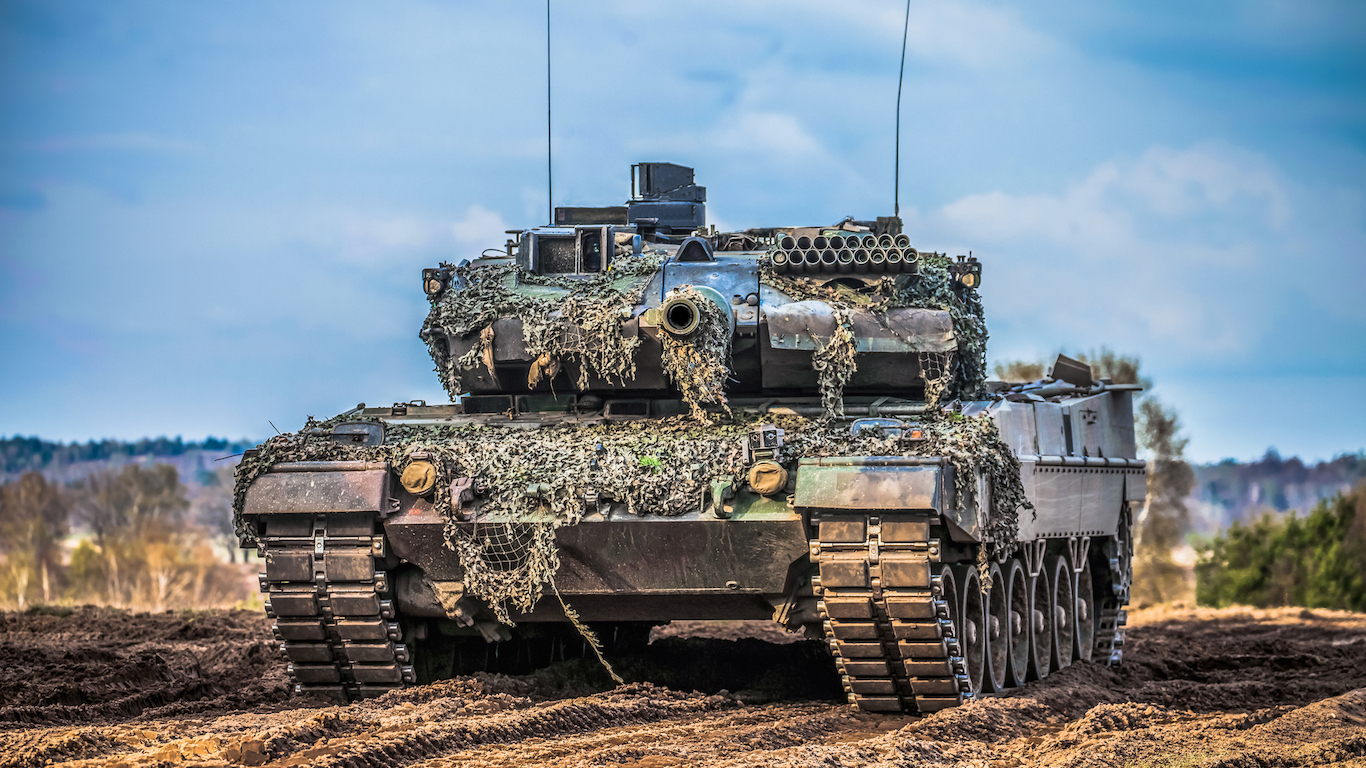
Abrams Tanks Cost $9 Million Each
The Abrams tank is effective enough that, even in small numbers, it could make a significant difference to the Ukrainian military.

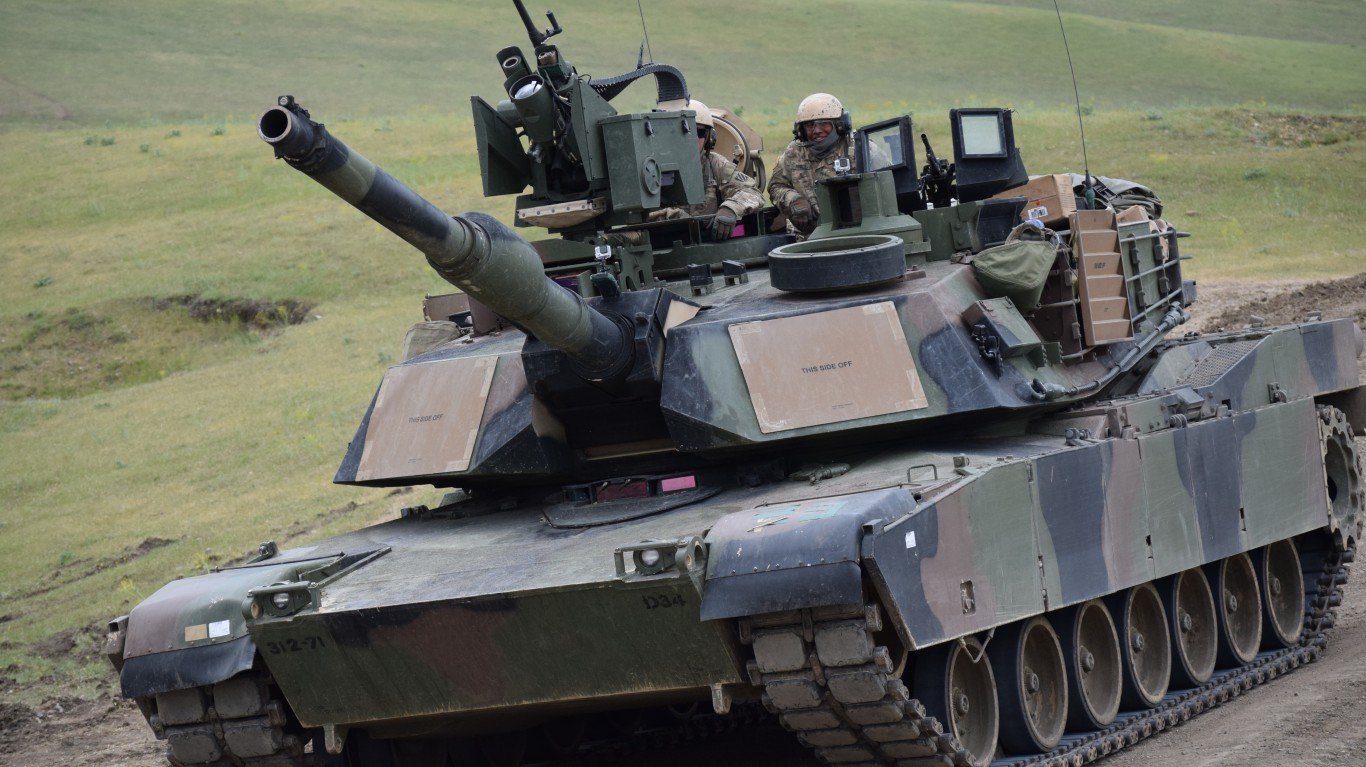
The United States has 4,400 Abrams tanks. Almost 10,000 are in operation worldwide. Very few of these may be sent to Ukraine. The tank is effective enough that, even in small numbers, it could make a significant difference as the Ukrainian military tries to hold against a possible Russian push this spring. Based on a recent analysis, these tanks cost about $9 million to build. (Click here for 30 inventions that shaped military history.)
The first Abrams was built in 1980. It has been used extensively in battle since then. Almost 1,800 were used in the liberation of Kuwait, Desert Shield and Desert Storm.
The Abrams is operated by an engine that uses jet fuel, which some experts believe makes it a poor weapon to send to Ukraine. Most other tanks use diesel fuel. The Abrams is also complicated to operate and requires extensive training. One thing the Ukrainian forces do not have in abundance is time. There are over 20 versions of the tank, so it can be adapted to almost any type of combat service.
The Abrams has state-of-the-art technology. This includes laser range finders, night site features and ballistics computers. According to the Military Analysis Network, the Abrams has six periscopes that give the tank commander 360 degrees of vision. According to the same source, the Abrams will be upgraded: “Further M1A2 improvements, called the System Enhancement Program (SEP), are underway to enhance the tank’s digital command and control capabilities and to improve the tank’s fightability and lethality.”
Billions of dollars in military aid have been sent to Ukraine, but the Abrams deployment will cost less than $100 million, if the current estimates are correct.
Contact [email protected] for any questions or corrections.
Douglas A. McIntyre is the co-founder, chief executive officer and editor in chief of 24/7 Wall St. and 24/7 Tempo. He has held these jobs since 2006.
McIntyre has written thousands of articles for 24/7 Wall St. He is an expert on corporate finance, the automotive industry, media companies and international finance. He has edited articles on national demographics, sports, personal income and travel.
His work has been quoted or mentioned in The New York Times, The Wall Street Journal, Los Angeles Times, The Washington Post, NBC News, Time, The New Yorker, HuffPost USA Today, Business Insider, Yahoo, AOL, MarketWatch, The Atlantic, Bloomberg, New York Post, Chicago Tribune, Forbes, The Guardian and many other major publications. McIntyre has been a guest on CNBC, the BBC and television and radio stations across the country.
A magna cum laude graduate of Harvard College, McIntyre also was president of The Harvard Advocate. Founded in 1866, the Advocate is the oldest college publication in the United States.
TheStreet.com, Comps.com and Edgar Online are some of the public companies for which McIntyre served on the board of directors. He was a Vicinity Corporation board member when the company was sold to Microsoft in 2002. He served on the audit committees of some of these companies.
McIntyre has been the CEO of FutureSource, a provider of trading terminals and news to commodities and futures traders. He was president of Switchboard, the online phone directory company. He served as chairman and CEO of On2 Technologies, the video compression company that provided video compression software for Adobe’s Flash. Google bought On2 in 2009.