




Alphabet (NASDAQ: GOOGL | GOOGL Price Prediction) and NVIDIA (NASDAQ: NVDA) just posted AI-heavy quarters from opposite ends of the silicon stack. Google leaned on its own TPUs, Gemini, and Cloud. NVIDIA rode Blackwell into hyperscaler data centers at a pace Jensen Huang called the fastest ramp in company history. Both are spending like the AI buildout is generational. Only one owns the customer end to end.
TPUs Carry Google. Blackwell Carries NVIDIA.
Google’s Q1 FY2026 revenue hit $109.90 billion, up 21.79% YoY, with EPS of $5.11. Cloud jumped 63% to $20 billion, and backlog nearly doubled sequentially to $462 billion. Sundar Pichai credited the vertical stack: “The fact that we own frontier models and own the silicon really helps us stay ahead of the curve.” New 8th-gen TPUs claim 80% better performance per dollar on inference.
NVIDIA answered with Q1 FY2027 revenue of $81.61B, up 85.2% YoY, and non-GAAP gross margin of 75.0%. Data Center alone printed $75.25B, +92%, with networking surging 199%. Huang called it “the largest infrastructure expansion in human history.”
One Owns the Customer. One Sells the Shovels.
| Lens | NVIDIA | |
| Core Bet | Full stack: TPU + Gemini + Cloud | Merchant GPU dominance |
| Gross Margin | 59.7% | 75.0% non-GAAP |
| Key Vulnerability | CapEx pressure, FCF down 46.63% | China loss, ~$50B TAM gone |
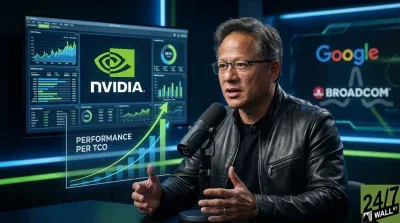
Google is now productizing its silicon. Pichai confirmed TPU sales “to a select group of customers in their own data centers.” That is a direct poke at NVIDIA’s installed base. Meanwhile, Alphabet’s seventh-gen Ironwood TPUs enable native FP8 training and inference, sidestepping what many observers call the NVIDIA tax. NVIDIA’s counter is ecosystem depth, CUDA, and Spectrum-X, which already annualizes over $8 billion and added Google Cloud as a customer.
The Next Test Is Whether TPUs Escape the Google Garden
I’m watching Google’s 2027 CapEx guide, which Pichai said will “significantly increase compared to 2026,” and whether external TPU deployments start converting backlog into recognized Cloud revenue. For NVIDIA, the tell is Blackwell 300 yields and Vera Rubin bookings against $119B in supply commitments. Prediction markets already price NVDA into a tight range, with 72% probability clustered near $208.
Why I Lean Toward Google on Risk-Adjusted Terms
Personally, I find Google more interesting at a P/E of 16 than NVIDIA at a $4.91T market cap. Google is up 103.78% over one year, yet still trades like a search utility while owning the silicon, the model, and the cloud. For a picks-and-shovels exposure with the fattest margins, NVIDIA offers the cleanest expression, and the $80B buyback is a real signal. For optionality on a company quietly disarming the NVIDIA tax, Google screens more interesting to me this quarter on a risk-adjusted basis. I would change my view fast if TPU hardware sales stall or if Blackwell demand accelerates beyond guide.
Contact [email protected] for any questions or corrections.










 Top Gaining Stocks
 Top Losing Stocks