Forget Nvidia: Is Google Quietly About to Steal the Crown as the World’s Most Valuable Company?
NVIDIA (NASDAQ:NVDA | NVDA Price Prediction) still wears the crown as the world’s most valuable company at roughly $4.78 trillion, and every AI headline runs through it. But look at what has been happening while everyone else stares at the…

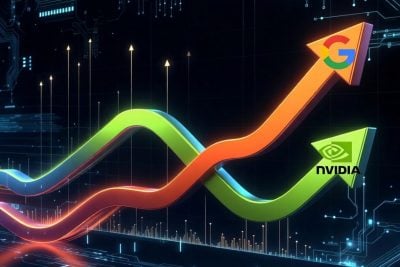
NVIDIA (NASDAQ:NVDA | NVDA Price Prediction) still wears the crown as the world’s most valuable company at roughly $4.78 trillion, and every AI headline runs through it. But look at what has been happening while everyone else stares at the headline. NVIDIA fell 12% in the past month, while Google (NASDAQ:GOOG) at a market cap of $4.38 trillion keeps grinding. The gap is closing in real time.
The crowded AI trade is finally getting scrutinized
NVIDIA’s last earnings report looked stellar on paper, and the stock still leaks. Traders’s concerns are structural. Goldman Sachs flagged AI infrastructure capex running around $770 billion in 2026, roughly the entire operating cash flow of the major cloud operators combined.
However, NVIDIA is quietly financing its own demand by backing Anthropic, OpenAI, and CoreWeave (NASDAQ:CRWV), who then turn around and buy chips. That circularity works beautifully when sentiment is high. It becomes a very different question when anyone leans on the tempo.
The bill for the AI buildout is showing up, and the market is starting to price the risk that it does not all might pencil out at 30 times earnings.
Google owns the whole stack
Google’s Q1 2026 revenue hit $109.90 billion, up 21.8% year over year, with EPS of $5.11 against a $2.63 consensus. That is the fourth consecutive earnings beat, and revenue growth is accelerating each quarter.
Google Cloud grew 63% to $20.03 billion, and backlog nearly doubled quarter over quarter to over $460 billion. That backlog is contracted future revenue already booked, which is a very different animal from a forward guide.
Google owns the models (Gemini processing 16 billion tokens per minute), the infrastructure (TPUs, plus custom Icefish chips reportedly being built by Samsung), the distribution (Search still growing 19%, YouTube, Android, 350 million paid subscribers), and the demand itself. NVIDIA sells shovels to one gold rush. Google is running four different mines at once and grinding its own shovels in the back.
The valuation and durability case for a retirement book
Then there is the multiple. Google trades at a trailing 27x P/E and a forward 25x, with a 36.1% operating margin and a 37.9% profit margin. Management just raised the dividend 5% to $0.22 per share, the stock was added to the Dow Jones Industrial Average on June 29, and Waymo is casually running 500,000 fully autonomous rides a week.
Analyst sentiment is stacked with 14 strong buys, 44 buys, and zero sell ratings. For a portfolio that wants durable AI exposure without a single-product hardware cycle riding shotgun, Google is the calmer expression of the same thesis.
Polymarket still gives Google only a 16% probability of finishing 2026 as the largest company in the world, and a 58% chance of ending July as number two. The crowd is late to price the rotation, which is exactly the moment before the re-rating actually happens.
The rotation from the NVIDIA headline trade toward Google is worth researching before the market finishes doing the math.
Contact [email protected] for any questions or corrections.
Omor Ibne Ehsan is a writer at 24/7 Wall St. He is a self-taught investor with a focus on growth, cyclical, and dividend equities that have strong fundamentals, value, and long-term potential. He also has an interest in high-risk, high-reward investments such as penny stocks.