This Is the American City That Collapsed From Rich to Poor
Per capita income in the United States has more than doubled in the past 60 years. That is not so in the "RV Capital of the World" though.


Per capita income in the United States has more than doubled in the past 60 years. In 1959, Americans’ average per capita income was about $15,000. As of 2019, the average per capita income in the United States was $35,672.
Incomes, however, have not risen equally nationwide. In some major metropolitan areas, incomes have increased far less. Many of these cities were relatively wealthy areas in the mid-20th century, but broad economic trends hampered growth and led to stagnant wages over the decades since.
To determine the American cities that went from rich to poor, 24/7 Wall St. calculated per capita income for all U.S. metropolitan areas and metro area equivalents in both 1959 and in 2019. We ranked cities based on their change in rank relative to all metro areas over that 60-year period. Income figures for 1959 have been adjusted for inflation.
Many of the metro areas on the list are Rust Belt communities, former manufacturing hubs that have undergone considerable economic decline in recent decades. Beginning in the 1970s, American manufacturers outsourced jobs to cheaper labor abroad. More recently, automation has taken a toll on employment in the manufacturing sector. Since peaking in June 1979, the number of Americans working in manufacturing has fallen by over 37%.
In other cases, manufacturers left the towns on the list in favor of areas where workers were not protected by collective bargaining agreements. Unionized workers are typically paid more than workers who are not in a union, and falling wages in these cities are likely attributable in part to a reduction in labor union participation.
Closures of major manufacturing operations that once served as an economic backbone in the metro areas on the list often triggered a long-term, downward economic spiral.
This city topped the list of cities that went from rich to poor.
Elkhart-Goshen, Indiana
> Inflation adj. per capita income; 1959: $16,844 (32 of 381 cities)
> Per capita income; 2019: $26,745 (323 of 381)
> Population change; 1959–2019: +93.2% (106,790 to 206,341)
> Unemployment rate; 2019: 3.1%
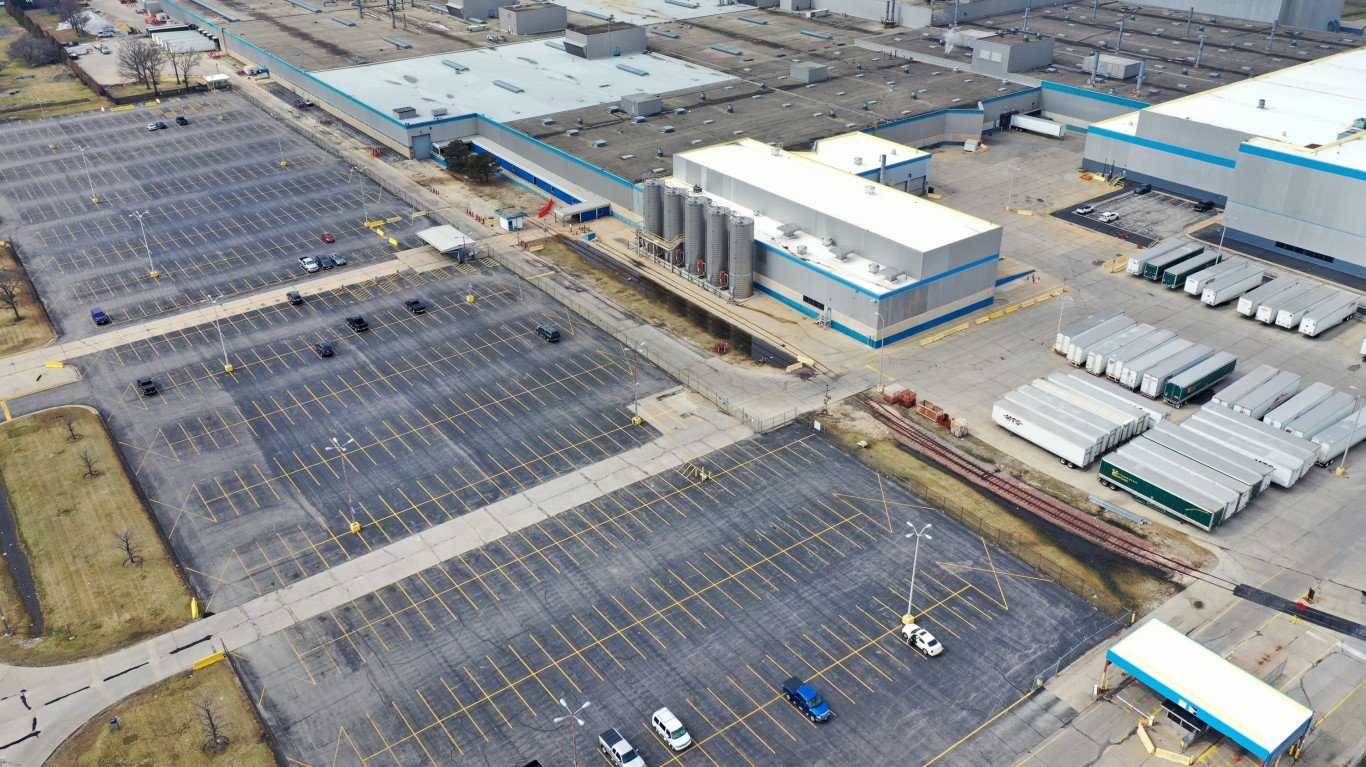
In 1959, only 31 of all 381 U.S. metro areas had a higher income per capita than Elkhart-Goshen, Indiana. As of 2019, 322 U.S. metro areas did. The area, which is known as the “RV Capital of the World,” has suffered in recent years due to declining demand for RVs, which are manufactured largely in the Elkhart area. RV shipments fell by about 16% in 2019 from the previous year, prompting local RV maker Thor Industries to reduce production, along with employee hours. Elkhart’s critical RV industry also was slammed during the Great Recession following the 2008 financial crisis, which sent the local unemployment rate to 22%.
Click here for the detailed methodology.
Contact [email protected] for any questions or corrections.
Douglas A. McIntyre is the co-founder, chief executive officer and editor in chief of 24/7 Wall St. and 24/7 Tempo. He has held these jobs since 2006.
McIntyre has written thousands of articles for 24/7 Wall St. He is an expert on corporate finance, the automotive industry, media companies and international finance. He has edited articles on national demographics, sports, personal income and travel.
His work has been quoted or mentioned in The New York Times, The Wall Street Journal, Los Angeles Times, The Washington Post, NBC News, Time, The New Yorker, HuffPost USA Today, Business Insider, Yahoo, AOL, MarketWatch, The Atlantic, Bloomberg, New York Post, Chicago Tribune, Forbes, The Guardian and many other major publications. McIntyre has been a guest on CNBC, the BBC and television and radio stations across the country.
A magna cum laude graduate of Harvard College, McIntyre also was president of The Harvard Advocate. Founded in 1866, the Advocate is the oldest college publication in the United States.
TheStreet.com, Comps.com and Edgar Online are some of the public companies for which McIntyre served on the board of directors. He was a Vicinity Corporation board member when the company was sold to Microsoft in 2002. He served on the audit committees of some of these companies.
McIntyre has been the CEO of FutureSource, a provider of trading terminals and news to commodities and futures traders. He was president of Switchboard, the online phone directory company. He served as chairman and CEO of On2 Technologies, the video compression company that provided video compression software for Adobe’s Flash. Google bought On2 in 2009.