U.S. gold exports surge 285% as Wall Street drains vaults to feed China’s generational gold rush
Every week, hundreds of millions of dollars in gold bars are flying out of vaults in lower Manhattan and northern New Jersey. Most are bricks weighing about 2.2 pounds, the kilogram size that Asian markets prefer. They’re packed in tamper-evident…


Every week, hundreds of millions of dollars in gold bars are flying out of vaults in lower Manhattan and northern New Jersey.
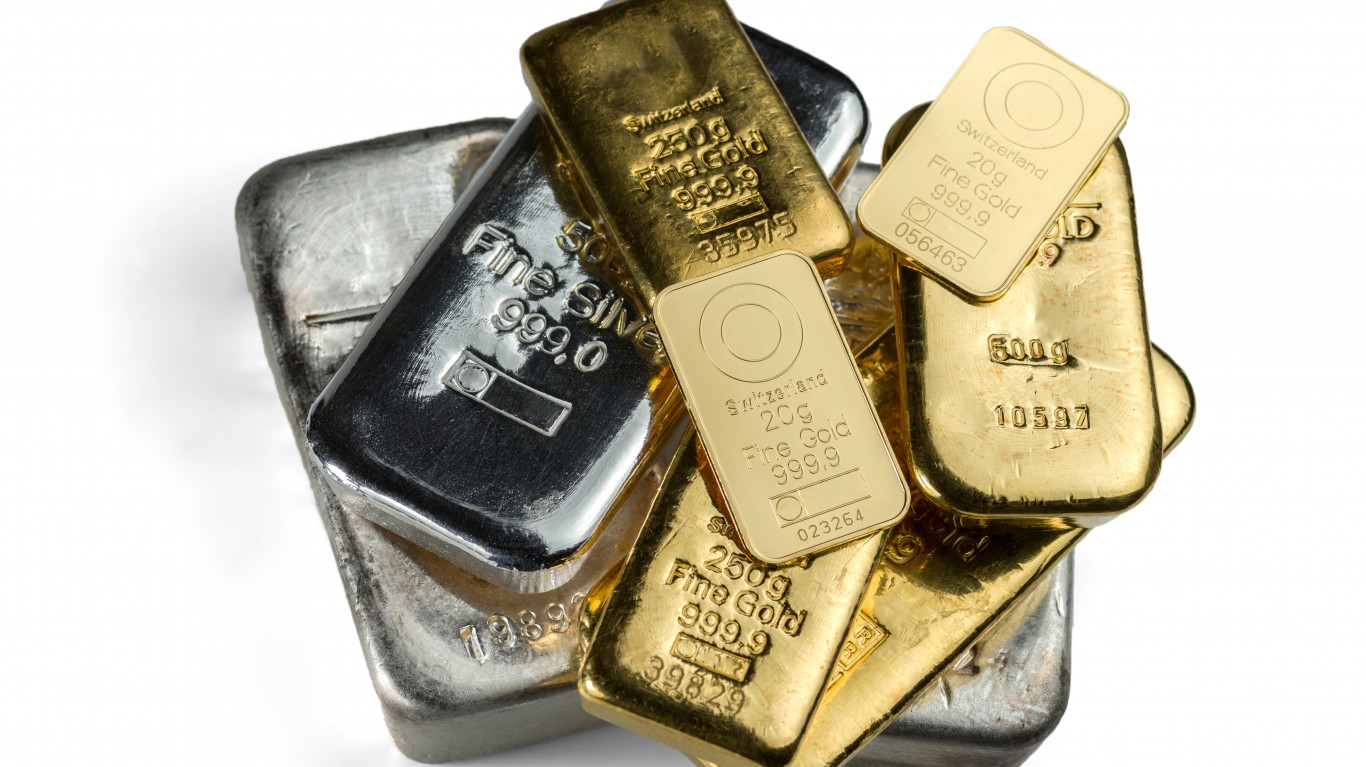
Most are bricks weighing about 2.2 pounds, the kilogram size that Asian markets prefer. They’re packed in tamper-evident cases, escorted by armed guards to JFK airport, and loaded into the cargo holds of commercial passenger jets bound for Zurich, the hub of the global gold refining industry.
From there, the bars continue on to buyers in China, India, and Hong Kong.
The flow is large enough to show up clearly in America’s trade numbers . U.S. exports topped $300 billion in January, February, and March of 2026, hitting an all-time high of $320.9 billion in March. That’s the first time the figure has cleared $300 billion in three consecutive months.
Gold was among the single largest contributors to the surge. It added $4.6 billion to January’s export gains and $8.0 billion to February’s. Across all of 2025, U.S. gold exports rose by nearly $50 billion compared to the year before.
The Trade That Filled America’s Vaults
The story starts in late 2024, when President Trump began threatening tariffs on a wide range of imports, possibly including gold.
Big banks worried that if tariffs hit, the price of gold inside the U.S. would jump above the price everywhere else. So they did what traders do: they raced to move gold into the country before the tariffs landed, betting they could sell it later at the higher American price.
A handful of giant Wall Street banks moved fast. JPMorgan, Morgan Stanley, HSBC, and Deutsche Bank were the most active.
They bought gold in London, where the world’s main gold market is based, in the form of 27-pound bars about the size of a large brick. The London bars weren’t the right shape or purity for American exchanges, so the banks flew them to Switzerland, where four specialized refineries melted them down, refined the metal further, and recast it into the smaller, purer bars American exchanges accept. The recast bars were then flown to vaults near JFK airport, including JPMorgan’s underground facility in lower Manhattan and Brink’s depositories across the Hudson in New Jersey.
The result was a stockpiling boom. Between December 2024 and March 2025, the gold sitting in New York’s main exchange-approved vaults more than doubled. It reached roughly 1,350 tonnes, the highest level ever recorded. That’s more gold than the official reserves of every country except the top six.
The banks made roughly $500 million on the trade in the first quarter of 2025 alone, about twice their normal earnings from gold trading.
Then in April 2025, the administration announced gold would be exempt from the new tariffs. The price gap between New York and London disappeared overnight. The banks no longer had a reason to hold the metal in America, and they began shipping it back out.
A Buyer That Won’t Stop Accumulating
The gold is flowing toward customers who can’t get enough of it.
China has added to its national gold reserves for sixteen straight months. The Czech Republic is on its thirty-sixth. Poland is in the middle of a multi-year plan to roughly double its gold holdings; the head of its central bank has described the buildup as a national security measure against Russia.
Poland led all central banks in 2025, adding 102 tonnes. Kazakhstan, Brazil, China, and Turkey were also among the top buyers.
Worldwide, central banks are buying gold at the fastest sustained pace in roughly fifty years.
The reason isn’t mysterious. In 2022, after Russia invaded Ukraine, the United States and Europe froze about $300 billion in Russian government money held in Western banks.
The lesson for every other country was unmistakable: dollars held abroad can be turned off with the stroke of a pen. Gold can’t be. It sits in a vault, and no one outside the owning country can freeze it, sanction it, or print more of it.
According to a recent industry survey, 68% of the world’s central banks now plan to add to their gold holdings in 2026, up from 62% the year before.
What the Record Numbers Show
The headline trade numbers are real. March’s $320.9 billion in exports was an all-time high. The year-to-date trade deficit shrank 55% compared to the same period last year, and exports overall grew 12%.
The U.S. Trade Representative has pointed to the figures as evidence that the administration’s tariff strategy is working.
Gold’s role in those numbers is worth understanding on its own. The metal leaving America is mostly not American gold. It’s foreign gold that was shipped in last year for the trade described above, processed through American vaults, and is now being shipped back out to global buyers.
That activity generates real money for American refiners, banks, and logistics firms. It also reinforces New York’s place at the center of the global gold market.
But it’s different in kind from exports of American-made aircraft, soybeans, or natural gas, which represent goods actually produced by American workers. Bryan Riley of the National Taxpayers Union, a free-market advocacy group, has pointed out that despite rising tariffs in 2025, the U.S. goods trade deficit actually grew. He suggests the headline numbers don’t always tell the rebalancing story the tariff agenda was designed to produce.
What the Buyers Are Telling the World
What’s striking isn’t that gold is leaving New York. It’s that so many central banks are working so hard to bring it in.
Sixteen straight months for China. Thirty-six for the Czech Republic. A multi-year buildup in Poland. None of these are speculative trades.
They are governments making the same long-term bet: that in a world where financial assets can be frozen, sanctioned, or printed, gold is the one thing that can’t be.
The tariff threat that first pulled the gold into America has been lifted. The gold is leaving anyway, headed to the central banks that want it most. And on its way out, it’s helping to set the export records the tariff agenda was designed to produce.
Contact [email protected] for any questions or corrections.
Don Lair writes about options income, dividend strategy, and the kind of boring-but-durable investing that actually funds retirement. He's the founder of FITools.com, an independent contributor to 24/7 Wall St., and a former writer for The Motley Fool.