Dave Ramsey on How to Tell if You’re Rich, Poor or Middle Class
We'd all like to be rich. As finance coach Dave Ramsey often says, "the rich get richer and the poor get poorer." According to the St. Louis Fed, the top 10% of U.S. households by wealth held an average of…

This post may contain links from our sponsors and affiliates, and Flywheel Publishing may receive compensation for actions taken through them.

We’d all like to be rich.
As finance coach Dave Ramsey often says, “the rich get richer and the poor get poorer.”
The numbers behind America’s wealth gap
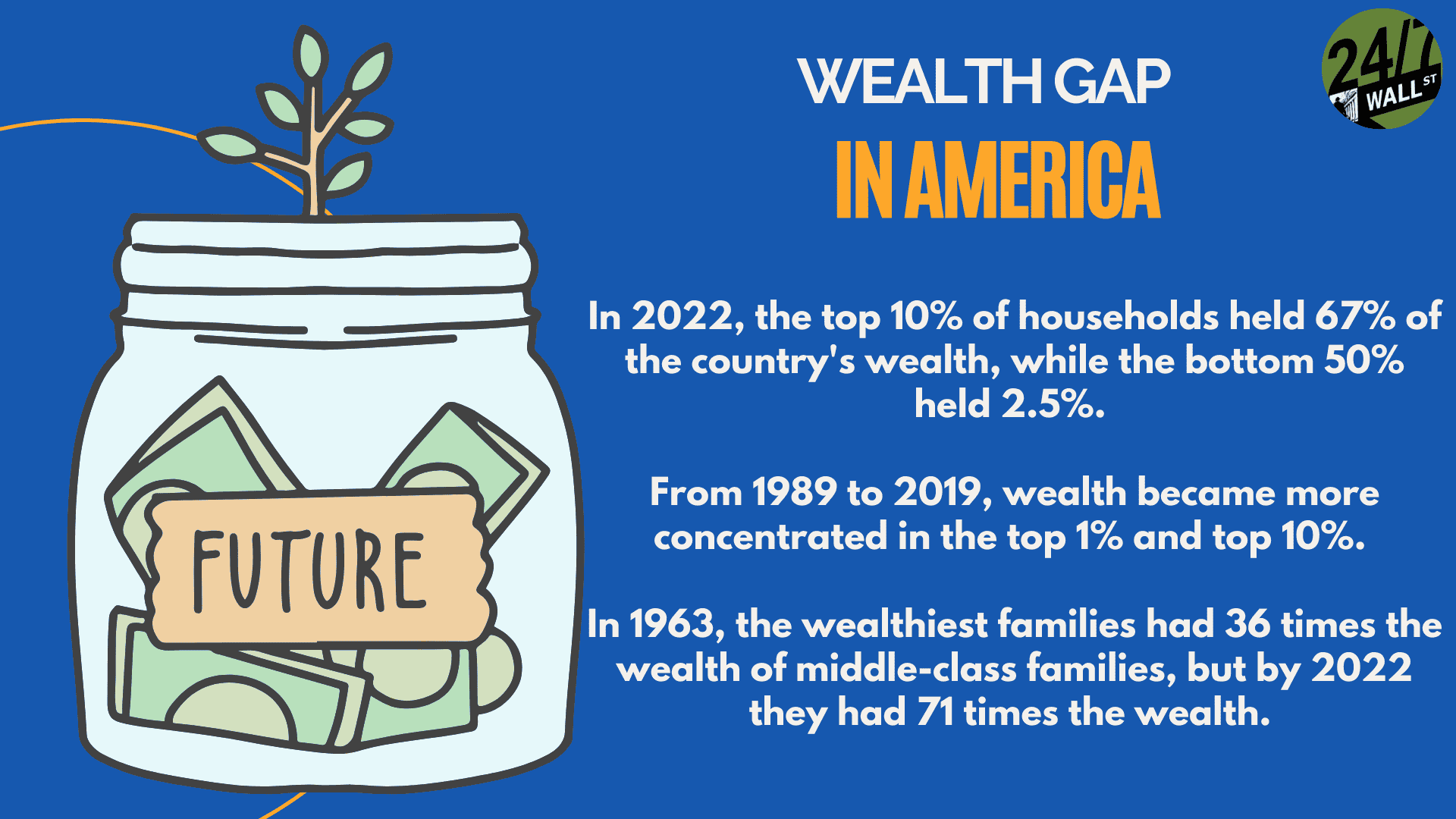
The scale of the divide is staggering. According to the St. Louis Federal Reserve’s Distributional Financial Accounts for the fourth quarter of 2024, the top 10% of U.S. households by wealth held an average of $8.1 million each and, as a group, controlled 67.2% of all household wealth in the country. The bottom 50% averaged just $60,000 each and collectively held roughly 2.5% of the nation’s total household wealth. In Ramsey’s view, that $8.1 million-to-$60,000 gulf is largely the product of habit, not luck.
Why is the wealth gap so big?
Ramsey traces the gap back to financial behaviors: the everyday choices that keep people in the lower, middle, or upper class. His core contention is that those habits are available to anyone willing to adopt them.
Wealthy people, Ramsey says, skip the question “How much per month?” and ask instead: “How much?” Paying for things outright means sidestepping interest charges that quietly erode everyone else’s balance sheet. That discipline, compounded over decades, is a core reason the wealthy stay wealthy. Ramsey Solutions’ National Study of Millionaires reinforces the point: eight out of ten millionaires built their wealth by investing in their company’s 401(k) plan, and 79% received no inheritance at all.
The middle class, by contrast, operates on installment plans. Monthly car payments, home improvement loans, and credit cards held for the airline miles are familiar patterns. Each individual payment may seem manageable, but financing everything collectively creates a significant drag on wealth-building that compounds over years, just as surely as investment returns compound for those at the top.
Ramsey reserves his sharpest observations for the habits that trap people at the bottom. He points to payday lenders, pawn shops, title loans, and rent-to-own services as tools that extract wealth from those who can least afford it. He also singles out the lottery. His documented position is that 78% of lottery tickets are sold in poor zip codes, and that lottery spending represents false hope rather than a genuine path out. Independent research backs the underlying disparity: according to data published by The Economist, residents of the poorest 1% of American zip codes spend about $600 a year on tickets on average, compared to $150 for those in the wealthiest 1%.
None of this, Ramsey emphasizes, is permanent. Financial habits can change, and his broader message is that anyone can rewrite their trajectory.
Steps to build wealth
One: increase your income. Dividend stocks offer one avenue for passive cash flow, and a part-time job is another. The core objective is simply to widen the gap between what comes in and what goes out.
Two: build a budget and actually use it. Without one, money disappears into a fog of small, untracked expenses. A budget makes spending visible, and visible spending is spending you can control. When asked where their money went, most people answer “I don’t know,” and that uncertainty is financially destructive.
Three: create an emergency fund. Traditional advice sets the starter target at $1,000, but given current cost-of-living levels, a figure closer to $2,500 is more realistic for covering a major car repair or an unexpected home expense. Setting aside roughly $210 a month reaches that goal within a year. Keep this money in a dedicated, separate account with automatic contributions, and funnel any windfalls such as bonuses, tax refunds, or gifts directly into it rather than spending them immediately.
Four: pay off your debt. Ramsey recommends the debt snowball method. List every debt from smallest to largest balance, attack the smallest first while making minimum payments on the rest, and roll the freed-up payment toward the next balance once the smallest is cleared. The momentum this builds, both mathematical and psychological, is substantial. The list should include student loans, car payments, credit cards, and eventually the mortgage.
2027 COLA projections and what they mean for retirement planning
For anyone building a retirement income plan, the Social Security cost-of-living adjustment (COLA) is worth watching closely. The 2026 COLA came in at 2.8%, a modest raise for the roughly 75 million Americans who receive benefits. The average monthly retirement benefit for retired workers currently stands at about $2,086, based on the Social Security Administration’s July 2026 data.
The outlook for 2027 has sharpened considerably since that adjustment took effect. As of September 11, 2026, Mary Johnson, an independent Social Security and Medicare policy analyst, projects a 3.5% COLA for 2027, up from her 3.4% August estimate after August inflation data came in warmer than expected. The Senior Citizens League now puts its forecast at 3.5% as well, trimming its earlier 3.6% projection after July data had cooled. AARP, meanwhile, bumped its estimate up to 3.6% on the same day, which the group calculates would add roughly $75 a month to the average retiree’s check. The official measurement window, covering July through September, closes with the September CPI-W report, and the Social Security Administration is expected to announce the final figure on October 14, 2026.
Wealthier retirees often treat COLA announcements as a prompt to revisit withdrawal strategies rather than defaulting to a fixed spending rule. When inflation accelerates, revisiting those guardrails can make a meaningful difference to how long a portfolio lasts.
Investing in your future
Five: live below your means. Personal finance voices from Dave Ramsey to Suze Orman converge on the same principle: distinguish between needs and wants, cut spending on wants, automate savings, and set a concrete savings target. The mechanics are straightforward. Following through is the hard part.
Six: invest in retirement accounts. An Individual Retirement Account (IRA) lets you grow money either tax-free or on a tax-deferred basis, depending on the type you choose. A traditional IRA often allows you to deduct contributions from your taxable income now. A Roth IRA uses after-tax dollars, but qualified withdrawals in retirement are entirely tax-free, making it a powerful long-term vehicle. For the self-employed, a Solo 401(k) offers the same basic structure as a workplace plan. Consult a financial advisor before choosing, since the right account depends on your income, tax situation, and timeline.
Editor’s note: The 2027 COLA projections have been updated to reflect data released September 11, 2026. Mary Johnson now estimates 3.5% (up from 3.4% in August), the Senior Citizens League has revised down to 3.5% (from 3.6%), and AARP has raised its forecast to 3.6% (up from 3.5%), which it estimates would add roughly $75 per month to the average retiree’s check. The SSA is expected to announce the official 2027 COLA on October 14, 2026.
Contact [email protected] for any questions or corrections.
Ian Cooper is a veteran market analyst and investment strategist with more than 20 years of experience covering stocks, commodities, and macro trends. Since 1999, he has helped investors identify market opportunities using a blend of technical analysis, fundamental research, and market sentiment.
He is the creator of the ADD News Flow Strategy, which focuses on trading market reactions to major news events and investor psychology. Cooper was also among the analysts who warned about the 2008 financial crisis and major financial institution collapses ahead of the broader market.
Before joining 247 Wall St., Cooper wrote extensively for InvestorPlace and other financial publications, covering market trends, trading strategies, and investment opportunities.