Winning Stocks Keep Winning, And That’s What iShares TOPT ETF Let’s You Bet On
Market concentration has reached levels not seen in decades. The three largest U.S. stocks now represent over 20% of the S&P 500’s total value, and the top 20 account for roughly half. iShares Top 20 U.S. Stocks ETF (NYSEARCA:TOPT) offers…

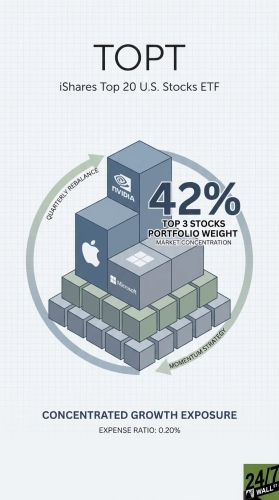
Market concentration has reached levels not seen in decades. The three largest U.S. stocks now represent over 20% of the S&P 500’s total value, and the top 20 account for roughly half. iShares Top 20 U.S. Stocks ETF (NYSEARCA:TOPT) offers a direct bet that this ‘winners keep winning’ trend will continue.
The Portfolio Role: Concentrated Megacap Exposure
TOPT tracks the S&P 500 Top 20 Select Index, holding the 20 largest U.S. companies by market cap. The index rebalances quarterly, automatically rotating holdings to reflect which companies remain in the top tier. This creates a momentum-adjacent strategy where recent winners that grow into the top 20 get added, while those that fall out get removed.
As of December 2025, NVIDIA Corporation (NASDAQ:NVDA | NVDA Price Prediction) represents 15.2% of the portfolio, Apple Inc (NASDAQ:AAPL) 14.5%, and Microsoft Corporation (NASDAQ:MSFT) 12.5%. Those three stocks alone comprise 42% of the fund.
The 0.20% expense ratio is competitive for a concentrated strategy. With $441 million in assets under management since launching in October 2024, TOPT remains relatively small but has attracted investors seeking simplified exposure to market leaders.
Does It Deliver on the Promise?
Since inception in late October 2024, TOPT has returned approximately 24%, pretty impressive for a fund that both launched near market highs, and was by design betting on the biggest winners thus far.
One Reddit user in the r/investing community asked whether TOPT was “worth putting some disposable cash into,” noting it “seeks to expand from the M7 to the top 20 stocks.” The question captures the fund’s appeal: slightly more diversification than owning just the Magnificent Seven while maintaining heavy exposure to the same mega-cap growth thesis.
The quarterly rebalancing ensures the fund stays current with market leadership without requiring manual adjustments.
The Tradeoffs You Accept
Concentration risk dominates. With 42% in three stocks and 72.5% in the top 10 holdings, TOPT magnifies single-stock volatility. When NVIDIA surged 66.7% year-over-year in earnings growth, that benefited the fund significantly. But when any top holding stumbles, the impact is immediate and substantial.
Sector concentration compounds this risk. Information technology represents 46.6% of the portfolio, with communication services and consumer discretionary adding another 24%. Over 70% sits in growth-oriented sectors that face elevated valuations. NVIDIA trades at 43x earnings, while Apple carries a PEG ratio of 2.8, suggesting limited upside relative to growth rates.
The quarterly rebalancing creates potential tax inefficiency. As stocks move in and out of the top 20, the fund must trade, generating capital gains passed to shareholders. This makes TOPT less suitable for taxable accounts.
Who Should Avoid TOPT
Risk-averse investors seeking stability should look elsewhere. The fund’s concentration means sharper drawdowns than diversified alternatives during corrections. With a beta above 1 implied by its holdings, TOPT will likely decline more than the broader market when sentiment turns negative.
Long-term retirement investors building core portfolio positions have better options. The lack of diversification across sectors, market caps, and investment styles makes TOPT inappropriate as a foundational holding.
Consider VOO Instead
Vanguard S&P 500 ETF (NYSEARCA:VOO) offers exposure to the same top 20 stocks TOPT holds, but adds 480 more companies for diversification. The expense ratio is just 0.03%, compared to TOPT’s 0.20%. While VOO’s top holdings still include NVIDIA, Apple, and Microsoft, their combined weight is lower, reducing concentration risk.
VOO provides broader sector exposure and smaller-cap participation while maintaining access to mega-cap leaders. For most investors, that balance offers better risk-adjusted returns over full market cycles. TOPT works as a tactical bet on continued mega-cap dominance, but VOO serves as a more durable core holding with lower costs and wider diversification.
Contact [email protected] for any questions or corrections.
I am a long time investor and student of business, and believe finding good companies that can become great investments is the best game on earth. After 20 years of writing and researching the public markets it is clear that individuals have never had more tools and information to take control of their financial lives. From ETFs and $0 commissions to cryptos and prediction markets there has never been a greater democratization of access to investing.
I write to help people understand the investments available to them so they can make the best choice for their portfolio, whether they're starting out or looking for income in retirement.