Investors Worried About Large Cap Concentration Risk Have a Great Option in MDY
The SPDR S&P 500 ETF Trust (NYSEARCA:SPY) tells a story of increasing concentration. The S&P 500 has become a technology-dominated index, with information technology representing over a third of its weight. This concentration intensifies at the top, where just three…

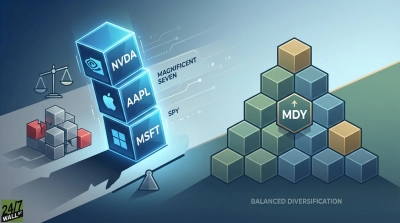
The SPDR S&P 500 ETF Trust (NYSEARCA:SPY) tells a story of increasing concentration. The S&P 500 has become a technology-dominated index, with information technology representing over a third of its weight. This concentration intensifies at the top, where just three mega-cap tech companies control more than a fifth of the entire index’s value—creating a portfolio structure that rises and falls with the fortunes of NVIDIA (NASDAQ:NVDA | NVDA Price Prediction), Apple (NASDAQ:AAPL), and Microsoft (NASDAQ:MSFT). For investors concerned about this mega-cap dominance, the SPDR S&P MidCap 400 ETF Trust (NYSEARCA:MDY) offers a compelling alternative.
The Concentration Problem Is Real
The Magnificent Seven’s dominance reshaped the S&P 500 in 2025, driving these tech giants to comprise roughly a third of the index’s market cap. This concentration created hidden portfolio risk—when these seven stocks surged, they delivered returns that significantly outpaced the broader index, making investors increasingly dependent on a handful of companies to drive their portfolio performance. The result is a market where diversification has given way to concentration, and where a stumble by any of these mega-caps can ripple through millions of portfolios.
MDY’s structure prevents any single company from dominating returns. The largest holding represents just 1.08% of the portfolio, ensuring that no individual stock failure can derail performance. This balanced approach stands in stark contrast to SPY, where the top 10 holdings command over 20% of the index and create concentrated risk.
Different Sectors, Different Risk Profile
MDY’s sector allocation reveals its diversification advantage. Industrials lead the portfolio, followed by financials and information technology, creating a balanced approach that provides exposure to economic growth without the tech-heavy concentration that defines large-cap indexes. Holdings like Comfort Systems USA (NYSE:FIX), Huntington Bancshares (NASDAQ:HBAN), and Ryder System (NYSE:R) represent companies tied to different economic drivers—construction services, regional banking, and transportation logistics.
Performance That Competes
MDY’s five-year track record demonstrates that mid-caps can deliver substantial returns even while trailing the mega-cap-driven surge in SPY. The performance gap tells the story of SPY’s tech concentration advantage during the AI boom—when mega-cap tech stocks surged, SPY captured those gains through its heavy weighting in the Magnificent Seven. But recent performance suggests the narrative is shifting. Through mid-January 2026, MDY’s year-to-date gain more than tripled SPY’s return as investors rotated away from concentrated mega-cap exposure toward the diversification that mid-caps provide.
The ETF charges a competitive expense ratio for broad mid-cap exposure and offers institutional-grade liquidity backed by a three-decade track record since its 1995 inception.
The Tradeoffs to Consider
Mid-cap stocks carry higher volatility than their large-cap counterparts, requiring investors to accept greater price swings in exchange for diversification benefits. This volatility stems from the cyclical nature of mid-cap businesses—when housing markets cooled in 2025, companies like Builders FirstSource (NYSE:BLDR) saw earnings cut in half as construction activity slowed. Despite MDY’s low 16% portfolio turnover suggesting a stable, buy-and-hold approach, individual holdings face business risks that established mega-caps have largely outgrown.
Investors also sacrifice the momentum that has driven large-cap tech. When mega-cap growth accelerates, MDY will likely lag. The five-year performance gap reflects this dynamic—SPY’s tech concentration delivered superior returns during the AI boom.
Who Should Avoid MDY
Investors with short time horizons should look elsewhere. Mid-cap volatility requires patience to weather sector rotations and economic cycles. Those seeking maximum growth exposure during technology bull markets will find MDY’s diversified approach limiting. The ETF’s 13% tech allocation means it won’t capture the full upside when mega-cap names surge.
Consider IJH as an Alternative
The iShares Core S&P Mid-Cap ETF (NYSEARCA:IJH) tracks the same index as MDY but charges just 0.05%—less than one-quarter of MDY’s expense ratio. For long-term holders, this 0.19 percentage point difference compounds significantly. IJH also offers comparable liquidity with over $90 billion in assets. The primary tradeoff is IJH’s shorter track record, having launched in 2000 versus MDY’s 1995 inception.
MDY serves investors seeking to reduce mega-cap concentration without abandoning U.S. equity exposure, but the cost advantage of alternatives like IJH deserves consideration for fee-conscious portfolios.
Contact [email protected] for any questions or corrections.
I am a long time investor and student of business, and believe finding good companies that can become great investments is the best game on earth. After 20 years of writing and researching the public markets it is clear that individuals have never had more tools and information to take control of their financial lives. From ETFs and $0 commissions to cryptos and prediction markets there has never been a greater democratization of access to investing.
I write to help people understand the investments available to them so they can make the best choice for their portfolio, whether they're starting out or looking for income in retirement.