Vanguard’s Other Index ETF Has Absolutely Destroyed SPY and VOO This Year | VXUS
While most investors obsess over SPY and VOO, Vanguard Total International Stock Index Fund ETF Shares (NYSEARCA:VXUS) has quietly delivered 29% returns through mid-December 2025, crushing the S&P 500’s 15% gain. For a $558 billion fund charging just 0.05% annually,…

This post may contain links from our sponsors and affiliates, and Flywheel Publishing may receive compensation for actions taken through them.
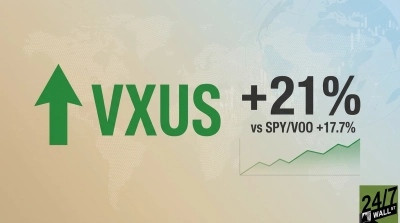
While most investors obsess over SPY and VOO, Vanguard Total International Stock Index Fund ETF Shares (NYSEARCA:VXUS) has quietly delivered 29% returns through mid-December 2025, crushing the S&P 500’s 15% gain. For a $558 billion fund charging just 0.05% annually, that outperformance represents billions in additional wealth for investors who looked beyond U.S. borders. The real story: international stocks achieved this despite mixed currency headwinds, suggesting local equity gains approached 25-30% in many markets.
What Powered International Markets in 2025
The macro environment shifted decisively in favor of international equities. Earnings growth outside the U.S. accelerated throughout 2025, with companies like Royal Bank of Canada (VXUS’s largest holding at 0.54%) posting 29% year-over-year earnings growth. This wasn’t isolated. Canadian financials, European industrials, and Asian technology firms benefited from synchronized global growth and easing monetary policy outside the United States.
Currency effects told a nuanced story. The Japanese yen weakened 3.3% against the dollar, amplifying returns from Japan’s 15-20% portfolio weight. But the British pound strengthened 1.3%, creating a modest headwind for the 30-35% European allocation. That VXUS still outperformed by 3.3 percentage points proves the performance came from genuine business fundamentals, not just favorable exchange rates.
Valuation compression also mattered. International stocks entered 2025 trading at significant discounts to U.S. equities. As that gap narrowed throughout the year, multiple expansion added several percentage points to returns. The forward price-to-earnings ratio for MSCI EAFE markets moved from roughly 12x to 14x, while the S&P 500’s premium valuation left less room for multiple expansion.
The 2026 Watchlist: Three Factors That Matter
Interest rate policy divergence will dominate. If the Federal Reserve maintains higher rates while the European Central Bank and Bank of Japan continue easing, that could weaken the dollar and provide another tailwind for international returns. Monitor monthly central bank statements and the quarterly World Economic Outlook from the IMF for policy trajectory signals.
On the micro side, watch VXUS’s quarterly fact sheet for shifts in country allocation. The fund’s 3% turnover keeps costs low, but periodic rebalancing can meaningfully alter exposure to high-growth regions. Canadian exposure has been rewarded in 2025, but 2026 could favor different geographies depending on where earnings growth accelerates.
Consider VEA for Developed Market Focus
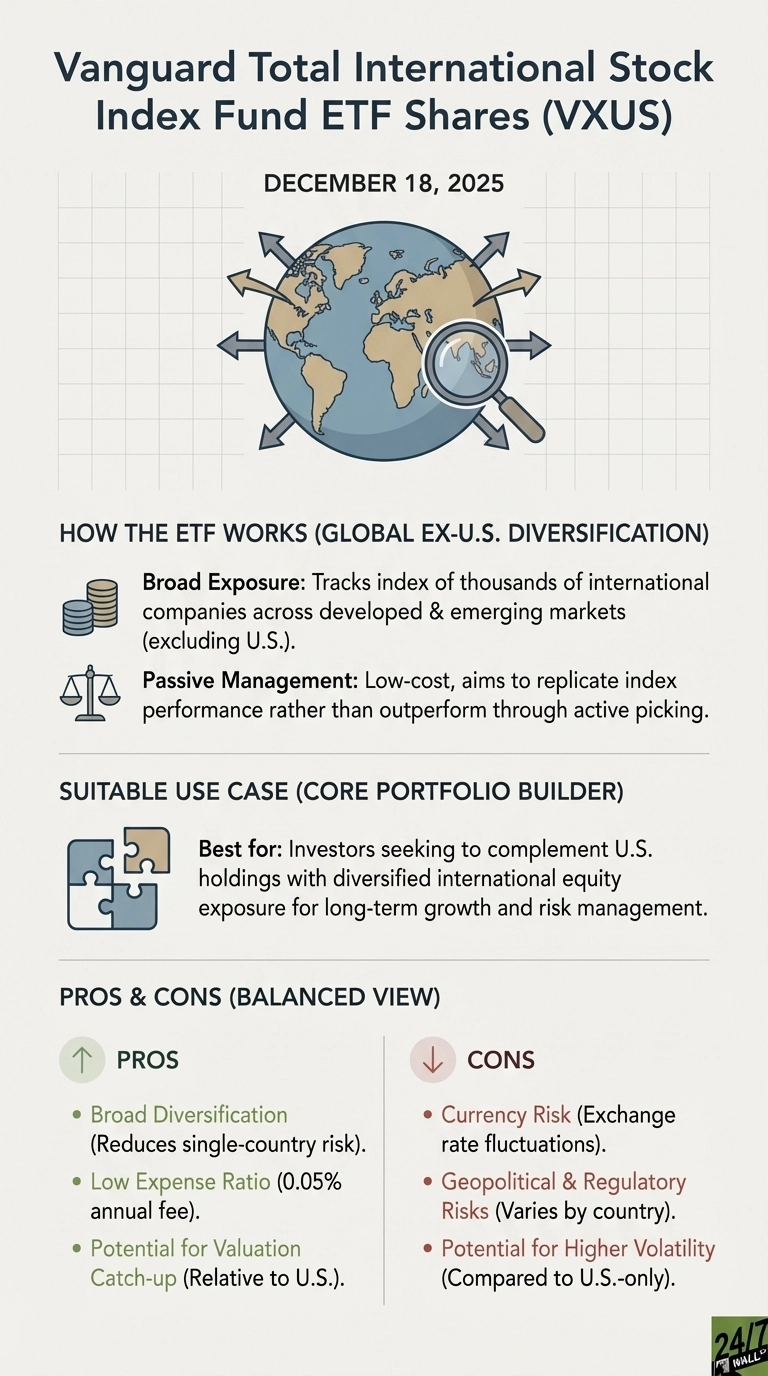
Vanguard FTSE Developed Markets ETF (NYSEARCA:VEA) excludes emerging markets entirely, offering a 0.05% expense ratio with tighter geographic focus on Europe, Japan, and Canada. For investors wanting international exposure without emerging market volatility, VEA provides similar diversification with potentially lower drawdown risk during global stress periods.
The 2026 outlook for VXUS hinges on whether international earnings growth sustains its momentum and whether valuation gaps with U.S. markets continue narrowing. Both factors remain in play.
Contact [email protected] for any questions or corrections.
Austin Smith is a financial publisher with over two decades of experience as an investor, analyst, and advisor. He covers stocks, ETFs, Artificial intelligence and personal finance for 24/7 Wall St. Previously, he spent over a decade at The Motley Fool as a senior editor for Fool.com, portfolio advisor for Millionacres, and launched The Ascent to help reader take control of their personal finances.
His work has been featured on Fool.com, NPR, CNBC, USA Today, Yahoo Finance, MSN, AOL, Marketwatch, and many other publications. He is as an advisor to private companies, and co-hosts The AI Investor Podcast with Eric Bleeker.
When not looking for investment opportunities, he can be found skiing, running, or playing soccer with his children. Learn more about Austin's investment approach here.