If You Like AMD’s Future, AMDY Lets You Go Full Send With An Over 100% Distribution Yield
The YieldMax AMD Option Income Strategy ETF (NYSEARCA:AMDY) has captured investor attention with its extraordinary 101.88% distribution rate as of December 17, 2025. This isn’t a traditional dividend ETF – AMDY generates income by selling weekly call options on Advanced…


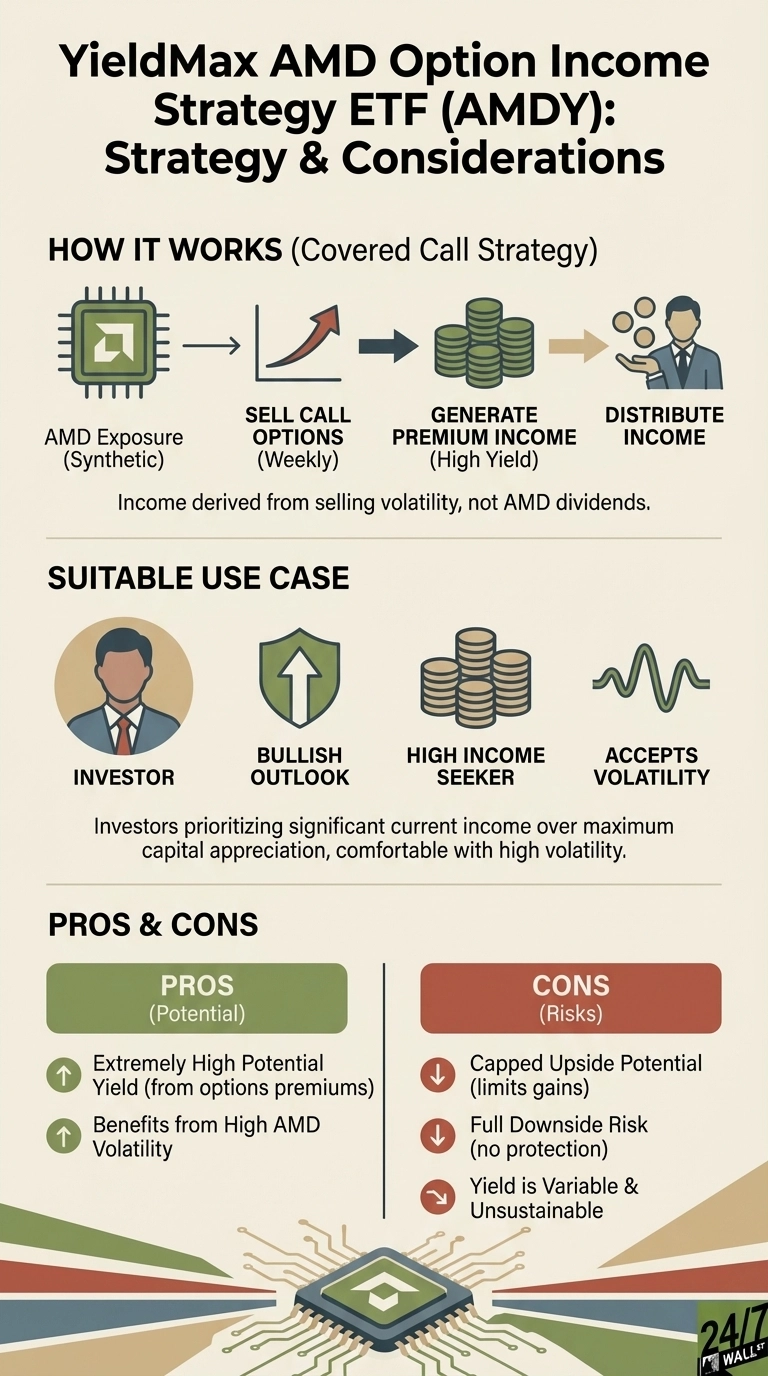
The YieldMax AMD Option Income Strategy ETF (NYSEARCA:AMDY) has captured investor attention with its extraordinary 101.88% distribution rate as of December 17, 2025. This isn’t a traditional dividend ETF – AMDY generates income by selling weekly call options on Advanced Micro Devices (NASDAQ:AMD | AMD Price Prediction) stock, collecting premiums from traders betting on AMD’s price movements.
How AMDY Generates Its Extreme Yield
AMDY employs a covered call strategy, selling short-term call options against synthetic AMD exposure. The fund’s 101.88% distribution rate means investors theoretically receive more than their initial investment back annually through distributions. However, this assumes the most recent weekly distribution remains constant—a significant assumption given variable options premiums.
The fund’s income depends entirely on AMD’s volatility. With a beta of 1.93, AMD moves nearly twice as much as the broader market, creating rich options premiums. AMD’s 52-week range of $76.48 to $267.08 illustrates this volatility—a 249% spread generating substantial options income. In 2025, AMD surged 76.7% through mid-December, significantly outperforming the S&P 500’s 16.13% gain. This explosive performance drove elevated options premiums enabling AMDY’s triple-digit distribution rate.
The Critical Tradeoff: Income Versus Upside
AMDY’s strategy caps upside participation. While AMD gained 76.7% in 2025, AMDY delivered a 53.9% price return—capturing approximately 70% of AMD’s appreciation. The fund sacrificed 23 percentage points of capital gains for its high distribution yield.
More concerning is downside risk. AMD currently trades at $213.43, down 20% from its 52-week high of $267.08. During this decline, options premiums compress, reducing AMDY’s distribution potential. The fund offers no downside protection—if AMD falls 30%, AMDY’s net asset value falls approximately 30%, and declining volatility simultaneously reduces income generation.
Evaluating AMD’s Fundamental Strength
AMD’s business fundamentals support the bullish case underlying AMDY’s strategy. Third quarter 2025 revenue reached $9.25 billion, up 35.6% year-over-year, with operating cash flow of $2.16 billion. The company maintains $4.81 billion in cash against $3.87 billion in debt. Management recently announced a multiyear partnership with OpenAI expected to generate over $100 billion in revenue.
However, AMD’s valuation leaves little room for disappointment. The stock trades at 112x trailing earnings, despite a more reasonable 35x forward multiple. Analysts maintain a consensus $282.82 price target, implying 32% upside—gains that AMDY holders would largely miss due to capped call positions. AMD pays no dividend, meaning AMDY’s distributions come entirely from options premiums.
Distribution Sustainability Assessment
AMDY’s 101.88% distribution rate is not sustainable in its current form. This figure represents an annualized rate based on a single week’s distribution during elevated AMD volatility. As AMD’s price stabilizes or declines, options premiums will compress, reducing weekly distributions significantly. The fund’s 30-day SEC yield of just 1.15% provides a more conservative baseline.
Investors should expect substantial distribution variability. During periods when AMD trades sideways or declines, weekly distributions may fall 50% or more from current levels.
Alternative: NVDY for Diversified Tech Exposure
Investors seeking similar options-based income with different underlying exposure should consider the YieldMax NVDA Option Income Strategy ETF (NYSEARCA:NVDY). This fund applies the same covered call strategy to NVIDIA stock. NVDY offers exposure to a different segment of the AI semiconductor market, currently yielding approximately 80% through its options premium strategy. Like AMDY, NVDY caps upside potential while maintaining full downside exposure.
Contact [email protected] for any questions or corrections.
I am a long time investor and student of business, and believe finding good companies that can become great investments is the best game on earth. After 20 years of writing and researching the public markets it is clear that individuals have never had more tools and information to take control of their financial lives. From ETFs and $0 commissions to cryptos and prediction markets there has never been a greater democratization of access to investing.
I write to help people understand the investments available to them so they can make the best choice for their portfolio, whether they're starting out or looking for income in retirement.