The AI Capex Cycle Is Crushing Equal-Weight NASDAQ. Here’s Why QQQ’s Concentration Bet Is Winning
The Invesco QQQ Trust (NASDAQ:QQQ) and the Direxion NASDAQ-100 Equal Weighted Index Shares (NYSEARCA:QQQE) own the same 100 stocks. The choice between them hinges on whether you want NVIDIA, Apple, and Microsoft to drive returns or let the other 97…

This post may contain links from our sponsors and affiliates, and Flywheel Publishing may receive compensation for actions taken through them.
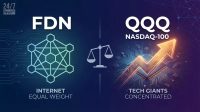
The Invesco QQQ Trust (NASDAQ:QQQ) and the Direxion NASDAQ-100 Equal Weighted Index Shares (NYSEARCA:QQQE) own the same 100 stocks. The choice between them hinges on whether you want NVIDIA, Apple, and Microsoft to drive returns or let the other 97 names carry equal weight. Over the past year that single choice produced a return spread of roughly 45.66% versus 27.51%, and the gap is the most revealing chart in tech.
What Each Fund Is Actually Betting On
QQQ tracks the NASDAQ 100 by market capitalization. The top eight names (Apple, Microsoft, NVIDIA, Amazon, Alphabet, Meta, Broadcom, and Tesla) collectively account for the majority of the fund’s price action. Owning QQQ is a concentrated bet that mega-cap platform economics, AI infrastructure spending, and winner-take-most dynamics in cloud and advertising will keep widening.
QQQE resets every constituent to roughly 1% weight at quarterly rebalance. The fund bets that smaller NASDAQ 100 names in biotech, consumer, and mid-cap software will mean-revert higher or at least carry their weight. It is a breadth bet dressed as a tech ETF.
Where The Difference Shows Up
The AI capex cycle has been brutal for equal-weight. Year to date QQQ is up 15.78% against 11.66% for QQQE. Over five years QQQ has returned 112.82% while QQQE delivered 55.05%. The ten-year figures are 562.66% versus 311.52%. That entire spread is the concentration premium paid by anyone who chose breadth.
Reddit has noticed. A "Arbitrage?" thread on r/wallstreetbets debated the cap-weight versus equal-weight trade this past weekend, while a "Fuck Semiconductors" post drew 311 upvotes from holders frustrated with how much of QQQ’s outcome is now a single sector call.
The Practical Comparison
| Metric | QQQ | QQQE |
|---|---|---|
| Weighting | Market cap | Equal (~1% each) |
| Rebalance | Annual reconstitution | Quarterly |
| Expense ratio | 0.18% | ~0.35% |
| Net assets | $385.3 billion | Far smaller |
| 1-year return | 45.66% | 27.51% |
QQQE generates more turnover from quarterly rebalancing, a mild drag in taxable accounts on top of the higher fee.
The Verdict
QQQ suits an investor who believes AI and platform mega-caps still have room to compound and is comfortable owning what is effectively a concentrated bet on eight stocks. QQQE fits the investor who already holds heavy mega-cap exposure through an S&P 500 fund and wants NASDAQ 100 breadth without doubling down on Apple and NVIDIA. A leadership change flips the call. If the next twelve months bring a rate cycle that compresses mega-cap multiples or a broadening rally into smaller NASDAQ names, the equal-weight version stops paying the concentration penalty and starts collecting on the mean-reversion trade it has been waiting years to win.
Contact [email protected] for any questions or corrections.
Austin Smith is a financial publisher with over two decades of experience as an investor, analyst, and advisor. He covers stocks, ETFs, Artificial intelligence and personal finance for 24/7 Wall St. Previously, he spent over a decade at The Motley Fool as a senior editor for Fool.com, portfolio advisor for Millionacres, and launched The Ascent to help reader take control of their personal finances.
His work has been featured on Fool.com, NPR, CNBC, USA Today, Yahoo Finance, MSN, AOL, Marketwatch, and many other publications. He is as an advisor to private companies, and co-hosts The AI Investor Podcast with Eric Bleeker.
When not looking for investment opportunities, he can be found skiing, running, or playing soccer with his children. Learn more about Austin's investment approach here.