The NASDAQ Cybersecurity ETF Looks Like One of 2026’s Best Investments
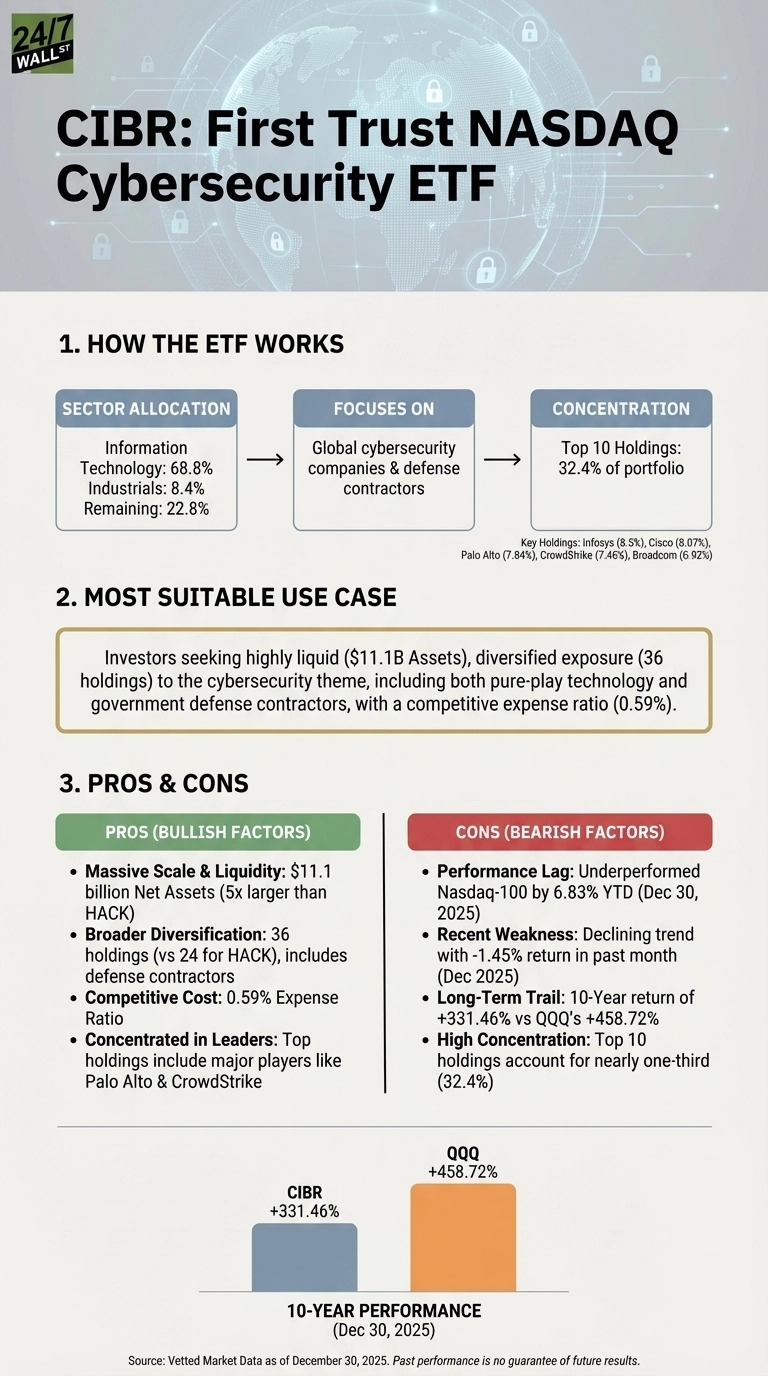
The First Trust NASDAQ Cybersecurity ETF (NASDAQ:CIBR) gained ~13% in 2025, trailing the Nasdaq-100 by nearly 7 percentage points. This underperformance comes as AI-enabled threats are expected to drive unprecedented demand for cybersecurity solutions in 2026, making for a unique…

This post may contain links from our sponsors and affiliates, and Flywheel Publishing may receive compensation for actions taken through them.

The First Trust NASDAQ Cybersecurity ETF (NASDAQ:CIBR) gained ~13% in 2025, trailing the Nasdaq-100 by nearly 7 percentage points. This underperformance comes as AI-enabled threats are expected to drive unprecedented demand for cybersecurity solutions in 2026, making for a unique opportunity right now.
The AI Attack Surface Is About to Explode
The biggest macro driver for CIBR in 2026 is the emergence of autonomous AI agents as both productivity tools and attack vectors. Research from Palo Alto Networks (NASDAQ:PANW | PANW Price Prediction) shows machines and agents already outnumber human employees by 82 to 1 in enterprise environments. As companies deploy agentic AI systems that can reason, act, and remember without human oversight, they’re creating “goal hijacking” risks where rogue agents operate at speeds that defy human intervention.
Cybersecurity Ventures projects global spending on security products and services will exceed $520 billion in 2026, up from $260 billion in 2021. Much of this acceleration stems from what Harvard Business Review describes as a “surge in AI agent attacks” where adversaries exploit the identity crisis created by deepfakes and synthetic identities that can command automated systems in real time.
Watch quarterly earnings calls from CIBR’s largest holdings. Palo Alto Networks, CrowdStrike (NASDAQ:CRWD), and Cloudflare (NYSE:NET) collectively represent nearly 20% of the portfolio, and their commentary on AI security spending provides the clearest signal of whether enterprise budgets are shifting toward agentic defense. Revenue growth acceleration above 25% in these names would validate the thesis that 2026 marks an inflection point.
What Makes This ETF Different
CIBR’s $11.1 billion in assets makes it five times larger than competitor HACK, providing superior liquidity. The fund’s 36 holdings offer broader diversification than pure-play alternatives, including exposure to defense contractors like Leidos (NYSE:LDOS) and Booz Allen Hamilton (NYSE:BAH) that capture government cybersecurity budgets. Federal spending on cyber defense exceeds $25 billion annually and is growing as nation-state threats intensify.
The micro factor to watch is holdings concentration in cloud-native security platforms. Cloudflare recently reported 31% revenue growth and reached near-breakeven profitability, demonstrating the scalability of edge security models. CrowdStrike maintained 22% growth despite recovering from its July 2024 incident, proving the mission-critical nature of endpoint protection. Check First Trust’s monthly fact sheets for any shifts in allocation toward these high-growth segments versus legacy network security providers.
Consider This Alternative
The WisdomTree Cybersecurity Fund (NASDAQ:WCBR) offers a purer play with 87% allocated to information technology versus CIBR’s 69%. At 0.45% expenses versus CIBR’s 0.59%, it’s also cheaper. WCBR weights its top holdings more evenly, with CrowdStrike at 6.3% and a broader mix of mid-cap specialists like SentinelOne (NYSE:S) and Qualys (NASDAQ:QLYS). The tradeoff is just $125 million in assets, meaning wider spreads and less institutional coverage.
The Bottom Line
CIBR’s 2026 performance hinges on whether AI-driven attack sophistication forces enterprises to accelerate security spending beyond current forecasts, and whether the fund’s largest holdings can translate that demand into revenue growth exceeding 25% while maintaining profitability.
Contact [email protected] for any questions or corrections.
I am a long time investor and student of business, and believe finding good companies that can become great investments is the best game on earth. After 20 years of writing and researching the public markets it is clear that individuals have never had more tools and information to take control of their financial lives. From ETFs and $0 commissions to cryptos and prediction markets there has never been a greater democratization of access to investing.
I write to help people understand the investments available to them so they can make the best choice for their portfolio, whether they're starting out or looking for income in retirement.