The 2 US Companies With a Better Credit Rating Than Uncle Sam Belong in Every Retirement Portfolio
S&P Global rates only two U.S. public companies AAA, one notch above the federal government itself. S&P downgraded the United States to AA+ in 2011, and Fitch followed in 2023, leaving Uncle Sam a step below the small club still…


S&P Global rates only two U.S. public companies AAA, one notch above the federal government itself. S&P downgraded the United States to AA+ in 2011, and Fitch followed in 2023, leaving Uncle Sam a step below the small club still graded at the top of the scale. That club has two members: Johnson & Johnson (NYSE: JNJ | JNJ Price Prediction) and Microsoft (NASDAQ: MSFT).
A AAA rating is the highest possible signal of debt-repayment confidence from a major agency. It reflects fortress balance sheets, durable free cash flow, and disciplined capital allocation across full credit cycles, signaling survivability through rate shocks and recessions. For retirement-focused investors who want holdings that can continue paying dividends through recessions and rate shocks, this rating is both rare and meaningful. For retirement-focused investors who want holdings that can continue paying dividends through recessions and rate shocks, this rating is both rare and meaningful. Below, we count down the two American companies that clear that bar, starting with the only U.S. technology firm in the group.
2. Microsoft
Microsoft carries a market capitalization of roughly $3.0 trillion and the kind of recurring software and cloud economics that bond analysts dream about. In Q3 FY2026, reported April 29, 2026, the company posted revenue of $82.89 billion, up 18.3% year over year, with EPS of $4.27 beating the $4.07 consensus estimate. Operating cash flow reached $46.68 billion in the quarter, and commercial remaining performance obligations stood at $627 billion, a multi-year contracted backlog few peers can match.

The AAA question for Microsoft is the AI capital expenditure cycle. Capex reached $30.88 billion in Q3 FY2026, up 84.4% year over year, while CEO Satya Nadella noted the AI business surpassed a $37 billion annual revenue run rate, up 123% year over year. The balance sheet still absorbs it: shareholders’ equity grew to $414.37 billion, debt-to-equity is 0.33, and interest coverage is 53.9x. The dividend was raised to $0.91 per quarter in 2026, compounding from $0.08 in 2004. Shares trade at a forward P/E of 21x. Year to date, the stock is down 15.7% as the market digests the capex bill, but the credit profile remains intact.

1. Johnson & Johnson
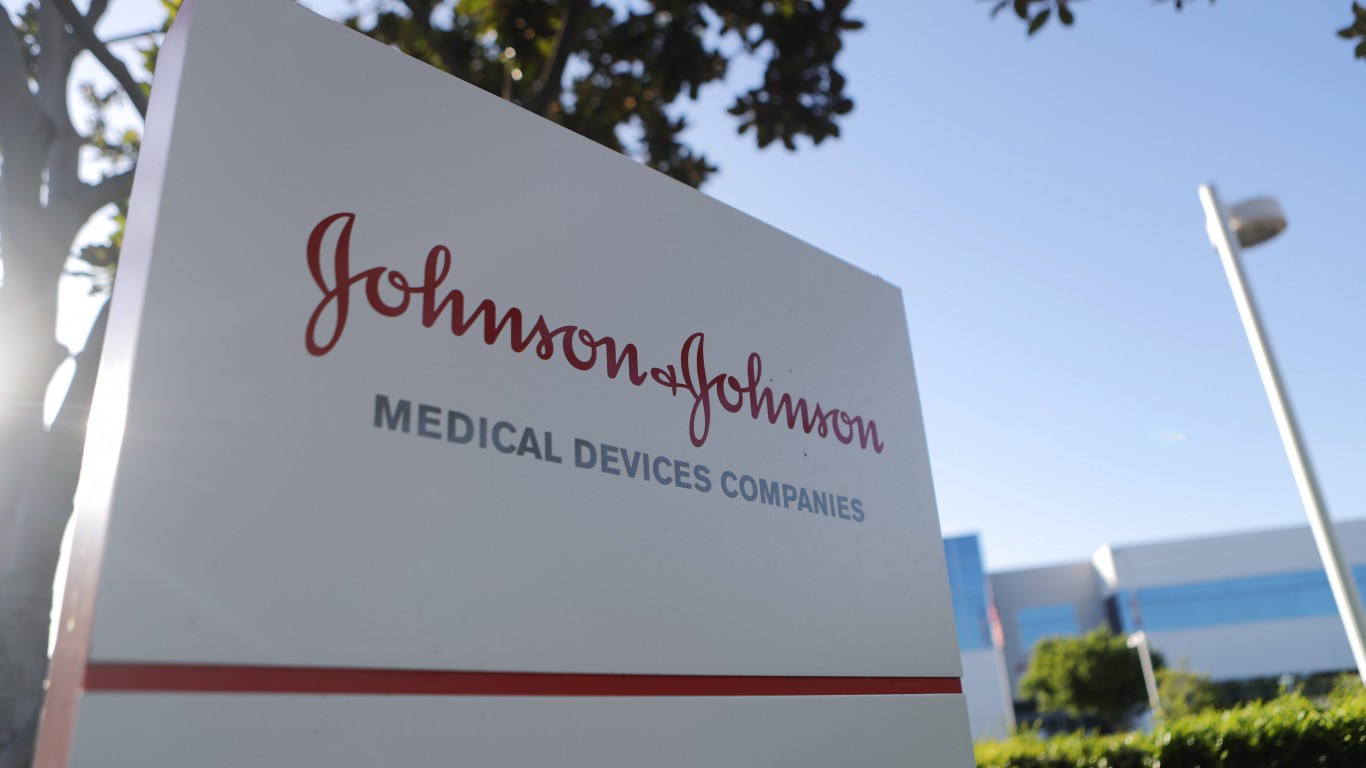
Johnson & Johnson tops the short list for retirement portfolios because its top rating is in addition to its status as a Dividend King. Q1 2026 marked the 64th consecutive year of dividend increases, with the quarterly payout raised 3.1% to $1.34 per share. Revenue rose to $24.06 billion, up 9.9% year over year, and adjusted EPS of $2.70 beat the $2.68 consensus, the fourth straight beat. Management raised full-year 2026 adjusted EPS guidance to $11.45 to $11.65.

The pharma and medtech cash flow profile, following the Kenvue separation, is what keeps rating agencies comfortable. Innovative Medicine posted $15.43 billion (+11.2%), with Darzalex at $3.96 billion (+22.5%) and Tremfya at $1.61 billion (+68.3%) offsetting Stelara biosimilar erosion of 59.7%. MedTech contributed $8.64 billion (+7.7%), led by cardiovascular at $2.38 billion (+13.0%). CEO Joaquin Duato said the company is “delivering on its promise for a year of accelerated growth and impact.” The talc litigation overhang remains material, with $330 million in litigation-related charges in Q1 2026, yet rating agencies still grade the balance sheet at the top tier because full-year 2025 free cash flow reached $20.4 billion and the trailing P/E is 26x. Shares have returned 45.5% over the past year, with a dividend yield near 2.4%.

What AAA Means for Retirement Investors
The case for owning both stocks in a retirement portfolio is straightforward. A AAA rating tells income-focused investors these two businesses are structured to survive credit cycles, recessions, and rate shocks while continuing to fund dividends and buybacks. Johnson & Johnson delivers that durability with 64 years of payout growth and a defensive healthcare mix; Microsoft delivers it with recurring cloud economics and a contracted backlog of $627 billion. The caveat remains that AAA does not equal cheap, and valuation discipline still applies. The rating provides a floor under the investment thesis while fundamentals carry it forward.
Contact [email protected] for any questions or corrections.
Trey has been an editor and author at 24/7 Wall St. for more than a decade, where he has published thousands of articles analyzing corporate earnings, dividend stocks, short interest, insider buying, private equity, and market trends. His comprehensive coverage spans the full spectrum of financial markets, from blue-chip stalwarts to emerging growth companies.
Beyond 24/7 Wall St., Trey has created and edited financial content for Benzinga and AOL's BloggingStocks, contributing additional hundreds of articles to the investment community.
Trey's editorial expertise extends across multiple publishing environments. He served as production editor at Dearborn Financial Publishing and development editor at Kaplan, where he helped shape financial education materials. Earlier in his career, he worked as a writer-producer at SVE. His freelance editing portfolio includes work for prestigious clients such as Sage Publications, Rand McNally, the Institute for Supply Management, the American Library Association, Eggplant Literary Productions, and Spiegel.
Outside of financial journalism, Trey writes fiction and has been an active member of the writing community for years, moderating workshop sessions at regional conventions.