Baby Boomers: 5 Simple Steps For A Prosperous Retirement
Recommended by top retirement consultants, five simple strategies can make a world of difference for baby boomers in their golden years.


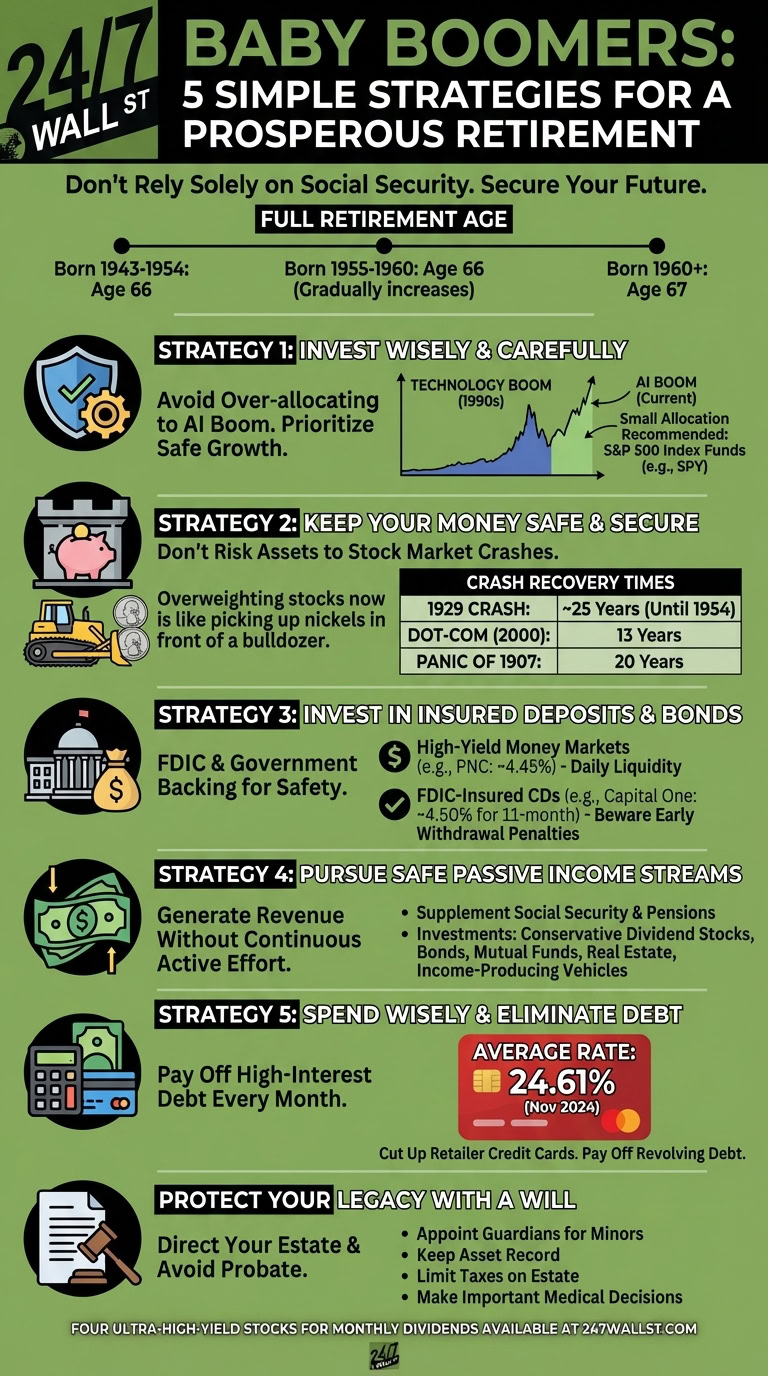
While getting to retirement age can be a blessing and a curse, the reality of counting on the U.S. government to provide for your needs is not the best idea. The full retirement age is 66 if you were born from 1943 to 1954. The full retirement age increases gradually if you were born from 1955 to 1960 until it reaches 67; for anyone born in 1960 or later, full retirement benefits are payable at age 67.
With the youngest baby boomers (Americans born between 1946 and 1964) approaching retirement age, it is becoming increasingly important to focus on five simple strategies that can ensure a prosperous and fully funded retirement. Recommended by some of the top retirement consultants, five simple strategies can make a world of difference for baby boomers in their golden years.
Invest wisely and carefully
While watching the AI boom explode, the stock market higher month after month is tempting for many, the reality for baby boomers is that you already had a technology boom in the 1990s that helped to launch your 401k’s and pension funds higher. While some growth can be good to help counter sticky inflation, go with a small allocation of S&P 500 index funds like the SPDR S&P 500 ETF Trust (NYSEArca: SPY).
Keep your money safe and secure

Baby boomers can’t risk the bulk of their assets being exposed to a stock market crash. A market crash, though devastating, is workable if you are in your 40s and making peak money. However, for baby boomers who have enjoyed unprecedented gains over the past 15 years, being overweighted to the stock market now is like picking up nickels in front of a bulldozer, and it could be a fatal shot to their retirement savings. Look at this data we dug up on the internet on the effect of major market crashes. The recovery time can be much longer than recessions or regular bear markets, sometimes taking decades:
- The 1929 crash lasted until 1932, and the Dow didn’t fully recover until November 1954.
- The dot-com stock correction/crash in March 2000 took 13 years to recover fully.
- The panic of 1907 took the stock market 20 years to return to its pre-crash level.
Invest in insured deposits and government bonds

High-yield money markets from major money center banks like PNC Financial Services Group Inc. (NYSE: PNC | PNC Price Prediction) currently pay a 3.15% yield monthly and have daily liquidity. Government bonds are insured by the full faith and credit of the U.S. government and can be bought through banks and brokerage firms.
The Federal Deposit Insurance Corporation (FDIC) insures certificates of deposits at FDIC-insured banks. The FDIC also insures other deposit products, such as checking and savings accounts, money market deposit accounts (MMDAs), and cashier’s checks. Capital One Financial Corp. (NYSE: COF) offers an 11-month CD that pays 3.90%. It is important to note that there can be penalties for early withdrawals of CDs.
Pursue safe passive income streams

Passive income is characterized by its ability to generate revenue without requiring the earner’s continuous active effort. It is a desirable financial strategy for those seeking to diversify their income streams to increase monthly cash payouts. The more passive income can help cover costly and rising costs like mortgage, insurance, taxes, and other expenses, the easier it is for investors to supplement Social Security or pension payments.
Most dividend investors seek solid passive income streams from quality dividend stocks. Shared ideas for earning passive income include investments like conservative dividend stocks, bonds, mutual funds, real estate, and additional income-producing vehicles.
Spend wisely and eliminate debt

We all like to buy nice things but also need to spend on dedicated monthly expenditures like mortgage or rent, utility bills, insurance for cars and homes, and many other must-have items. Pay off credit cards every month, as the rates they charge are staggering; the average credit card interest rate typically hovers around 22 to 24%. While the Fed’s recent rate cut to close out 2025, basis points may help lower rates on other types of loans, it’s unlikely to impact credit card interest rates significantly.
In addition, pay off and cut up department store and other retailer credit cards. While using most major credit cards can help you rack up airline flyer miles or hotel benefits, retailer and other revolving debt credit accounts usually don’t offer any advantages.
Protect your estate and legacy assets with a will

With a will, you can direct where and to whom your estate will go after your death. If you died without a will, in most cases, your estate would be distributed according to your state’s law and could be caught up in probate for months, depending on where you live. Wills make the administration of your estate run smoothly.
There are also many other benefits of having a will, such as the ability to appoint guardians for any minor children, keeping a helpful record of assets that surviving relatives might not be aware of, limiting taxes payable on deceased estates, important decisions regarding medical care should a person be unable to and many other benefits.
Contact [email protected] for any questions or corrections.
Lee Jackson has covered Wall Street analysts' equity and debt research and equity strategy daily for 24/7 Wall St. since 2012. His broad, diverse career, including a stint as creative services director at an NBC affiliate in Austin, Texas, gives him unique insight into the financial industry.
Lee Jackson's journey in the financial industry spans more than 30 years, including nearly two decades as an institutional equity salesperson at Bear Stearns, Lehman Brothers, and Morgan Stanley. His career spanned pivotal sell-side Wall Street events, from the dot-com rise and bubble to the Long-Term Capital Management debacle, 9/11, and the Great Recession of 2008. This reflects his resilience and adaptability amid market volatility.
Lee Jackson’s practical financial industry experience, gained through a career at some of the biggest banks and brokerage firms, is complemented by a lifetime of writing across various platforms. This unique combination allows him to shed light on the intricacies of Wall Street in a way only someone with deep insider experience and knowledge can. Moreover, his extensive network across Wall Street continues to provide direct access for him and 24/7 Wall St., a privilege few firms enjoy.
Since 2012, Jackson’s work for 24/7 Wall St. has been featured in Barron’s, Yahoo Finance, MarketWatch, Business Insider, TradingView, Real Money, The Street, Seeking Alpha, Benzinga, and other media outlets. He attended the prestigious Cranbrook Schools in Bloomfield Hills, Michigan, and has a degree in broadcasting from the Specs Howard School of Media Arts.