Dave Ramsey: Do These 5 Things Now to Achieve Wealth
If you want to achieve lasting wealth, borrowing from personal finance expert Dave Ramsey's playbook is a solid place to start. His advice covers everything from curbing spending to rethinking your lifestyle, and his core framework comes down to five…


If you want to achieve lasting wealth, borrowing from personal finance expert Dave Ramsey’s playbook is a solid place to start. Ramsey’s advice spans everything from curbing spending to rethinking your lifestyle, and his core framework comes down to five practical tools. Follow them consistently and, in time, they can move you meaningfully closer to your financial goals.
No. 1: Have a written plan.
Good intentions are a starting point, but putting a plan on paper makes it real. A budget is not just a spending tracker; it is the foundation of any serious wealth-building effort. That means itemizing assets, liabilities (including regular expenses), and all sources of income. On the income side, Ramsey urges people to rely on their own savings and investments rather than treating future Social Security benefits as a guaranteed income floor. He advises viewing Social Security as an unpredictable bonus rather than a baseline strategy.
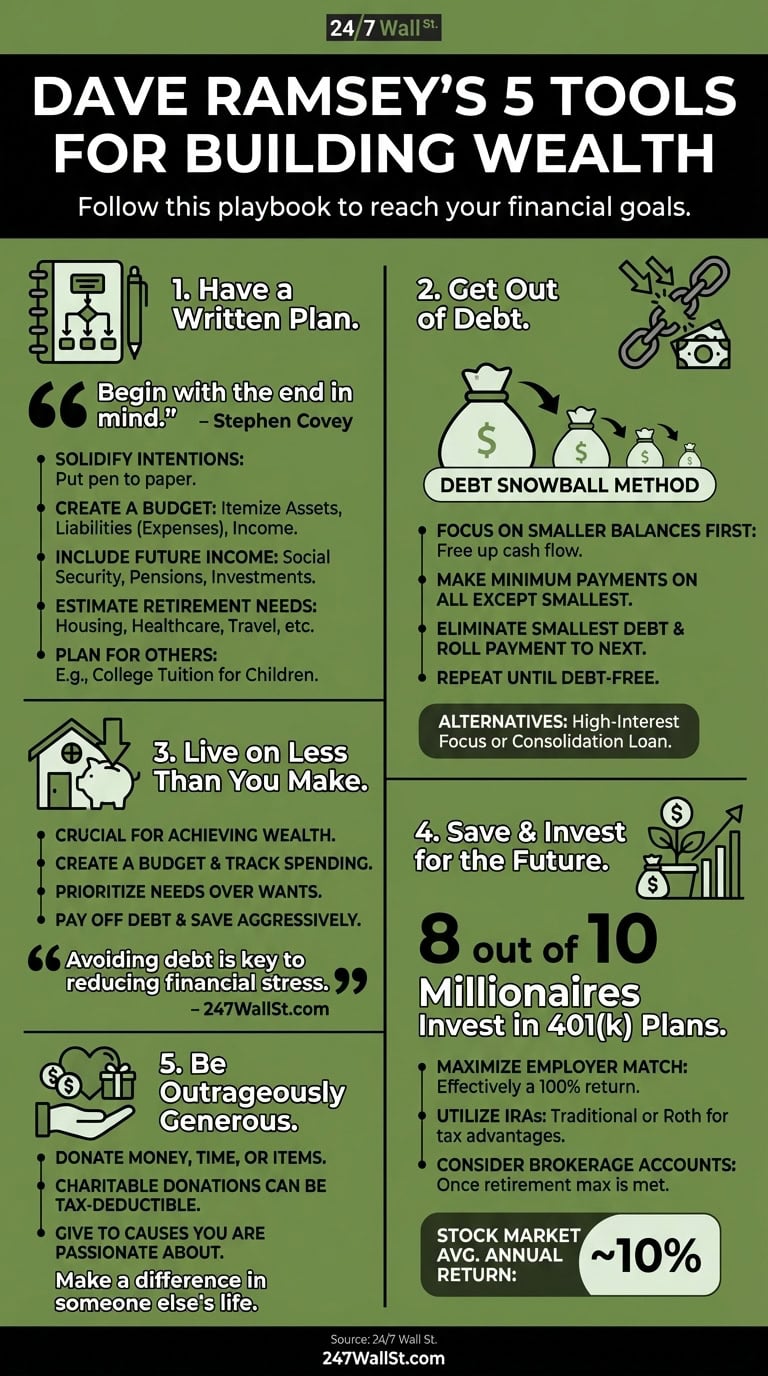
As retirement approaches, think through the full picture of what you will actually spend. Stephen Covey, author of The 7 Habits of Highly Effective People, captured the idea well: “begin with the end in mind.” That means estimating annual costs for housing, health care, food, travel, transportation, and even pet expenses before you need that money.
If you hope to help your children or grandchildren with college tuition or other major expenses, write that goal down now and build a plan around it.
No. 2: Get out of debt.
Debt is one of the most reliable obstacles to wealth, and the scale of the problem is considerable. Americans closed 2025 owing a record $1.28 trillion on their credit cards alone, according to the Federal Reserve Bank of New York. Ramsey’s answer is a method known as the debt snowball: focus on the smallest balance first, eliminate it completely, and then roll that freed-up payment toward the next smallest debt. The psychological momentum of quick wins keeps people on track when the larger balances feel overwhelming.
As described by Ramsey Solutions, the process is straightforward: “Make minimum payments on all debts except the smallest — throwing as much money as you can at that one. Once that debt is gone, take its payment and apply it to the next smallest debt (while continuing to make minimum payments on your other debts).” Repeat until the slate is clear.
Other approaches exist for those who prefer a different path. Paying only minimums on most balances while directing extra cash toward the highest-interest debt can lower total interest paid. A consolidation loan is another option: it combines multiple balances into a single payment, which can simplify repayment and sometimes free up room to build a small emergency fund at the same time.
No. 3: Live on less than you make.
Spending less than you earn sounds simple, and conceptually it is. Putting it into practice is harder. Ramsey’s prescription is familiar but effective: build a budget, track every dollar, prioritize needs over wants, eliminate debt, and save consistently. Living within your means reduces financial stress and creates the surplus that makes investing possible.
In the current environment, that discipline requires extra vigilance. Digital shopping has made impulse spending frictionless, and one-click purchases can quietly erode a budget before you notice. Budgeting apps that flag unplanned transactions in real time have become useful tools for people who want to keep spending aligned with their goals. As 247WallSt.com contributor Chris MacDonald notes, Ramsey “emphasizes the importance of avoiding debt, particularly from credit cards, which can lead to a cycle of overspending and financial strain. Instead, prioritize budgeting and saving so you can develop a more positive relationship with money, viewing it as a tool for achieving goals rather than a source of stress.”
No. 4: Save and invest.

A workplace 401(k) with an employer match is one of the most powerful savings vehicles available. Capturing the full match is effectively an immediate return on your contribution, dollar for dollar up to the matching limit. The results compound over time: Fidelity Investments counted a record 769,000 401(k) millionaires on its platform at the end of the second quarter of 2026, up from 645,000 just one quarter earlier. According to Ramsey Solutions, eight out of 10 millionaires invested in their company’s 401(k) plan. Ramsey’s recommended order of operations is to contribute to a workplace 401(k) up to the employer match first, then fully fund a Roth IRA, and finally return to the 401(k) to reach the 15% retirement savings threshold.
An individual retirement account (IRA) offers another tax-advantaged path, whether or not you have access to a workplace plan. A traditional IRA may allow you to deduct contributions on your tax return, depending on your income and filing status. A Roth IRA works differently: contributions go in after tax, but qualified withdrawals in retirement, including all growth and dividend distributions, come out completely tax-free. It is worth consulting a financial advisor to determine which type fits your situation best.
For 2026, the IRA contribution limit is $7,500 for savers under age 50. Those 50 and older can contribute an additional $1,100 (the SECURE 2.0 catch-up amount), bringing their total to $8,600. Once you have maxed out an IRA, the workplace 401(k) allows employee contributions up to $24,500. Beyond these tax-advantaged accounts, a standard brokerage account gives you access to the broader stock market, which has historically delivered an average annual return of roughly 10%.
No. 5: Be outrageously generous.
Ramsey’s fifth tool is generosity, and he means it broadly. If cash is tight, give your time. Donate food, clothes, or other goods. The practical benefits are real: as Ramsey Solutions notes, “charitable donations can be tax-deductible, which can help lower your tax bill.” Beyond the financial upside, Ramsey argues that giving to a cause you care about produces its own rewards, including the satisfaction of making a tangible difference in someone else’s life.
Editor’s note: The 401(k) millionaire figure has been updated to 769,000 based on Fidelity Investments’ Q2 2026 retirement analysis, and context on Americans’ record $1.28 trillion in credit card debt (Federal Reserve Bank of New York) has been added to the debt section. IRA and 401(k) contribution limits reflect 2026 IRS figures: $7,500 base IRA limit, $8,600 for savers 50 and older, and a $24,500 employee 401(k) ceiling.
Contact [email protected] for any questions or corrections.
Ian Cooper is a veteran market analyst and investment strategist with more than 20 years of experience covering stocks, commodities, and macro trends. Since 1999, he has helped investors identify market opportunities using a blend of technical analysis, fundamental research, and market sentiment.
He is the creator of the ADD News Flow Strategy, which focuses on trading market reactions to major news events and investor psychology. Cooper was also among the analysts who warned about the 2008 financial crisis and major financial institution collapses ahead of the broader market.
Before joining 247 Wall St., Cooper wrote extensively for InvestorPlace and other financial publications, covering market trends, trading strategies, and investment opportunities.