Read This Before Buying ETHA In 2026
Ethereum’s volatility makes timing difficult, but accessing it through a tax-advantaged account can help offset the wild swings. That’s where iShares Ethereum Trust ETF (NASDAQ:ETHA) comes in, offering direct exposure to Ethereum’s price movements without the complexity of wallets, private…

Ethereum’s volatility makes timing difficult, but accessing it through a tax-advantaged account can help offset the wild swings. That’s where iShares Ethereum Trust ETF (NASDAQ:ETHA) comes in, offering direct exposure to Ethereum’s price movements without the complexity of wallets, private keys, or exchange accounts.
Built for Liquidity and Large Positions
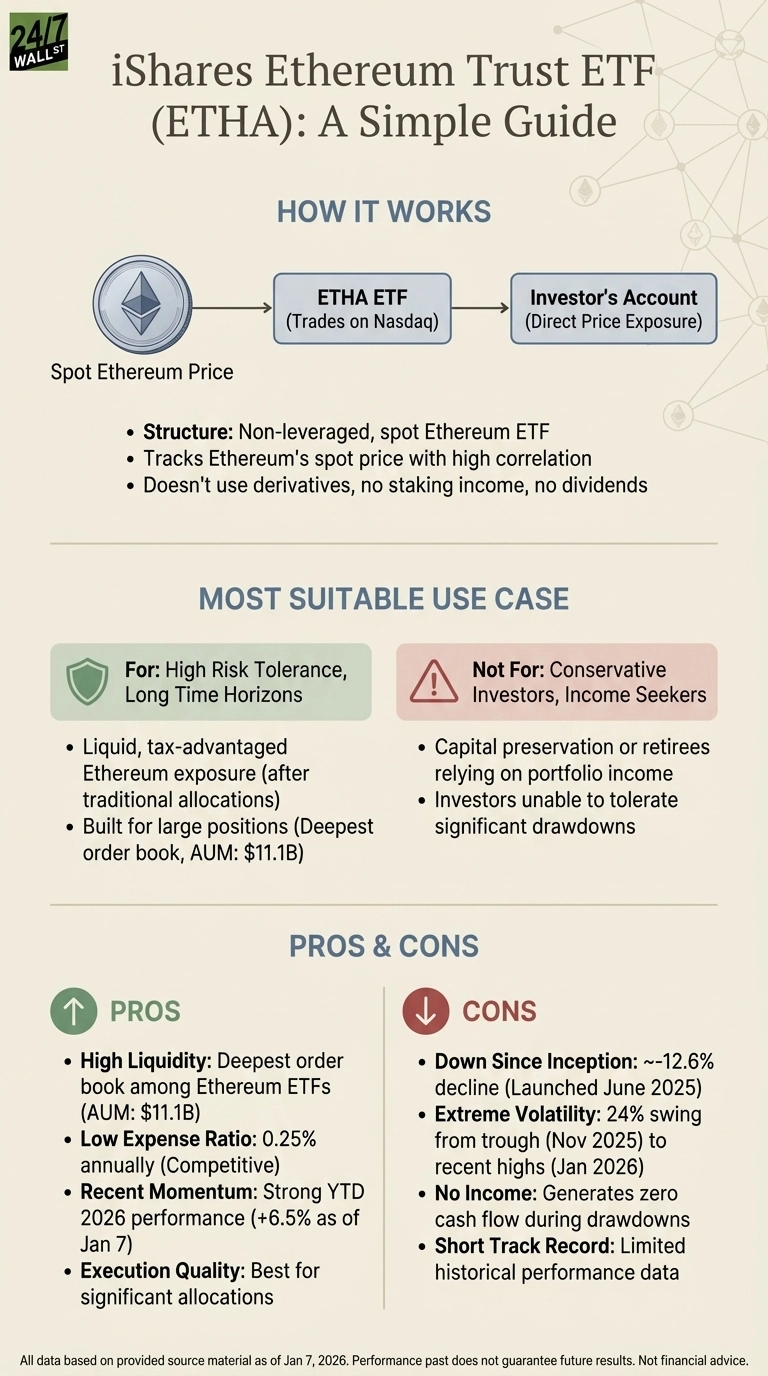
ETHA’s primary strength is execution quality. With $11.1 billion in assets and roughly $190 million in average daily trading volume, it offers the deepest order book among Ethereum ETFs. One Reddit investor analyzing multiple Ethereum ETFs for a $100,000 position concluded ETHA was “the best one to invest in” because of its liquidity advantage. For investors planning significant allocations or large exits, that depth matters more than saving a few basis points on the spread.
The fund charges 0.25% annually and tracks Ethereum’s spot price with high correlation. It doesn’t use derivatives, doesn’t generate staking income, and doesn’t pay dividends. You’re buying pure price exposure.
Performance Has Been Disappointing
ETHA launched in June 2025 near $27 and currently trades around $24, a roughly 13% decline since inception. The seven-month track record shows underperformance relative to other crypto ETFs during this period.
Ethereum bottomed at $2,620 in November 2025 before recovering to current levels around $3,250. That 24% swing from trough to recent highs illustrates the core challenge: Ethereum’s price action remains unpredictable and far more volatile than traditional equity allocations.
The Cost of Crypto Exposure
Allocating to ETHA means accepting several tradeoffs. First, you’re taking on extreme volatility with no income cushion. Unlike dividend-paying equities or bond funds, ETHA generates zero cash flow during drawdowns. Second, Ethereum’s performance depends heavily on network adoption, regulatory developments, and speculative sentiment, all of which can shift rapidly. Third, the fund’s short track record means limited data for evaluating how it behaves across full market cycles.
Major advisory platforms are adjusting their crypto allocations. Betterment recently announced it is increasing Bitcoin exposure while decreasing Ethereum in its crypto portfolios to better align with market capitalization weighting, signaling that institutional preference may be shifting toward Bitcoin’s relative stability.
Who Should Avoid ETHA
This ETF is not appropriate for conservative investors seeking capital preservation or retirees relying on portfolio income. It’s also unsuitable for anyone who cannot tolerate 20% to 30% drawdowns or who lacks a multi-year time horizon. If you need your capital within two years or cannot stomach watching your position halve during a crypto winter, ETHA is not the right vehicle.
Consider IBIT for Bitcoin Exposure Instead
For investors seeking cryptocurrency exposure with slightly better downside protection, iShares Bitcoin Trust (NASDAQ:IBIT) offers a compelling alternative. Bitcoin’s larger market capitalization and broader institutional adoption provide marginally more stability, though both remain highly speculative assets. IBIT carries the same 0.25% expense ratio and similar liquidity characteristics.
ETHA serves one role well: providing liquid, tax-advantaged Ethereum exposure for investors with high risk tolerance and long time horizons, but only after traditional equity and fixed-income allocations are established.
Contact [email protected] for any questions or corrections.
I am a long time investor and student of business, and believe finding good companies that can become great investments is the best game on earth. After 20 years of writing and researching the public markets it is clear that individuals have never had more tools and information to take control of their financial lives. From ETFs and $0 commissions to cryptos and prediction markets there has never been a greater democratization of access to investing.
I write to help people understand the investments available to them so they can make the best choice for their portfolio, whether they're starting out or looking for income in retirement.