The Real Cost of Retiring in America’s Most Famous Retirement Community
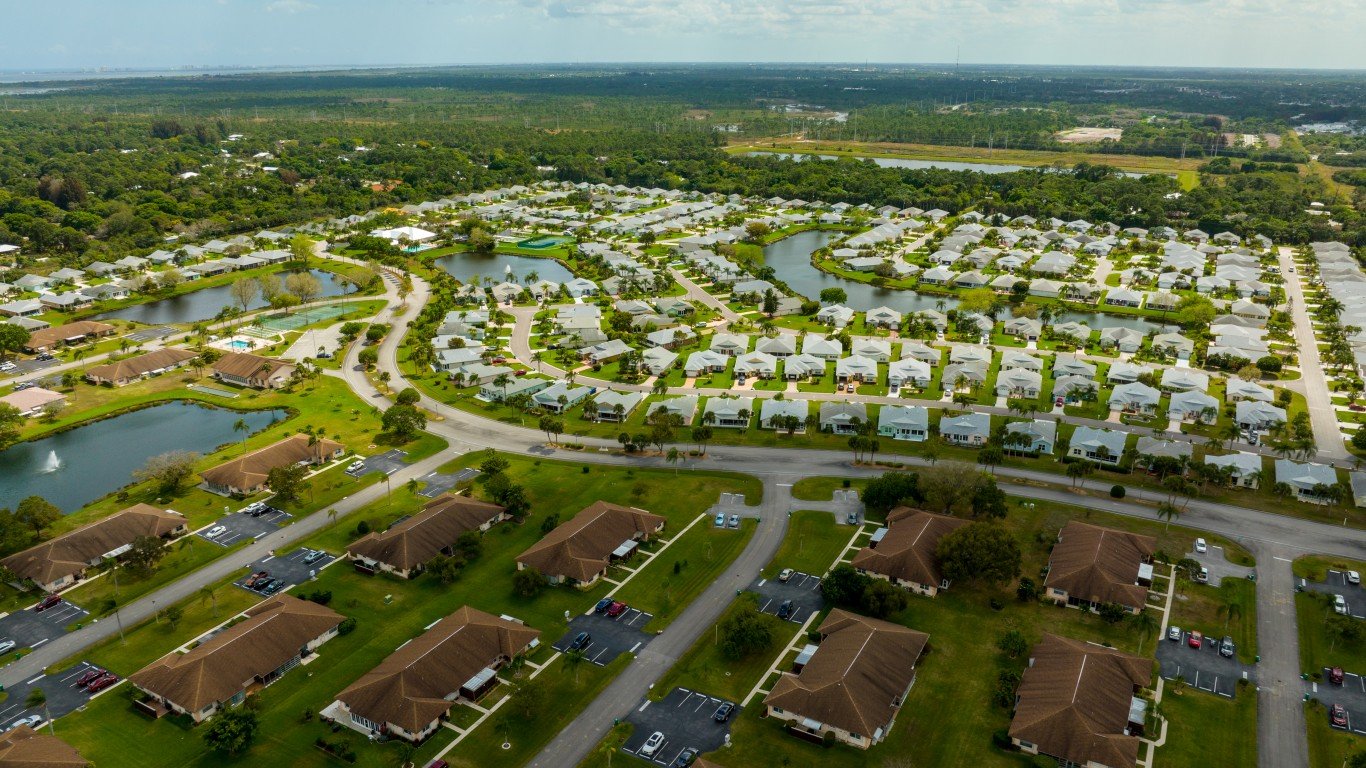
The Villages comes up frequently when readers ask us to stress test a retirement plan. It is the country’s best known retirement community, an inland sprawl of golf carts, town squares, and pickleball courts in central Florida housing more than…


The Villages comes up frequently when readers ask us to stress test a retirement plan. It is the country’s best known retirement community, an inland sprawl of golf carts, town squares, and pickleball courts in central Florida housing more than 150,000 mostly older residents. The pitch sells itself. The math is more complicated than the brochures suggest, and the costs that trip people up sit outside the standard budget line items.
This piece walks through what a couple in their mid-sixties realistically needs to fund the standard Villages lifestyle: a modest detached home, two golf carts, a country club membership’s worth of activity, and the calm of knowing the money will not run out at 88.
What you are actually buying into
Start with the house. The median listing price in The Villages is around $379,000, and Zillow (NASDAQ:Z | Z Price Prediction) puts the average value at roughly $393,000. Call it $385,000 for a paid-off home in this analysis.
The Villages layers on three charges most buyers underestimate. The monthly amenity fee, currently $204 for new buyers, covers recreation centers, executive golf, and entertainment infrastructure. The Community Development District (CDD) assessment funds maintenance and fire services at roughly $355 to $1,200 a year depending on district. The infrastructure bond, the developer’s municipal financing for streets and utilities, comes with the deed at about $14,000 on older homes and $23,000 to $28,000 on newer ones, typically amortized over 30 years in your tax bill.
Florida helps. The state has no individual income tax and ranks first nationally on that measure, meaning no tax on Social Security, pension income, or IRA withdrawals. The trade is a statewide cost of living index of 103.4, slightly above the national average, and a homeowners insurance market that has been brutal even inland. Plan on $1,500 to $2,500 a year for a standard Villages home, and expect it to keep climbing.
The working budget
Here is what an active Villages couple, both 67, owning their home outright, actually spends in current dollars:
- Property taxes, CDD, and bond payment combined: about $5,500
- Amenity fee: $2,448
- Homeowners insurance: $2,000
- Utilities, water, trash, internet: $4,200
- Home maintenance and reserves: $5,500
- Medicare Part B for two at the 2026 standard premium of $202.90 each: $4,870
- Medigap, Part D, dental, out of pocket healthcare: $7,500
- Groceries and household: $11,000
- Dining out, golf greens fees beyond executive courses, clubs and travel: $12,000
- One car plus two golf carts (insurance, charging, batteries, depreciation): $7,500
- Gifts, personal, miscellaneous: $6,000
- Federal income tax on withdrawals: $3,500
That lands near $72,000 a year before income taxes are fully accounted for, and closer to $80,000 once you cover the tax on traditional IRA withdrawals. Trim travel and golf and you can live well on $65,000. Add a Country Club membership and frequent travel and you reach $100,000 quickly.
The math, in plain dollars
Social Security does serious work here. The average retired worker benefit in January 2026 is $2,071 a month after the 2.8% COLA, so a typical couple draws around $50,000 a year combined. Higher earners claiming at 70 can reach $70,000 or more.
Subtract Social Security from an $80,000 budget and the portfolio has to cover roughly $30,000 a year. At a 4% withdrawal rate, that implies a portfolio of about $750,000. Push the budget to $100,000 and the gap widens to $50,000, requiring $1.25 million. If one spouse claims early at 62 and benefits drop accordingly, add another $200,000 to the target.
Those are honest numbers for a couple buying in at 67 with the house paid off. Retire at 60 and the bridge to Medicare adds $20,000 to $30,000 a year in ACA premiums and out of pocket healthcare for five years, plus a tighter 3.3% withdrawal rate for the longer horizon. That alone pushes the target past $1.6 million for an early Villages retirement.
The cost most buyers underprice
The Villages has a structural feature that does not show up in most retirement calculators: the amenity fee is tied to inflation and can increase over time. A $204 monthly fee growing at 3% annually becomes roughly $370 per month after twenty years. That increase may seem modest in any single year, but it compounds across a long retirement. The infrastructure bond stacks on top of the fee, carries interest, and remains attached to the property regardless of how often a resident uses the amenities it helps finance.
The same logic applies to golf carts. Couples buy two, often a second to match a spouse’s color preference, and a quality cart runs $15,000 to $25,000. Batteries need replacement every five to seven years at $1,500 to $3,000. Across a 25 year retirement, two carts quietly cost six figures, displacing exactly the recreation budget the amenity fee is supposed to cover. The lifestyle markers that justify the move are themselves recurring liabilities priced like one-time purchases.
The honest number for a couple buying into The Villages today at 67, with the house paid off, two Social Security checks at the average benefit, and a portfolio invested in a balanced mix of index funds and a treasury ladder for near-term withdrawals, is about $1.2 million. That funds an $80,000 to $90,000 lifestyle at a 4% withdrawal rate with enough cushion to absorb a rising amenity fee, a Florida insurance market that is not done repricing, and the slow grind of replacing carts and roofs. Less than that works only if you keep the budget under $65,000 and stay disciplined about the bond, the fee escalator, and the second golf cart you did not need.
Contact [email protected] for any questions or corrections.
Drew Wood has edited or ghostwritten nine books and published more than 1,500 articles on investing, business, politics, travel, world cultures, wildlife, and earth science. He holds a doctorate and four master's degrees and has nearly 30 years of college teaching experience. His travels have taken him to 25 countries, including three years living in Ukraine.