A 58-Year-Old With $3 Million Faces the Most Expensive Retirement Decision
At 58 with $3 million saved, working one additional year represents one of the most financially consequential retirement planning decisions a person can make. For many near-retirees, "one more year syndrome" becomes a recurring dilemma, as one Reddit user described…

This post may contain links from our sponsors and affiliates, and Flywheel Publishing may receive compensation for actions taken through them.

At 58 with $3 million saved, working one additional year ranks among the most financially consequential retirement planning decisions a person can make. For many near-retirees, “one more year syndrome” becomes a recurring trap, as one Reddit user described watching colleagues repeatedly delay retirement despite having plenty of resources to stop. The math behind that single extra year reveals why this decision deserves serious, unhurried consideration.
The Scenario at a Glance
- Age: 58 years old
- Current Portfolio: $3 million in retirement savings
- Decision Point: Retire now or work one more year
- Key Tension: Balancing immediate freedom against enhanced financial security
- Critical Factor: Compounding effect of contributions plus market returns
This scenario mirrors similar situations faced by professionals approaching 60 who wonder whether they have crossed the financial finish line or just drawn close to it.
The Financial Reality of One More Year
A single additional working year delivers a triple benefit. First, you avoid withdrawing from your portfolio, preserving capital that would otherwise begin shrinking. Second, your existing $3 million keeps compounding. Assuming a conservative 7% annual return, well below the S&P 500’s trailing 12-month total return of approximately 22% as of early July 2026, that growth alone adds $210,000 in market appreciation. Third, you are almost certainly adding substantial new savings on top of that gain.
Maximizing retirement contributions at 58 means taking full advantage of 2026 IRS limits: a $24,500 base 401(k) deferral plus an $8,000 catch-up for savers age 50 and older, for a total of $32,500 in employee contributions. Combined with a 7% return on the existing portfolio, that single extra year could lift your nest egg to roughly $3.36 million. Apply the 4% safe withdrawal rate and your sustainable annual income climbs from $120,000 to $134,400, a 12% permanent increase in spending power that compounds across decades of retirement. One meaningful 2026 wrinkle: under SECURE 2.0, savers whose prior-year FICA wages exceeded $150,000 must now make all age-based 401(k) catch-up contributions as Roth contributions, shifting the tax timing but not the contribution opportunity itself. It is also worth looking two years ahead. Once a plan participant turns 60, SECURE 2.0’s “super catch-up” provision raises the limit to $11,250 instead of $8,000, allowing a total of $35,750 in annual employee contributions for those aged 60 through 63.
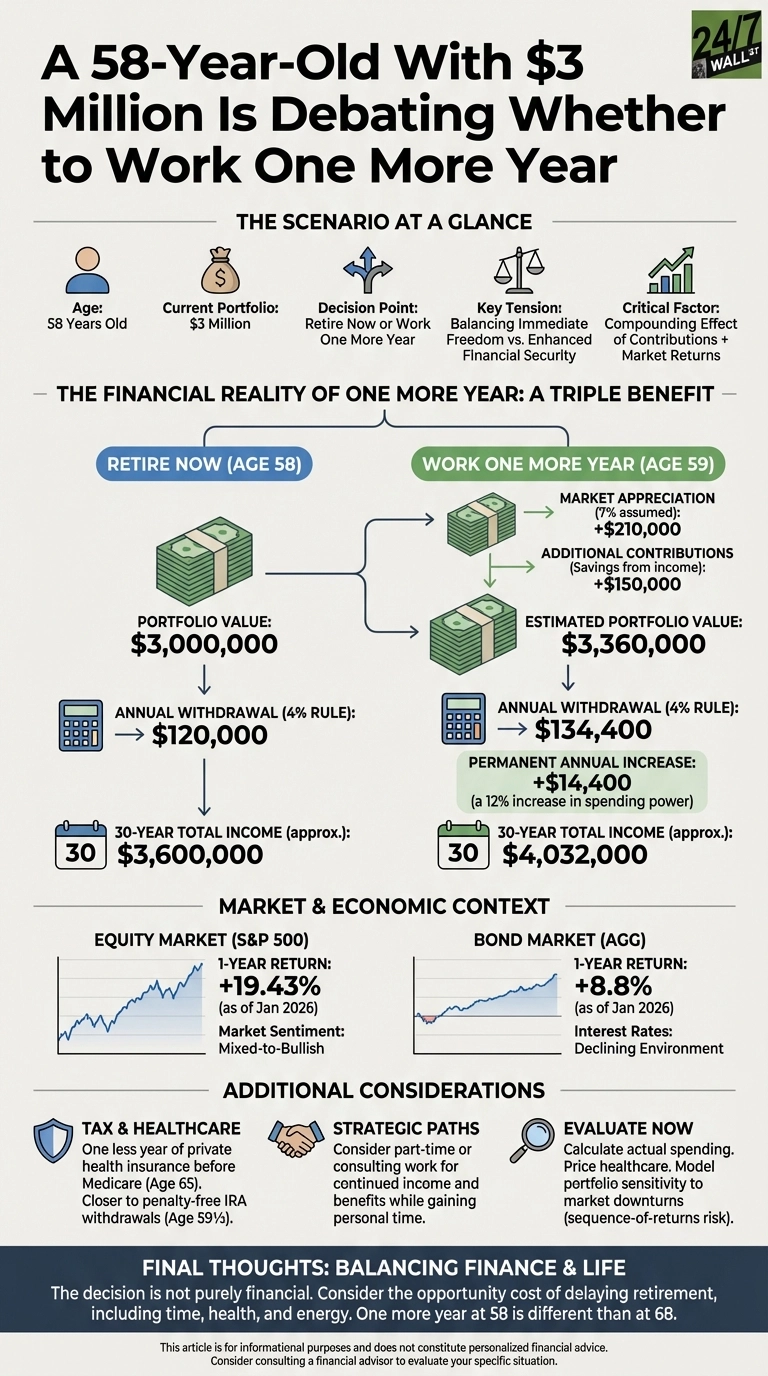
Tax and healthcare considerations add further weight to the calculation. Working another year means one fewer year of private insurance premiums before Medicare eligibility at 65, and that matters more in 2026 than it has in years. The enhanced ACA premium tax credits that had held marketplace costs in check expired on January 1, 2026, after Congress failed to reach an agreement on an extension. According to KFF research, the average subsidized marketplace enrollee is now paying 114% more in annual premiums than in 2025. A separate KFF analysis published in July 2026 found that the average marketplace deductible also grew by roughly $1,000 per person this year, with more enrollees shifting to higher-deductible plans as affordability pressures mounted. For a 58-year-old without employer coverage, quality individual market plans can realistically run $15,000 to $25,000 per year at current rates, and a couple in their early 60s earning around $85,000 annually could face roughly $22,600 per year for benchmark silver-plan coverage. Delaying retirement by a year also edges you closer to penalty-free IRA withdrawals at age 59.5, reducing the friction of early portfolio access if it becomes necessary.
Advanced Structural Paths for the Early Bridge
Standard retirement guidance treats age 59.5 as the threshold for penalty-free distributions, but younger corporate professionals have additional tools available. The IRS Rule of 55 lets employees who separate from their employer during or after the calendar year they turn 55 take penalty-free distributions from that employer’s 401(k). Separately, Section 72(t) of the tax code permits Substantially Equal Periodic Payments (SEPP) from a traditional IRA, providing early access to capital without the standard 10% penalty, provided the payment schedule is maintained for five years or until age 59.5, whichever comes later. Each path carries real constraints, and modeling them with a tax professional before any retirement date is not optional.
Mitigating Front-End Sequence Risk with a Cash Buffer
Working one extra year does more than grow a portfolio balance. It creates a practical window to guard against sequence-of-returns risk: the threat that a sharp early market decline forces asset sales while prices are depressed, permanently impairing long-term compounding. By directing final-year earnings and maximum catch-up contributions into short-duration fixed income or cash equivalents, a near-retiree can build a liquid runway covering the first two to three years of expenses. That cushion means an equity market correction in year one or two does not require selling broad index funds at a loss. Markets tend to recover; a retiree who avoids forced selling during a downturn preserves the compounding engine that sustains the rest of retirement.
Strategic Paths Worth Considering
When the job is tolerable and health is solid, working one more year delivers measurable, lasting security. The extra $14,400 in annual withdrawal capacity, sustained over 30 years, represents more than $430,000 in additional lifetime spending power before any portfolio growth is factored in.
When burnout or health concerns dominate, the calculus shifts. A $3 million portfolio already supports a comfortable retirement with proper asset allocation. Splitting holdings between broad market equity index funds and investment-grade fixed income can sustain withdrawals while managing volatility. For context, iShares Core U.S. Aggregate Bond ETF (NYSEARCA:AGG) currently carries a 30-day SEC yield of approximately 4.8%, providing a meaningful income stream alongside equity holdings.
A middle path is also worth exploring seriously. Negotiating part-time work or consulting arrangements can preserve income and benefits while returning a substantial portion of personal time, enabling a phased transition rather than a hard stop.
What to Evaluate Now
Start by tracking 12 months of actual spending to establish a real baseline rather than a budget estimate. Price healthcare coverage in your state through ACA marketplaces to quantify what will likely be the single largest retirement expense before Medicare kicks in, keeping in mind that the expiration of enhanced premium tax credits has sharply raised both 2026 premiums and deductibles. Then stress-test your portfolio against a significant market drawdown in the first few years of retirement. Retiring into a sustained decline creates sequence-of-returns risk that one more year of employment would largely sidestep, both by adding savings and by allowing the construction of a near-term cash buffer.
The most common mistake near-retirees make is treating this as a purely financial question, when it is equally one of life satisfaction and physical capacity. One more year at 58 involves a fundamentally different trade-off than the same decision at 68. The opportunity cost of delay includes time, health, and energy, assets no spreadsheet can fully capture.
This article is for informational purposes and does not constitute personalized financial advice. Consider consulting a financial advisor to evaluate your specific situation.
Editor’s note: This pass updates the AGG 30-day SEC yield to approximately 4.8% based on September 2026 data, adds context on the SECURE 2.0 super catch-up limit of $11,250 for savers aged 60 to 63, and incorporates KFF’s July 2026 finding that the average ACA marketplace deductible grew by roughly $1,000 per person in 2026 as enrollees shifted to higher-deductible plans following the expiration of enhanced premium tax credits.
Contact [email protected] for any questions or corrections.
Austin Smith is a financial publisher with over two decades of experience as an investor, analyst, and advisor. He covers stocks, ETFs, Artificial intelligence and personal finance for 24/7 Wall St. Previously, he spent over a decade at The Motley Fool as a senior editor for Fool.com, portfolio advisor for Millionacres, and launched The Ascent to help reader take control of their personal finances.
His work has been featured on Fool.com, NPR, CNBC, USA Today, Yahoo Finance, MSN, AOL, Marketwatch, and many other publications. He is as an advisor to private companies, and co-hosts The AI Investor Podcast with Eric Bleeker.
When not looking for investment opportunities, he can be found skiing, running, or playing soccer with his children. Learn more about Austin's investment approach here.