I’m 52 With $5 Million and I’m Tired of Working. Can I Retire Now and Stretch My Savings?
The 2026 Northwestern Mutual Planning & Progress Study found that Americans' retirement "magic number" rose more than 15% to $1.46 million, while nearly half of respondents fear outliving their savings. So if you're sitting on $5 million, you may be…

This post may contain links from our sponsors and affiliates, and Flywheel Publishing may receive compensation for actions taken through them.

The 2026 Northwestern Mutual Planning & Progress Study found that Americans’ perceived retirement “magic number” climbed to $1.46 million, a jump of more than 15% from $1.26 million in 2025 and a return to the record high set in 2024. That figure now stands more than 50% above where it was in 2020, pushed upward by persistent inflation, rising life expectancies, and growing uncertainty about Social Security. The survey of 4,375 adults found that 46% don’t expect to be financially prepared for retirement, and nearly half (48%) believe they will somewhat or very likely outlive their savings. High-net-worth Americans, those with more than $1 million in investable assets, set the bar considerably higher at $2.67 million on average. Against that backdrop, sitting on $5 million at age 52 puts you in an enviable position, though closing out your career this early comes with real complexity.
Such is the situation a 52-year-old outlined on Reddit. In a recent post, they explained that they just hit $5 million and want to know how to generate income and live off of that sum.
Retiring at 52 on $5 million is more than possible. The math can work when the right structure is in place from the start, but it demands real discipline and sustained foresight across what could be a 40-year retirement.
Make sure you’ve accounted for everything
Substantial assets make early retirement more achievable, but a strategic approach matters regardless of your starting point. One critical detail buried in the Reddit post: the Redditor’s $5 million includes a paid-off $1.4 million home. A primary residence is not an investment portfolio unless it generates income. For practical planning purposes, that positions the investable base closer to $3.6 million, and that is the figure that actually drives the retirement math.
A high-value home does not have to sit idle, though. Early retirees can pursue geographic arbitrage by downsizing or relocating to a lower-cost region, freeing up hundreds of thousands in liquid capital in the process. A Home Equity Line of Credit can also function as a volatility buffer during equity market downturns, protecting the core portfolio from forced liquidations at unfavorable prices.
At age 52, government benefits like Medicare and Social Security are still years away. Medicare eligibility begins at 65. The earliest Social Security can be claimed is 62, but filing at that age locks in a permanently reduced benefit. For a multi-millionaire planning a 30-plus-year retirement, that trade-off deserves serious thought, particularly given ongoing uncertainty about the program’s long-term funding picture.
Navigating the early withdrawal vulnerability window
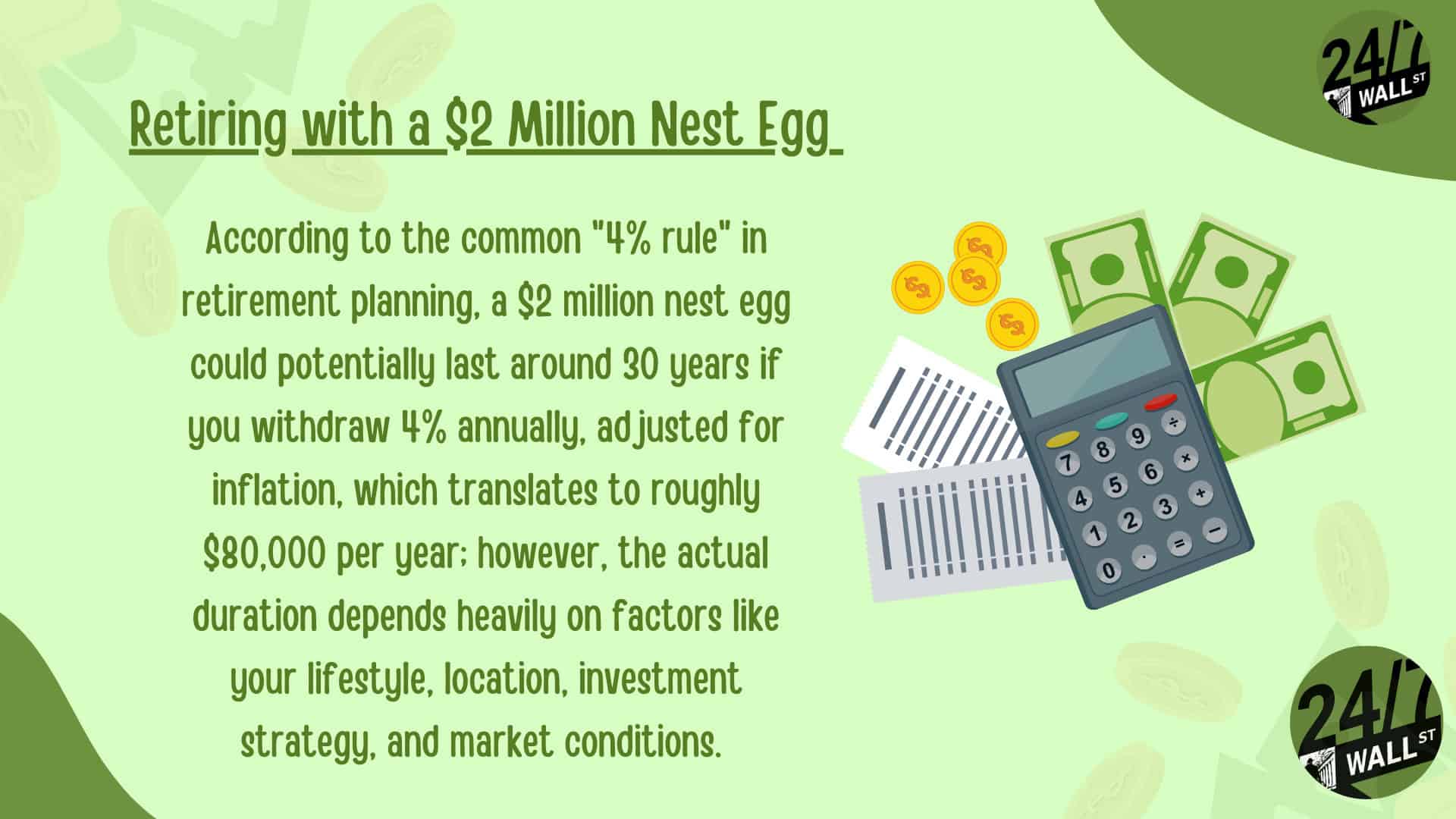
In the context of early retirement, it often makes sense to look past the standard 4% rule and apply a more conservative withdrawal rate. With $3.6 million, a 3% withdrawal rate yields $108,000 per year before inflation adjustments, providing meaningful living expenses while leaving the portfolio room to compound through market cycles.
Retiring at 52 exposes a portfolio to serious sequence-of-returns risk. A market downturn in the first few years can permanently impair a nest egg in ways that later recoveries cannot fully repair. One practical solution is building a three-to-five-year buffer of cash and short-term Treasuries to fund early distributions. That cushion gives the core equity portfolio time to ride out downturns without being drawn down at the worst possible moment.
A 52-year-old also needs to navigate IRS distribution penalties carefully. Accessing traditional retirement accounts before age 59.5 without a 10% penalty requires tools like IRS Section 72(t) Substantially Equal Periodic Payments (SEPP) or a Roth IRA conversion ladder. The ladder moves pre-tax funds into Roth accounts and allows tax-free withdrawals after a five-year seasoning period. Before leaving the workforce, maximizing contributions is worth the effort. The annual 401(k) contribution limit is $24,500 for 2026, and workers age 50 or older can contribute an additional $8,000 as a catch-up, for a total of $32,500. Workers ages 60 to 63 can go further: SECURE 2.0 provides a “super catch-up” of $11,250 available in lieu of the standard $8,000, bringing their maximum to $35,750. One important 2026 wrinkle affects high earners who made more than $150,000 in FICA wages in 2025. They are now required to route catch-up contributions into a Roth account rather than a traditional pre-tax account, a permanent SECURE 2.0 change that affects both the tax benefit and the account structure for last-mile savers.
The healthcare bridge and the 2026 subsidy cliff
Health insurance ranks among the largest and most unpredictable costs for early retirees, and the landscape shifted sharply in 2026. Enhanced premium tax credits that had kept Affordable Care Act marketplace plans affordable since 2021 expired at the end of 2025, and Congress did not renew them. KFF reported that average monthly premiums for all marketplace enrollees rose 58%, from $113 to $178 per month. That increase, while steep, came in below KFF’s earlier projection of 114%, because millions of enrollees responded by shifting from silver plans to lower-premium, higher-deductible bronze plans. Bronze plan share jumped from 30% to 40% of all plan selections between 2025 and 2026 as a direct result. The average marketplace deductible climbed 37%, from $2,759 in 2025 to a record $3,786 in 2026, the steepest single-year increase in the program’s history. Total effectuated enrollment is projected to fall to roughly 17.5 million people in 2026, and potentially as low as 16.5 million, down from 22.3 million in 2025.
The picture may not stabilize quickly. ACA Marketplace insurers are already proposing a median premium increase of roughly 15% for 2027, according to the Peterson-KFF Health System Tracker, partly because the exodus of healthier enrollees in 2026 left behind a costlier risk pool. For an early retiree facing a 13-year gap before Medicare eligibility, that trajectory underscores just how important active income management is over the entire healthcare bridge period.
The 400% Federal Poverty Level subsidy cliff returned with the expiration of those enhanced credits. Households with income above $62,600 for a single person or $84,600 for a couple in 2026 lose all federal subsidy eligibility. Exceeding that threshold by even a dollar eliminates every dollar of premium assistance, and the financial jump is stark: a 60-year-old earning just over the cliff threshold pays roughly $1,244 per month for coverage, compared with about $515 per month for someone just below it, according to KFF modeling cited by CNBC.
The income-management strategy available to early retirees remains valuable despite the tighter rules. Because ACA eligibility for premium tax credits is based on modified adjusted gross income rather than total assets, a retiree can draw from Roth accounts, return of principal, or carefully timed capital gains to keep taxable income below the subsidy threshold. Health Savings Account contributions reduce income for subsidy-eligibility purposes, making HSA funding a particularly useful tool for those still working before retirement. Balances accumulated before leaving work can then cover out-of-pocket medical expenses in early retirement, letting the investment portfolio compound untouched through the gap years before Medicare kicks in at 65.
Don’t be afraid to get help
If you’re 52 with $5 million in assets, you have clearly done something right. That success does not eliminate the value of professional guidance. A financial planner can model what an immediate retirement looks like across different market and longevity scenarios and recommend an asset allocation that sustains growth without taking on unnecessary risk.
After running the numbers carefully, you may find that retiring at 52 is entirely feasible. You may also find that staying in some form of productive work for a few more years, whether in a full-time role or as a fractional consultant, could strengthen your position considerably. The Northwestern Mutual study found that Americans with a financial advisor plan to retire at 63.7 on average, roughly two and a half years earlier than those without one, who target age 66.1. Additionally, 74% of people who work with an advisor feel confident they will be financially prepared for retirement, compared to just 43% of those without one. The goal in either case is a retirement plan you can execute with real confidence, one that holds up not just on paper but across whatever markets and healthcare costs the next four decades may bring.
Editor’s note: This article has been updated to add context on 2027 ACA Marketplace premium projections, with Peterson-KFF Health System Tracker data showing insurers are proposing a median increase of roughly 15% for 2027 following the sicker risk pool left after healthier enrollees exited in 2026. The article’s existing 2026 ACA figures, 401(k) contribution limits, and Northwestern Mutual survey statistics were all verified against primary sources and are unchanged.
Contact [email protected] for any questions or corrections.
Maurie Backman has more than a decade of experience writing about financial topics, including retirement, investing, Social Security, and real estate. Her work has appeared on sites that include The Motley Fool, USA Today, U.S. News & World Report, The Washington Post, and Kiplinger.
Prior to becoming a full-time financial writer, Maurie worked in the financial industry trading distressed debt. She then changed course and spent a few years designing electronic toys. After a stint in content marketing and UX, she shifted back into writing and has since covered everything from the housing market to estate planning to Medicare.
When she's not busy writing, Maurie can be found hiking, walking her dogs, driving her kids to their various sports practices and games, and curling up with a good book. She cooks on occasion and bakes way too often.