Retirees: A Corporate Bond ETF Returned 10% While Paying Monthly Income All Year
When investment-grade corporate bonds deliver monthly income while rates remain elevated, the question is whether the total package justifies a portfolio allocation. iShares iBoxx $ Investment Grade Corporate Bond ETF (NYSEARCA:LQD) answers with over 3,000 bonds, monthly distributions, and returns…

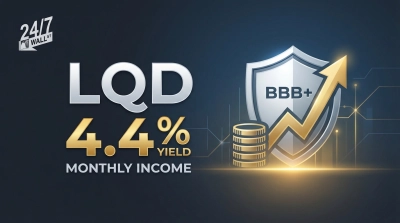
When investment-grade corporate bonds deliver monthly income while rates remain elevated, the question is whether the total package justifies a portfolio allocation. iShares iBoxx $ Investment Grade Corporate Bond ETF (NYSEARCA:LQD) answers with over 3,000 bonds, monthly distributions, and returns extending beyond its headline yield.
How LQD Generates Income
LQD achieves its diversification by tracking the Markit iBoxx USD Liquid Investment Grade Index, which requires every bond to maintain a BBB- rating or better. This quality threshold ensures the fund stays within investment-grade territory while still accessing over 3,000 individual bonds. The result is a portfolio where no single issuer dominates—the top 10 holdings represent just 2.8% of assets, spreading credit risk across hundreds of companies from financials to industrials.
The fund generates monthly distributions averaging $0.41 per share from the coupon income of its underlying bonds. This creates predictable cash flow that differs fundamentally from equity dividends tied to corporate earnings cycles. After accounting for the modest 0.14% expense ratio, the fund’s 30-day SEC yield of 4.91% reflects the income stream investors can expect from holding the ETF.
Total Return Tells the Full Story
The past year demonstrated how LQD’s value extends beyond its yield alone. Total returns exceeded 10% as bond valuations recovered from the 2022-2023 rate shock, with monthly income combining with price appreciation to outpace the broader bond market’s 8.8% gain. This performance shows how corporate credit can deliver both income and capital appreciation when market conditions align.
Price gains reflect tightening credit spreads and stabilizing rate expectations. As Seeking Alpha analyst Trapping Value noted in December 2025, “The fund is a solid choice for those trying to stay away from the equity bubble.” While the analyst suggested individual bond selection could yield better opportunities, the comment underscores LQD’s role as a diversified core holding for investors seeking corporate credit exposure without single-issuer risk.
The Tradeoffs Investors Accept
Duration risk represents LQD’s primary vulnerability. The fund’s eight-year effective duration creates meaningful rate sensitivity—a scenario where rates rise 1% could erase roughly 8% of the fund’s value, potentially offsetting multiple months of income distributions. This mathematical relationship between rates and bond prices makes timing and rate outlook critical considerations.
The fund’s exposure to BBB-rated debt—the lowest tier of investment-grade bonds—creates a tradeoff between yield and credit quality. These securities offer higher yields than AA or AAA debt precisely because they sit closer to junk status and face greater downgrade risk during economic stress. The banking sector’s significant presence in the portfolio amplifies this concern, as financial sector headwinds could trigger rating downgrades that push bonds below investment-grade thresholds.
Who Should Avoid LQD
Investors with short time horizons or those who cannot tolerate interim price volatility should look elsewhere. Duration risk makes LQD unsuitable for cash management or near-term liquidity needs. Retirees depending on stable principal values may find price swings disruptive, even if income remains consistent.
Consider VCIT for Lower Costs
Vanguard Intermediate-Term Corporate Bond ETF (NASDAQ:VCIT) offers comparable investment-grade corporate bond exposure with two key advantages: a significantly lower expense ratio of 0.03% versus LQD’s 0.14%, and similar yield of 4.77%. The cost difference compounds meaningfully over multi-year holding periods.
VCIT holds over 2,000 bonds with intermediate-term maturities, providing slightly less duration risk than LQD’s eight-year profile. For investors seeking corporate bond exposure with lower annual costs and modestly reduced rate sensitivity, VCIT presents a credible alternative.
LQD delivers reliable monthly income backed by investment-grade corporate debt, but its duration risk and BBB concentration require investors to accept meaningful price volatility in exchange for that yield.
Contact [email protected] for any questions or corrections.
I am a long time investor and student of business, and believe finding good companies that can become great investments is the best game on earth. After 20 years of writing and researching the public markets it is clear that individuals have never had more tools and information to take control of their financial lives. From ETFs and $0 commissions to cryptos and prediction markets there has never been a greater democratization of access to investing.
I write to help people understand the investments available to them so they can make the best choice for their portfolio, whether they're starting out or looking for income in retirement.