I Have $122,000 In Savings But My Husband Won’t Let Me Pay Off Our $23,000 Debt
Marriage and money rarely align perfectly, especially when childhood experiences shape opposing financial philosophies. When one spouse sees opportunity and the other sees risk in the same cash pile, resolution requires more than math. On a January 2026 episode of…


Marriage and money rarely align perfectly, especially when childhood experiences shape opposing financial philosophies. When one spouse sees opportunity in a cash pile while the other sees security, resolution requires more than a spreadsheet. It requires a conversation about values and fear.
On a January 2026 episode of The Dave Ramsey Show, a caller named Joe from Huntsville brought that tension into sharp relief. The couple had sacrificed for years while she stayed home raising their children, carefully setting aside every spare dollar until they accumulated $122,000. That sum represented security to her husband but felt like wasted potential to Joe. The hidden cost of that security blanket: $23,000 in student loan debt still draining their account month after month.
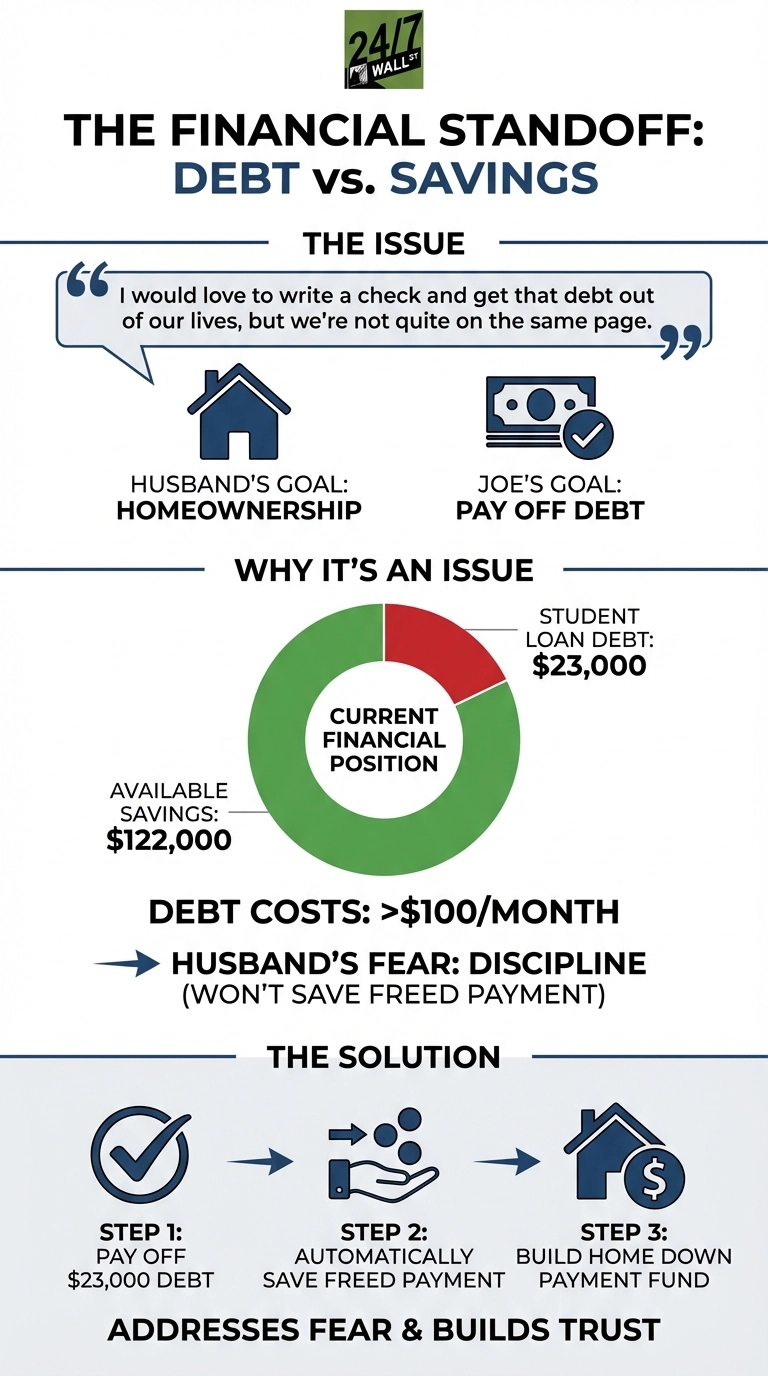
“I would love to write a check and get that debt out of our lives, but we’re not quite on the same page,” Joe explained. “My husband’s not comfortable with that yet because we’re not homeowners.”
Rachel Cruze identified the core issue. “He’s wanting to be a homeowner, which is one of the largest financial purchases you ever make,” she said. “He wants to do that big thing first before paying off debt.”
Joe had mapped out a path forward that addressed both goals: eliminate the debt draining them every month, put down enough on a home to avoid private mortgage insurance, and keep enough cash on hand to handle emergencies. “That would leave us pretty comfortable,” she said. Her husband’s real fear centered on discipline: “That we wouldn’t actually save” the freed-up monthly payment. When Cruze asked about his upbringing, Joe revealed his family “spoke about money very often except during tight financial seasons,” a pattern that explained his anxiety about watching their cash reserves decline.
That anxiety is more common than many couples realize. According to Ramsey Solutions’ own research, money is the number one issue married couples argue about, and a quarter of couples in Fidelity’s 2024 Couples and Money study named it their greatest relationship challenge. A Bankrate survey published in January 2026 found that 40% of Americans in committed relationships admit to some form of financial infidelity with their current partner, with hidden purchases and undisclosed credit card debt leading the list of secrets. Joe and her husband were at least arguing openly, which puts them in better shape than many.
Where the Advice to Pay Off Debt First Holds Up
The math strongly favors Joe’s position. Their student loan debt was costing the family more than $100 every month, money that could never be recovered once spent on interest. Eliminating that $23,000 obligation would immediately free up that cash flow, turning payments that vanished into the lender’s pocket into dollars that could be routed toward a down payment fund instead.
The down payment question is worth spelling out clearly. Lenders require private mortgage insurance on conventional loans when a buyer puts down less than 20% of the purchase price, and that insurance typically runs between 0.3% and 1.5% of the loan amount per year. On a median-priced home, that adds hundreds of dollars to the annual cost of ownership for no direct benefit to the borrower. With $122,000 in savings and the $23,000 debt gone, this couple would have the reserves to clear that 20% threshold on a modestly priced home in their market while still keeping a comfortable emergency cushion. They would not be stretching thin. They would be optimizing.
Where the Situation Needs Context
The husband’s discipline concern is not irrational. Research consistently shows that households eliminating debt often treat the freed cash flow as license to spend rather than a redirected savings stream. Without automated transfers in place on day one, monthly payments can quietly migrate toward subscriptions and dining out. The U.S. personal saving rate slid from 6.2% in early 2024 to 4.0% in the first quarter of 2026, a sign that discretionary spending tends to expand whenever cash loosens up.
Housing market timing adds another layer. The husband’s homeownership goal is not without urgency: the FHFA House Price Index shows U.S. home prices rose 1.7% between the first quarter of 2025 and the first quarter of 2026. That said, J.P. Morgan Global Research projects national home price growth will stall near 0% through the rest of 2026, and the 30-year fixed mortgage rate sits around 6.4%. The argument that waiting will cost them heavily in appreciation looks weaker in 2026 than it would have in 2021 or 2022. Taking a few months to retire the debt is unlikely to push them out of reach of the market, particularly in a mid-size city like Huntsville where prices have remained more accessible than coastal metros.
Options This Couple Might Consider
This standoff is really about trust, not math. The husband’s childhood scarcity created a fear that deserves acknowledgment, not dismissal. Joe’s instinct to eliminate the debt is financially sound, but the path forward requires buy-in from both partners, and buy-in requires a concrete plan rather than a verbal promise.
One practical approach is combining the debt payoff with automated accountability. On the same day the student loan check clears, set up an automatic transfer equal to that freed monthly payment into a dedicated home savings account. Both spouses receive the bank notifications. The discipline question becomes structural rather than a matter of willpower, which addresses the husband’s concern directly. Rachel Cruze has noted that zero-based budgeting, where every dollar is assigned a job before the month begins, is the tool that keeps freed cash flow from disappearing. Naming the freed payment “home fund” in the budget removes the temptation entirely.
Setting a firm home purchase target date also matters. A specific goal with a visible savings meter is more compelling than a vague intention. Financial decisions made from fear often cost more in the long run than the risks being avoided. For this couple, the real risk is not paying off the debt. The risk is letting the disagreement fester while $100 or more drains out every single month with nothing to show for it.
Editor’s note: This article was updated to include the current U.S. median home price (Redfin, May 2026), the FHFA House Price Index showing 1.7% annual appreciation through Q1 2026, J.P. Morgan’s 2026 housing price forecast, the PMI cost range of 0.3% to 1.5% annually, the Bankrate January 2026 finding that 40% of Americans in committed relationships admit to financial infidelity, and the decline in the U.S. personal saving rate to 4.0% in Q1 2026.
Contact [email protected] for any questions or corrections.
I am a long time investor and student of business, and believe finding good companies that can become great investments is the best game on earth. After 20 years of writing and researching the public markets it is clear that individuals have never had more tools and information to take control of their financial lives. From ETFs and $0 commissions to cryptos and prediction markets there has never been a greater democratization of access to investing.
I write to help people understand the investments available to them so they can make the best choice for their portfolio, whether they're starting out or looking for income in retirement.