Invesco’s RAFI ETF Has One of The Best Charts I’ve Seen This Year
The Invesco RAFI Developed Markets ex-U.S. ETF (NYSEARCA:PXF) has delivered one of the most impressive runs in international equity markets over the past year. This wasn’t a volatile momentum spike that reversed course. Instead, the rally unfolded with remarkable consistency,…

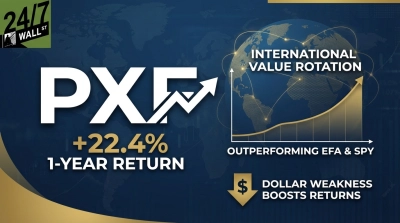
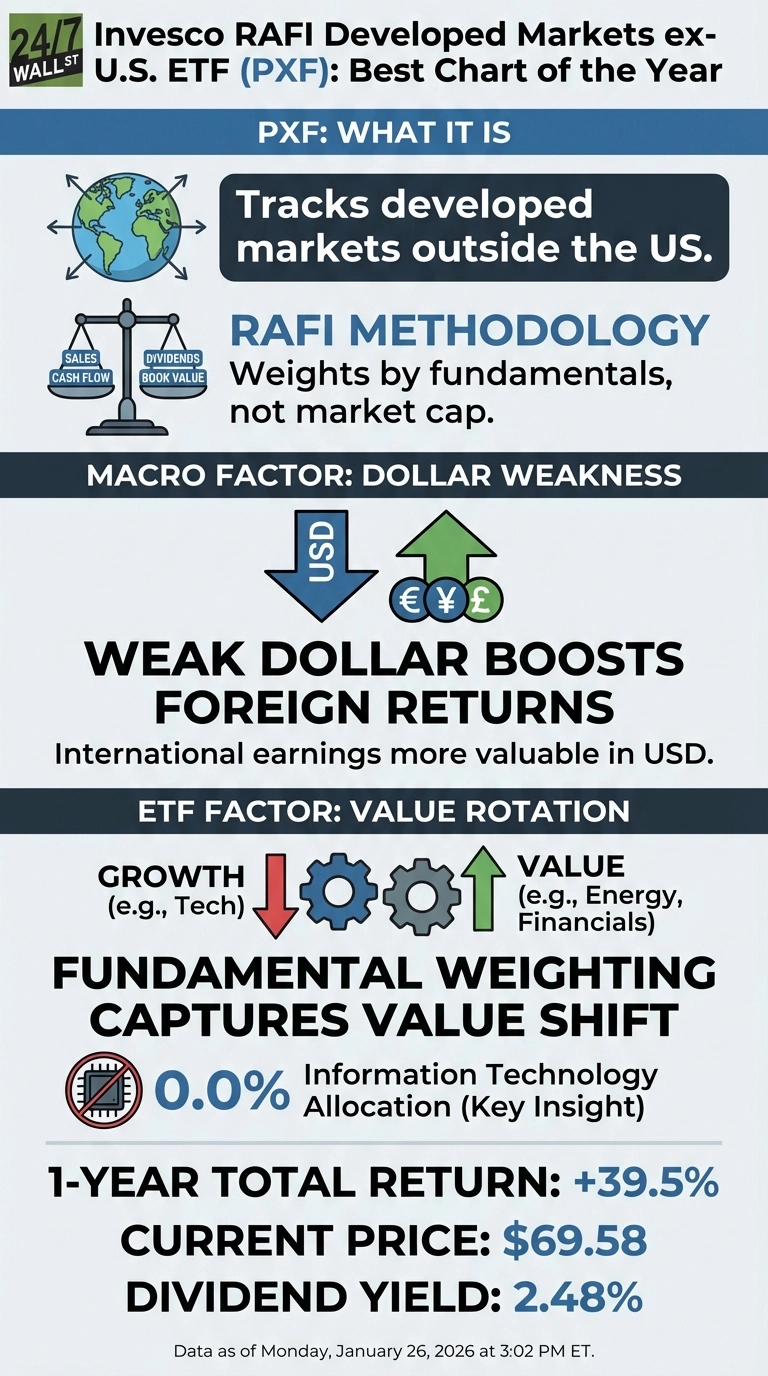
The Invesco RAFI Developed Markets ex-U.S. ETF (NYSEARCA:PXF) has delivered one of the most impressive runs in international equity markets over the past year. This wasn’t a volatile momentum spike that reversed course. Instead, the rally unfolded with remarkable consistency, delivering a 22.4% return over the past year with a maximum drawdown of only 8.3%, reflecting sustained demand for international value exposure as investors rotated away from expensive U.S. growth stocks.
PXF’s fundamental weighting methodology created a natural advantage during the international rotation. The fund returned 22.4% over the past year, outperforming the iShares MSCI EAFE ETF (NYSEARCA:EFA) which returned 18.7% over the same period. The approach automatically tilted the portfolio toward value sectors like financials and energy, which became the market leaders as investors rotated away from expensive U.S. growth stocks. The SPDR S&P 500 ETF Trust (NYSEARCA:SPY) returned 19.2% over the same period, underscoring how dramatically the leadership shifted away from U.S. mega-cap technology.
The Dollar Dynamic Driving International Returns
A major factor supporting international equity performance is dollar weakness. When the U.S. dollar declines against major currencies like the euro, yen, and pound, international stocks get a tailwind from currency translation. For U.S. investors, foreign earnings become more valuable when converted back to dollars. This dynamic has been particularly powerful as markets price in Federal Reserve rate cuts and a narrowing interest rate differential between the U.S. and other developed economies.
Watch the DXY Dollar Index for confirmation of this trend. If the dollar continues weakening, international developed markets should maintain their advantage. The Federal Reserve’s monthly policy statements and quarterly economic projections provide insight into rate trajectory, which directly influences currency movements. A sustained dovish stance would support continued dollar weakness and benefit international holdings.
Fundamental Weighting Captures the Value Rotation
The RAFI methodology weights companies based on their fundamental business strength rather than market capitalization. By focusing on metrics that reflect actual business value, the approach naturally identifies cash-generative companies in sectors like financials and energy while avoiding overvalued growth stocks. This fundamental lens explains why the fund was positioned perfectly for the value rotation.
The fund’s top holdings reveal why fundamental weighting worked so well during this rotation. Cash-generative businesses in sectors like technology, energy, and financials score highly on the RAFI metrics of sales, cash flow, and dividends. As investors shifted capital toward these value characteristics and away from expensive growth stocks, PXF’s methodology positioned the fund perfectly to capture the trend.
The combination of dollar weakness and value outperformance has created an ideal environment for fundamentally-weighted international exposure, making this dynamic the key factor to watch over the next year.
Contact [email protected] for any questions or corrections.
I am a long time investor and student of business, and believe finding good companies that can become great investments is the best game on earth. After 20 years of writing and researching the public markets it is clear that individuals have never had more tools and information to take control of their financial lives. From ETFs and $0 commissions to cryptos and prediction markets there has never been a greater democratization of access to investing.
I write to help people understand the investments available to them so they can make the best choice for their portfolio, whether they're starting out or looking for income in retirement.