Why Investors Rewarded Meta and Tesla But Punished Microsoft Despite Revenue Beat
Three mega-cap tech companies reported earnings on Wednesday, and the market’s verdict was swift and brutal for one company while two Magnificent 7 members received stamps of approval. Microsoft (NASDAQ:MSFT | MSFT Price Prediction) beat estimates with $4.14 in adjusted…

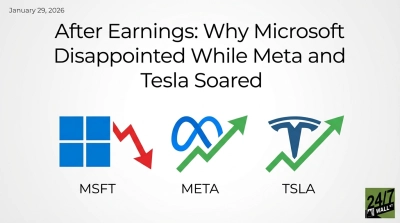
Three mega-cap tech companies reported earnings on Wednesday, and the market’s verdict was swift and brutal for one company while two Magnificent 7 members received stamps of approval.
Microsoft (NASDAQ:MSFT | MSFT Price Prediction) beat estimates with $4.14 in adjusted earnings. Meta (NASDAQ:META) crushed expectations with $8.88 EPS versus $8.18 estimated, rallying 9% in a week. Tesla (NASDAQ:TSLA) reported collapsing profits (earnings down 37% year-over-year to just $1.37 billion) yet held steady on robotaxi dreams. Yet, of the three, only Microsoft shares plummeted.
The divergence reveals everything about what the market will tolerate in 2026.
Microsoft’s Execution Problem
Microsoft saw its biggest one-day decline since the Covid crash on Thursday. Headline figures were great. Adjusted earnings of $4.14 easily topped Wall Street’s estimates. Revenue also topped expectations.
So, why did shares crash the next day? Azure growth came in at 39% with a forecast for similar growth rates next quarter. That came in slightly below Wall Street’s forecasts. Widely followed independent researchers such as Semi Analysis had forecast Microsoft seeing Azure growth rates that could reach as high as 54% in late calendar 2026. Investors see Azure as Microsoft’s future, and now the company is underperforming lofty growth expectations that have been building across Wall Street.
The unfortunate reality is that Microsoft is now facing a kind of “prisoner’s dilemma.” If it uses compute capacity for its own products, it takes away from Azure’s growth. Yet, if it devotes more compute to Azure it risks lower growth in Copilot and its valuable franchises such as its Office suite getting disrupted by the very companies its renting Azure capacity to.
Microsoft briefly took its foot off the pedal on AI spending in early 2025 and is now suffering the consequences. Azure can’t grow to the rates Wall Street expected because it doesn’t have the capacity.
Meta hasn’t taken its foot off the pedal, and Wall Street just rewarded the company in a much different way than Microsoft.
Meta’s Profitability Proof Point
Meta delivered what Microsoft couldn’t: proof that AI investments are paying off now. The company’s 8.6% earnings surprise came with 26% revenue growth and operating margins of 41%. Reality Labs still bleeds cash, but Meta’s core advertising business is printing money thanks to AI-driven targeting improvements.
What’s the difference between Meta and Microsoft? For starters, Meta is showing that its investments into AI are leading to revenue acceleration. The company forecast 30% growth next quarter. As I noted earlier, Microsoft is in a tough position where its significantly constrained on compute needed to provide revenue acceleration for products like Copilot and its Office suite. Meta spent the past year building a narrative that would allow it to both pursue superintelligence (via building frontier models) AND having enough compute capacity to accelerate growth in its core products.
At 28x trailing earnings and 23x forward earnings, Meta trades cheaper than Microsoft despite faster revenue growth.
Tesla’s Narrative Premium
Tesla’s resilience defies fundamental logic. The company trades at 294x trailing earnings with profit margins of 5.3% and earnings down 37% year-over-year. Automotive gross margins of 18% are compressing, not expanding.
Yet the stock holds because Elon Musk sold investors on a robotaxi future that renders current automotive economics irrelevant. At a $1.4 trillion market cap on $95.6 billion in revenue, Tesla’s 15x sales multiple prices in a business model that doesn’t exist yet.
The lesson: investors will fund vision if you’re Tesla, tolerate current profitability if you’re Meta, but punish execution stumbles if you’re Microsoft. The AI gold rush continues, but the market is only trusting certain ‘visions’ for the future.
Contact [email protected] for any questions or corrections.
Eric Bleeker, CFA has been investing for more than 20 years. He began his career working at Microsoft before joining Motley Fool, one of the largest publishers of financial research. In his 15 years at Motley Fool Eric served as the General Manager for Fool.com and led coverage in the Technology & Telecom sector. In addition, he was a featured columnist and has hosted dozens of investing seminars attended by more than a million total investors. Eric has more than 1,000 financial bylines to his name and has been featured in The Wall Street Journal, CNBC, Fox Business, and many other leading publications. He is currently focused on artificial intelligence investing and is a CFA Charterholoder.