Stay-at-Home Mom of 11 Years Faces Financial Abuse During Divorce as Husband Locks Her Out of Accounts
When one spouse controls all the money, divorce becomes a battle for survival. The law protects homemakers, but knowing your rights and enforcing them are different challenges. On a recent episode of The Dave Ramsey Show, a caller described her…


When one spouse controls all the money, divorce transforms from a legal process into a battle for basic survival. The law does protect homemakers, but knowing your rights and actually enforcing them are two very different challenges.
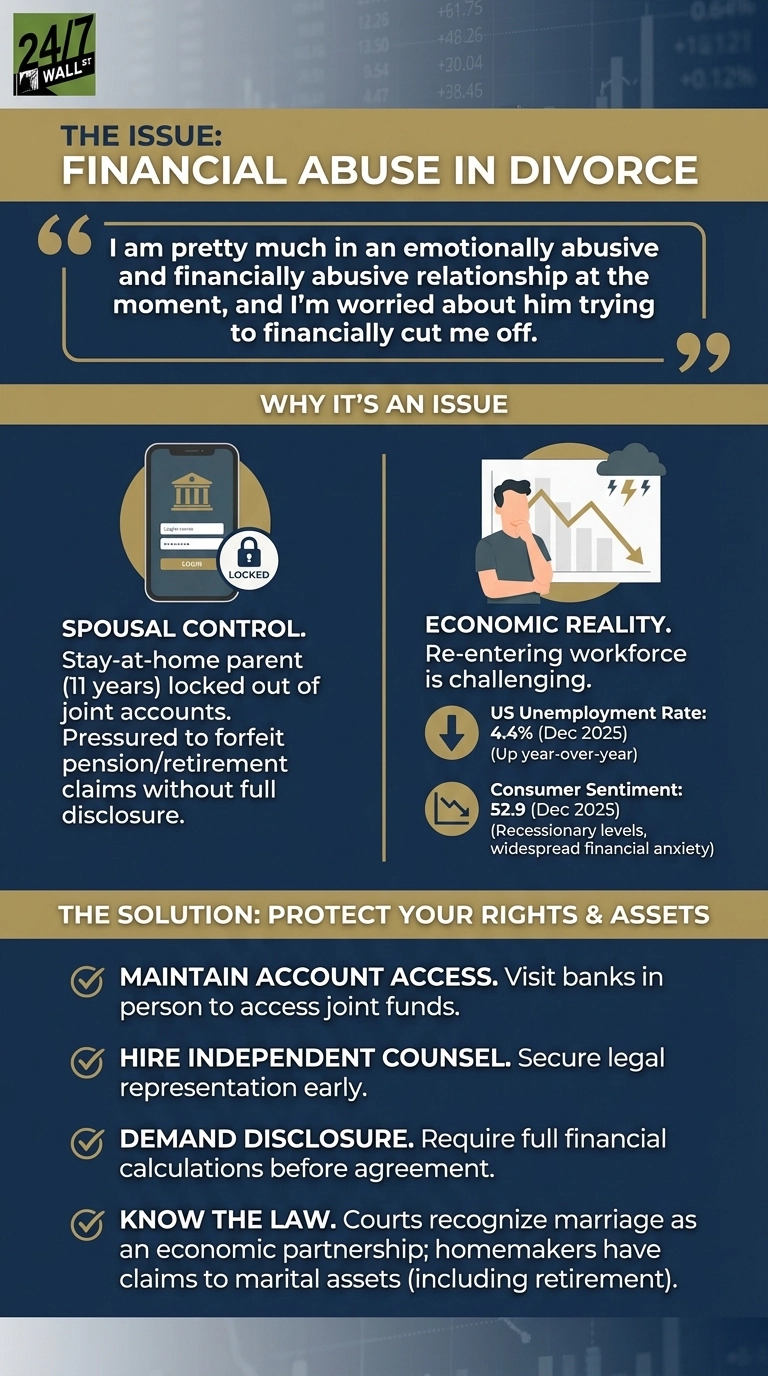
On a recent episode of The Dave Ramsey Show, a caller laid out her situation during divorce proceedings. For 11 years, she had focused on raising three young children while her husband built his career. When she tried to get a clear picture of their finances, she found he had locked her out of their joint banking app entirely. That single act exposed the power imbalance that had defined their marriage.
“I am pretty much in an emotionally abusive and financially abusive relationship at the moment, and I’m worried about him trying to financially cut me off,” she said. His settlement proposal made the manipulation plain: he offered to let her keep the house and receive child support, but only in exchange for surrendering all claims to his pension and retirement accounts built up across their 11-year marriage. “I don’t want to verbally agree to something that I don’t have full calculations in front of me,” she explained.
Ramsey’s co-host directed her to visit the bank in person. Joint accounts remain legally accessible to both account holders regardless of app-level restrictions, and no informal lockout changes that. The caller had already consulted attorneys and filed a petition, placing herself on a clear path toward child support, alimony, and her share of marital retirement assets.
Courts Protect Economic Partnerships
Marriage functions as an economic partnership, and every contribution matters whether it means earning a paycheck or raising the children who make the other spouse’s career possible. Stay-at-home parents who supported a spouse’s professional advancement for more than a decade carry well-established legal claims to marital assets, including every retirement account that grew during the marriage.
Financial abuse in divorce takes several overlapping forms: cutting off access to accounts, hiding assets, or pushing a financially dependent spouse to sign a settlement before any independent legal review. Research shows that economic abuse appears in 94% to 99% of domestic violence cases, making it one of the most pervasive and least visible tools of control. The protective response calls for speed: maintain access to joint accounts, retain independent counsel, and demand complete financial disclosure before any negotiation begins. Only a court order can lawfully restrict a joint account holder’s access.
The Hidden Disparities in Asset Valuation
Courts enforce equitable division regardless of who earned the income. In most states, assets accumulated during a marriage belong to both partners. A pension or 401(k) that grew over 11 years of marriage is marital property, full stop. Surrendering those assets without independent valuation or legal counsel could erase hundreds of thousands of dollars in future retirement security.
Face-value comparisons rarely reflect genuine equality once hidden tax liabilities come into view. A traditional 401(k) holds pre-tax dollars subject to ordinary income tax on every future withdrawal, while home equity represents wealth that has already been taxed. Treating them as equivalent at face value is one of the most common and costly traps in divorce negotiations. The proper instrument for dividing an employer-sponsored retirement plan is a Qualified Domestic Relations Order (QDRO), a court order directing the plan administrator to transfer a defined share of benefits to the former spouse. A correctly structured QDRO avoids the 10% early withdrawal penalty even when the recipient is under 59 and a half.
The Pension Benefit Guaranty Corporation released its QDRO Practical Guide on March 25, 2026, specifically to help participants and former spouses navigate this process. The PBGC’s guide makes the stakes plain: without a valid QDRO that the PBGC has approved, the agency can only pay benefits to the participant, no matter what the divorce decree says about how those benefits should be divided. Failing to secure an approved QDRO before a divorce is finalized can result in the permanent loss of those expected benefits.
The Digital Lockout: Tech-Driven Financial Control
Modern financial abuse increasingly relies on technology to enforce isolation and control. Estimates for 2025 find that roughly 70% of domestic violence survivors report being monitored through phones, GPS trackers, or social media accounts. Beyond banking app exclusions, abusers routinely exploit shared cellular plans, smart home devices, and location-sharing features to track movements or disrupt utilities during a separation. Everyday household technology, from voice-enabled speakers to internet-connected thermostats, can serve as a surveillance tool when a controlling partner retains access.
Breaking free from digital abuse requires a thorough and deliberate reset. Anyone in this situation should change all passwords from a new or unlinked device, revoke biometric data stored on shared hardware, and open entirely separate accounts for all legal correspondence. Any device a controlling partner could have previously accessed should be treated as compromised until independently verified otherwise.
Navigating Workforce Re-entry After a Long Absence
Re-entering the job market after 11 years away is difficult under any circumstances, and the wage data make that concrete. A Bankrate analysis of Census Bureau Current Population Survey data found that full-time working mothers earned a median of $56,680 in 2024, compared to $76,388 for fathers working full time. That 35% gap, which widened from both 2023 and 2022, reflects what researchers call the motherhood penalty. The American Association of University Women reports that full-time employed mothers earn roughly 71 cents for every dollar earned by fathers, a disparity that persists even when controlling for education and occupation.
For someone returning to the labor market after more than a decade away, the starting disadvantage compounds quickly. Hiring research consistently finds that employers read a long parenting gap as a signal of reduced commitment to what scholars call the “ideal worker” standard, making stay-at-home parents less likely to receive offers than both currently employed candidates and those laid off from prior jobs. This is precisely why equitable alimony and a proportional share of marital assets serve as critical financial anchors: they compensate for years of career momentum lost while professional peers advanced. Practical re-entry strategies include corporate returnship programs designed specifically for mid-career candidates, skills-based resume formats that highlight transferable competencies, and remote roles that offer the scheduling flexibility single parents often need.
Emergency Protocols: The First 48 Hours of Separation
Pressure to settle quickly can feel overwhelming when emotions run high, and that urgency is rarely accidental. Advice to “just agree” or “move on fast” almost always benefits the party holding more financial information. Individual circumstances require individual solutions, and those solutions require complete transparency about the full financial picture first.
When an abrupt financial separation looks imminent, three protective steps take priority. First, document all financial holdings immediately by taking screenshots of account balances, investment portfolios, and recent tax returns before access is cut off. Second, open a standalone checking account at a completely separate financial institution, one with no connection to any account the other party can reach. Third, route any incoming personal income or emergency funds directly to that private account to preserve liquidity. Each of these steps is reversible if circumstances improve. Delaying them is not.
Editor’s note: This pass updated the economic-abuse statistic to reflect the full cited range of 94% to 99% across domestic violence cases, replaced an unverified Payscale wage-gap figure with AAUW data showing full-time employed mothers earn roughly 71 cents per dollar earned by fathers, and added detail from the PBGC’s official QDRO guide page clarifying that without an approved QDRO the agency can only pay the participant regardless of what the divorce decree states.
Contact [email protected] for any questions or corrections.
Austin Smith is a financial publisher with over two decades of experience as an investor, analyst, and advisor. He covers stocks, ETFs, Artificial intelligence and personal finance for 24/7 Wall St. Previously, he spent over a decade at The Motley Fool as a senior editor for Fool.com, portfolio advisor for Millionacres, and launched The Ascent to help reader take control of their personal finances.
His work has been featured on Fool.com, NPR, CNBC, USA Today, Yahoo Finance, MSN, AOL, Marketwatch, and many other publications. He is as an advisor to private companies, and co-hosts The AI Investor Podcast with Eric Bleeker.
When not looking for investment opportunities, he can be found skiing, running, or playing soccer with his children. Learn more about Austin's investment approach here.