




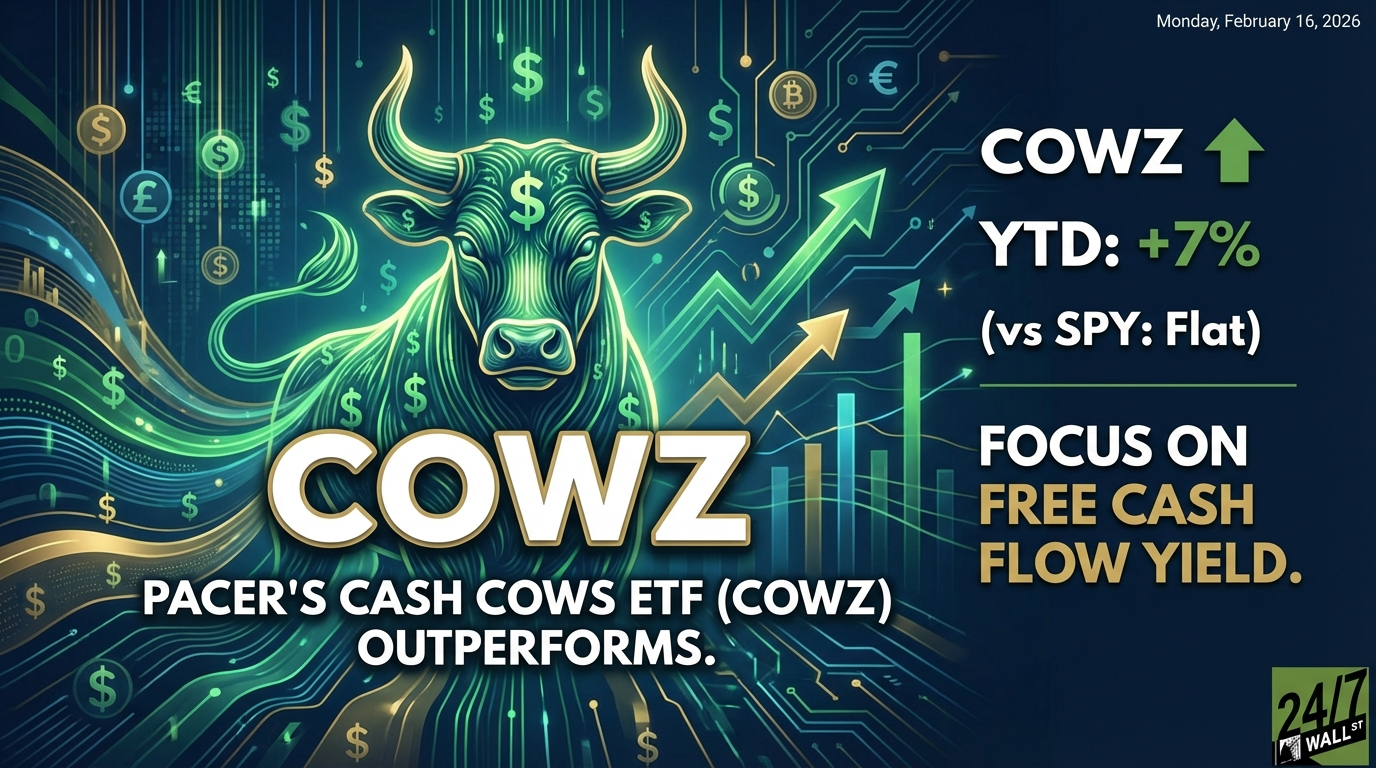
While the S&P 500 (NYSEARCA:SPY) sits flat year-to-date, the Pacer US Cash Cows 100 ETF (NYSEARCA:COWZ) has surged nearly 7%. This shift reflects growing concerns about expensive technology valuations and concentration risk, with the Magnificent Seven trading above 30x earnings on average while comprising over 30% of the S&P 500.
COWZ addresses a specific portfolio problem, exposure to profitable, cash-generative businesses trading at reasonable valuations. The ETF screens the Russell 1000 (NYSEARCA:IWB) for the 100 stocks with the highest free cash flow yield, then holds them in equal weight. It’s a quality value strategy that prioritizes companies converting revenue into cash shareholders can actually use.
The return engine is straightforward: businesses with strong free cash flow can fund dividends, buy back shares, pay down debt, or reinvest for growth without relying on external financing. This capability matters more now than during the zero-rate era.
With the Federal Funds rate at 3.75% and the 10-year Treasury yielding 4.09%, companies that generate cash internally gain a competitive advantage. They avoid expensive external financing while delivering returns that compete directly with fixed income alternatives.
This cash flow focus naturally tilts the portfolio toward sectors generating cash today rather than speculative growth bets. Healthcare represents 22.3% of holdings while Energy accounts for 18%, fboth sectors known for mature businesses with established revenue streams.
COWZ’s cash flow focus delivered nearly 20 percentage points of outperformance over five years, driven by a fundamental market shift. As the Fed’s aggressive rate hiking cycle made capital more expensive, investors abandoned the unprofitable growth companies that dominated 2020-2021 and rotated into businesses with proven profitability and strong balance sheets.
The fund holds mature businesses like Exxon Mobil (NYSE:XOM | XOM Price Prediction), Chevron (NYSE:CVX), Gilead Sciences (NASDAQ:GILD), and Merck (NYSE:MRK) – companies throwing off cash rather than burning it. With $18.3 billion in assets under management and just 1.51% portfolio turnover, COWZ demonstrates institutional validation while keeping trading costs low through a disciplined buy-and-hold approach.
The fund charges a 0.49% expense ratio, higher than broad market ETFs but reasonable for an actively screened strategy that rebalances to maintain its cash flow focus.
The 1.8% dividend yield presents a trade-off for income investors. With 10-year Treasuries currently yielding 4.09%, COWZ requires meaningful equity appreciation to justify both the yield gap and the additional risk inherent in stocks versus risk-free government bonds.
Sector concentration also creates volatility: energy’s surge drove much of the recent outperformance, but that cuts both ways when oil prices fall. The healthcare and energy tilt means COWZ moves differently than broad market indexes during sector rotations.
COWZ’s cash flow methodology and equal-weight approach position it as a quality value strategy, though the lower dividend yield and sector concentration create specific risk-return characteristics investors should consider the total return profile to appreciate what a gem COWZ may be in their portfolio. With today’s tech heavy and stretched valuation environment, I’m a buyer.
Contact [email protected] for any questions or corrections.













 Top Gaining Stocks
 Top Losing Stocks