Is This Eos Energy’s First Step Toward Repairing Investor Trust?
Investors in Eos Energy Enterprises (NASDAQ: EOSE) felt a profound sense of betrayal last week when the company unveiled its fourth-quarter and full-year 2025 results. The numbers fell dramatically short of the guidance provided just two months earlier during the…

Investors in Eos Energy Enterprises (NASDAQ: EOSE) felt a profound sense of betrayal last week when the company unveiled its fourth-quarter and full-year 2025 results. The numbers fell dramatically short of the guidance provided just two months earlier during the Q3 earnings call in early November, where management had narrowed the full-year revenue outlook to a baseline of $150 million to $160 million. This came only weeks before Eos raised substantial capital — $600 million in convertible notes and $458 million in stock sales — without any indication that the business was deteriorating.
With no prior warnings of operational collapse, the stock cratered 39% in a single trading session, erasing over $1 billion in market value and leaving shareholders questioning management’s credibility. Now, the CEO appears to be initiating efforts to rebuild that eroded trust in the energy storage firm.
Still Smarting From Rug Burns
Eos Energy’s 2025 full-year revenue came in at $114.2 million, representing a staggering 700% year-over-year growth but still missing the low end of its own $150 million guidance by a wide margin. Wall Street had anticipated around $155 million, making the shortfall even more pronounced. Fourth-quarter revenue reached a record $58 million, up 90% sequentially and 700% from the prior year, driven by scaled production and a 609% increase in customer deliveries. However, the company reported a net loss of $969.6 million for the year, heavily influenced by $746.8 million in non-cash items, and an adjusted EBITDA loss of $219.1 million.
The previous earnings call occurred about four weeks into Q4, with management reiterating confidence in hitting the targets and highlighting a strong backlog of $644.4 million at the time. Just three weeks later, in mid-November, Eos completed its massive fundraising at $12.78 per share for the stock portion, signaling apparent strength and no hints of trouble ahead.
Yet, when the actual figures emerged, the earnings per share loss ballooned to $0.84 against expectations of $0.24, shocking the market. The stock, which had traded around $12 before the report, plunged to approximately $6.74 per share by the close.
Management attributed the revenue miss to challenges that materialized late in the quarter, expressing disappointment while emphasizing operational progress like efficiency gains, automation enhancements, and a growing commercial pipeline of $23.6 billion. Adjusted gross margins improved by 230 points year-over-year, and the backlog expanded to $701.5 million, but these positives were overshadowed by the failure to meet guidance.
For 2026, Eos initiated revenue guidance of $300 million to $400 million, aiming for disciplined scaling and margin improvements, but analysts noted this fell short of some expectations, further fueling skepticism.
A Vote of Confidence from the CEO
Amid the fallout, CEO Joe Mastrangelo has signaled his continued faith in Eos Energy’s future. Yesterday, he purchased 60,000 shares of Eos stock at an average price of $5.75 per share, totaling $345,000. This open-market buy increased his direct ownership to 1,46 million shares, valued at approximately $8.4 million. Coming just days after the earnings debacle, it was potentially aimed at demonstrating alignment with shareholders and optimism about the company’s trajectory.
Legendary investor Peter Lynch once observed that insiders might sell shares for any reason, but they typically buy for just one: belief that the stock price will rise. Insider purchases like Mastrangelo’s are often viewed as bullish indicators, suggesting executives see undervaluation or upcoming catalysts.
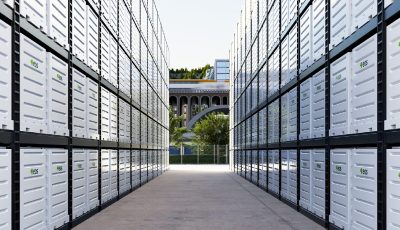
In Eos’s case, this could point to confidence in the company’s zinc-based long-duration energy storage technology, which addresses growing demand from utilities, data centers, and industrial clients. With a pipeline exceeding 91 gigawatt hours (GWh) and recent milestones like launching Indensity and achieving 2 GWh annualized capacity, Mastrangelo’s action underscores potential despite recent setbacks.
However, this buy contrasts with insider activity in December 2025, where several executives and directors sold shares, some tied to exercising options. Such transactions are common for liquidity but can raise eyebrows amid volatility.
Key Takeaways
Mastrangelo’s $345,000 investment isn’t enormous in absolute terms, especially for a company with a $2 billion market cap, but it’s meaningful given his existing 1.46 million shares. It helps align management’s interests with those of shareholders, potentially signaling that the post-earnings dip around $6 (down from pre-earnings levels near $12) represents a buying opportunity. Yet, it doesn’t fully mend the trust breach from the guidance miss and “rug pull” sentiment.
Eos operates in a niche with limited competition for zinc-based LDES systems, positioning it well for long-term growth in renewables and grid stability. While EOSE could evolve into a compelling buy, it’s premature at current levels. For now, this CEO purchase is a positive first step, but rebuilding faith will require consistent delivery.
Contact [email protected] for any questions or corrections.
After two decades of patrolling the dark corners of suburbia as a police officer, Rich Duprey hung up his badge and gun to begin writing full time about stocks and investing. For the past 20 years, he’s been cruising the markets looking for companies to lock up as long-term holdings in a portfolio while writing extensively on the broad sectors of consumer goods, technology, and industrials. Because his experience isn’t from the typical financial analyst track, Rich is able to break down complex topics into understandable and useful action points for the average investor. His writings have appeared on The Motley Fool, InvestorPlace, Yahoo! Finance, Money Morning, and, of course, 24/7 Wall St. He has been featured in both U.S. and international publications, including MarketWatch, Financial Times, Forbes, Fast Company, and USA Today.