Roundhill’s 50% Yield Innovation-100 ETF Is Waiting To Step on A Landmine
Roundhill Innovation-100 0DTE Covered Call Strategy ETF (CBOE:QDTE) was built for a specific type of investor: someone who wants meaningful income from tech exposure without simply riding the Nasdaq up and down. The fund sells zero-days-to-expiration covered calls on the…

This post may contain links from our sponsors and affiliates, and Flywheel Publishing may receive compensation for actions taken through them.

Roundhill Innovation-100 0DTE Covered Call Strategy ETF (CBOE:QDTE) was built for a specific type of investor: someone who wants meaningful income from tech exposure without simply riding the Nasdaq up and down. The fund sells zero-days-to-expiration covered calls on the Innovation-100 Index each morning, collects the premium, and distributes it weekly. With roughly $927 million in assets and a strategy that has attracted a devoted income-seeking following, QDTE has delivered. But the architecture of the fund creates a specific landmine that most holders are not thinking about clearly.
The covered call premium cushions losses slightly on bad days. It does not stop them. And the holdings underneath this fund are not your average blue chips sitting quietly in a portfolio. They are some of the most volatile, highest-multiple, binary-outcome names in the market.
The Upside Cap Does Not Come With a Downside Floor
The primary risk facing QDTE is straightforward but easy to underestimate: the fund’s underlying holdings can fall sharply, and the daily options premium collected does almost nothing to offset a serious drawdown. Selling a 0DTE covered call generates a small amount of daily income. It does not generate a hedge. If a core holding drops sharply in a week, a few days of premium income will not make a dent.
Strategy / MicroStrategy (MSTR)
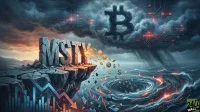
Consider what is actually sitting in this fund. Strategy (NASDAQ:MSTR | MSTR Price Prediction), formerly MicroStrategy, is essentially a leveraged bitcoin vehicle. In Q4 2025, the company reported a net loss of $12.44 billion, driven almost entirely by a $17.44 billion unrealized loss on its bitcoin holdings. The company holds 713,502 bitcoins, and every meaningful move in bitcoin price flows directly into the stock. MSTR has already fallen 46.78% over the past year, and bitcoin itself has traded as low as $65,769 in early March 2026 after touching nearly its recent highs in late 2025. Polymarket traders currently price a 65.5% probability that bitcoin dips to $55,000 before year end. If that happens, MSTR would almost certainly crater, and QDTE’s daily call premium would be irrelevant noise against the NAV destruction.
Palantir (PLTR)
Then there is Palantir (NASDAQ:PLTR). The company posted genuinely strong Q4 2025 results, with revenue growing 70% year-over-year to $1.41 billion and a Rule of 40 score of 127%. But the stock trades at a trailing price-to-earnings ratio of around 234x and a price-to-sales ratio of nearly 79x. At that valuation, the margin for error is essentially zero. Any guidance miss, government contract reduction, or macro sentiment shift can trigger a violent repricing. Palantir’s own insiders have been selling aggressively, with CEO Alexander Karp and multiple other executives liquidating large positions on February 20, 2026, at prices between $132 and $136, well below where the stock had been trading just weeks earlier. Palantir is down 13.82% year-to-date through March 4.
Tesla (TSLA)
Tesla (NASDAQ:TSLA) adds a different flavor of risk. Vehicle deliveries fell 16% year-over-year in Q4 2025 to 418,227 units, and automotive revenue declined 11%. The stock sits at a trailing P/E of 370x, which requires an enormous amount of future growth to justify. Kalshi prediction markets currently place only a 20% probability on Tesla delivering more than 500,000 vehicles in any single quarter before 2027, suggesting the crowd is skeptical of the exponential delivery growth the valuation demands. The stock is already down 9.73% year-to-date.
NVIDIA (NVDA)
NVIDIA (NASDAQ:NVDA) is the fund’s most credible holding from a fundamental standpoint, with Q4 FY2026 revenue of $68.13 billion, up 73% year-over-year. But even NVIDIA carries a specific landmine: its Q1 FY2027 guidance explicitly excludes any Data Center compute revenue from China, a market where the company previously generated meaningful revenue. NVIDIA is down 6.4% over the past week as of March 4.
QDTE Fund Overview
The transmission mechanism is simple. When any of these names gaps down sharply on a binary event, whether that is a bitcoin crash, a Palantir valuation reset, a Tesla delivery miss, or an escalation in China export restrictions, QDTE’s NAV drops with it. The daily premium from selling a covered call might represent a fraction of a percent of NAV. A significant drawdown in a major holding is not offset by a week’s worth of income distributions.
The Volatility Regime Can Work Against the Fund in Two Directions
The secondary risk is subtler but equally real. QDTE’s income depends entirely on implied volatility in its underlying index. Higher volatility means fatter option premiums and bigger weekly distributions. Lower volatility means the opposite. The current environment creates a two-sided trap.
The VIX currently sits at 23.57, up 35.1% over the past month and sitting at roughly the 87th percentile of observations over the past year. That elevated reading is temporarily supportive of premium income. But it also reflects genuine market stress, which is precisely the environment where QDTE’s underlying holdings tend to suffer most. Innovation-oriented, high-multiple growth stocks are the first to be sold when fear rises.
The VIX reached a peak of 52.33 on April 8, 2025, during a period of extreme market panic. During that kind of event, QDTE would be collecting elevated premiums while simultaneously watching its NAV erode as holdings like MSTR, PLTR, and TSLA sold off hard. The premium income is procyclical with the fear that causes the damage.
If volatility instead normalizes back toward the 12-month average of around 19 or lower, premium income compresses and the fund’s headline yield shrinks. Investors who bought in for the distribution may find themselves holding a lower-yielding fund while the underlying holdings remain fully exposed to any future shock. The VIX touched 13.47 as recently as December 24, 2025, demonstrating how quickly the environment can shift.
What to Watch Before the Landmine Goes Off
For the concentration and drawdown risk, the most actionable signal is bitcoin’s price. MSTR’s stock moves in tight correlation with bitcoin, and a break below the $65,769 support level seen on March 1 would likely accelerate selling pressure in MSTR and drag on QDTE’s NAV. Track bitcoin daily on any major exchange or financial data platform. The $60,000 level is the next meaningful floor to watch.
For Palantir specifically, monitor the company’s government contract pipeline. A meaningful reduction in U.S. government spending, or any high-profile contract termination, would hit a stock already priced for perfection. The company’s own SEC filings note that contracts are subject to termination for convenience provisions. Check Palantir’s quarterly filings for any changes in total contract value or government revenue trajectory.
For the volatility premium risk, the CBOE’s VIX index is the right instrument to monitor weekly. The critical threshold is sustained movement below 15, which historically signals a low-volatility regime where 0DTE premium income compresses significantly. The FRED VIX data series updates daily and provides the historical context needed to assess where current readings sit relative to recent norms.
QDTE has gained 23.52% over the past year, which is a respectable result for an income-oriented strategy. But that performance came during a period of generally rising tech stocks and elevated volatility. The fund’s architecture rewards exactly those conditions. What it does not do is protect investors when those conditions reverse. Anyone holding QDTE for income should understand that the weekly distribution is not a cushion against a serious drawdown in its underlying holdings. It is simply what the fund pays while it waits to see whether the landmine gets stepped on.
Contact [email protected] for any questions or corrections.
I am a long time investor and student of business, and believe finding good companies that can become great investments is the best game on earth. After 20 years of writing and researching the public markets it is clear that individuals have never had more tools and information to take control of their financial lives. From ETFs and $0 commissions to cryptos and prediction markets there has never been a greater democratization of access to investing.
I write to help people understand the investments available to them so they can make the best choice for their portfolio, whether they're starting out or looking for income in retirement.