





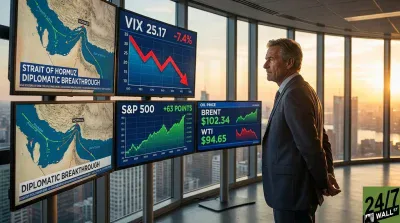
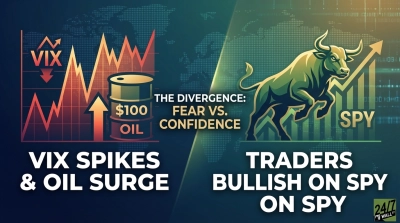
Wall Street’s fear gauge is pulling back this morning even as the world grows more unsettled. The VIX is trading at 22.74, down 0.77 points (-3.28%) in pre-market trading, despite oil with WTI crude at $95.40 on reports of strikes on Gulf energy infrastructure and the Strait of Hormuz still largely paralyzed.
A Fear Gauge That Refuses to Panic
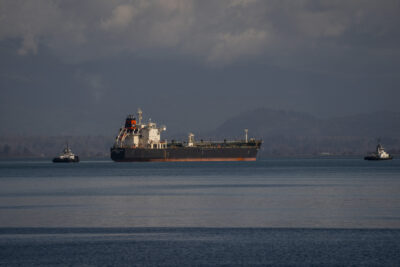
The backdrop for this morning’s VIX decline is hard to square with the reading itself. WTI crude has surged to $95.40, with Brent also elevated on reports of strikes targeting the Majnoon oil field in Iraq and a gas field in the U.A.E. Shipping through the Strait of Hormuz remains largely paralyzed, with only a handful of tankers crossing since the weekend compared to more than 100 in peacetime. Around 1,100 ships remain trapped in the Persian Gulf.
Equity futures are nudging higher regardless. Large-cap tech led the way as the QQQ edged up slightly more than the S&P 500, while small caps tracked closely behind. Domestic-focused investors are not fleeing risk despite the headlines. SPDR S&P 500 ETF Trust (NYSEARCA:SPY) closed Monday up about 1%, while Invesco QQQ Trust (NASDAQ:QQQ) outpaced it slightly, suggesting investors are rotating toward growth rather than fleeing risk. Small caps, often the most sensitive to domestic economic conditions, tracked closely behind, suggesting the risk-off impulse that typically accompanies geopolitical shocks has not materialized.
The VIX’s year-to-date gain of just 10.87% is strikingly modest. Over the past month, the index surged from roughly 17 to a peak of 29.49 on March 6, then began pulling back even as the geopolitical situation stayed unresolved. That pattern mirrors the VIX’s behavior after last year’s panic spike to 52.33, when the index retreated steadily through the summer to near 13.47 in December.
What Markets Are Actually Pricing In
The VIX at sits in the elevated uncertainty range, but it is not signaling crisis. Prediction markets assign only a 10.5% probability to the Bab el-Mandeb Strait being effectively closed by March 31, suggesting traders are not pricing in a worst-case shipping scenario. The 10-year Treasury yield at 4.28% reflects macro pressure the bond market is absorbing steadily rather than in a panic.
Powell’s tone on Wednesday and any developments in Gulf shipping lanes are the two events most likely to shift the VIX meaningfully in either direction.














 Top Gaining Stocks

 Top Losing Stocks