





Picking individual energy stocks means riding commodity price swings, managing earnings surprises, and hoping management allocates capital well. Three income-focused alternatives offer exposure to energy cash flows with different risk profiles than individual stock picking, and right now all three yield well above the 4.28% 10-year Treasury.
Three Ways to Own Energy Income
Adams Natural Resources Fund (NYSE:PEO) is a closed-end fund that has paid uninterrupted quarterly dividends for over 25 years. Recent quarterly distributions have run in the $0.49 to $0.53 range, with year-end special distributions layered on top, producing a a 7.7% yield that sits well above the current 10-year Treasury rate. That income consistency is backed by over 25 years of uninterrupted dividends and $803.6 million in net assets spread across diversified natural resources companies, giving investors broad commodity exposure rather than a single-stock bet. Shares have also gained ground over the past year, adding a total-return dimension to the income story.
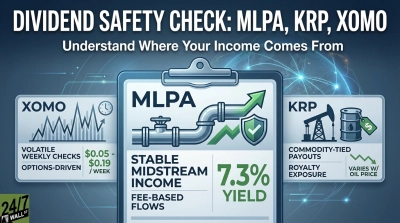
Global X MLP ETF (NYSEARCA:MLPA) takes a different approach, focusing entirely on master limited partnerships that own and operate energy infrastructure. Pipelines, processing facilities, and storage terminals generate fee-based revenues that do not depend heavily on oil prices — pipeline tolls get paid whether oil is at $60 or $90, which sets this fund apart from upstream producers. The fund yields 7.29% with a low 0.45% expense ratio, and its top three holdings — Enterprise Products Partners, Energy Transfer, and MPLX, together represent about 37% of the portfolio, concentrating exposure in the largest, most liquid MLPs. Shares are up 13% year-to-date, reflecting strong investor appetite for infrastructure income.
MLP distributions carry a tax advantage worth understanding. A portion of each distribution is typically classified as return of capital, which defers taxes until you sell. That makes the stated yield more valuable on an after-tax basis than a comparable yield from a regular dividend stock, particularly for investors in higher brackets.
Viper Energy (NASDAQ:VNOM | VNOM Price Prediction) is a Permian Basin royalty company that earns income from mineral rights without operating wells or spending on capital expenditures — meaning operators absorb drilling costs while Viper collects a cut of production revenue. That asset-light model supports a base-plus-variable dividend structure, with recent quarterly payments ranging from $0.52 to $0.65 per share per share depending on realized cash flows, producing a current yield of 5.4%. Shares have also gained 18% year-to-date, suggesting the market is rewarding the royalty model’s combination of income and capital appreciation potential.
The Tradeoffs You Should Know
All three carry real risks. PEO and VNOM have direct commodity exposure, meaning a sustained drop in oil prices would pressure distributions. WTI crude recently touched $94.65 per barrel, near a 12-month high, which currently supports cash flows. But the 12-month low was $55.44, a wide range that illustrates how quickly the income picture can shift.
MLPA’s fee-based infrastructure model reduces that commodity sensitivity, but the fund’s concentration in a handful of large MLPs means a credit event or regulatory change at one major holding would ripple through the portfolio. The MLP structure also creates K-1 tax forms at the partnership level, though holding MLPA as an ETF wrapper generally simplifies that complexity for individual investors.
Viper’s variable dividend component means the payout fluctuates quarter to quarter based on realized cash flows. Investors who need a fixed monthly income number will find that unpredictability frustrating.
Together, the three options span a spectrum from pure commodity exposure with PEO, to fee-based infrastructure stability with MLPA, to royalty-model flexibility with Viper — representing different risk profiles within the energy income space.
Contact [email protected] for any questions or corrections.












 Top Gaining Stocks
 Top Losing Stocks