ExxonMobil’s $100 Billion Cash Flow Story Isn’t Over Yet
Oil just dropped more than 20% in a single month, yet the market keeps rewarding ExxonMobil with a premium valuation. The reason traces back to a two-year cash haul that most investors have not fully priced into their thinking.

The headline number is not a forecast or a promise. It is what Exxon Mobil (NYSE:XOM | XOM Price Prediction) has already put through the register across the past two fiscal years, and it explains why the market is willing to pay nearly 23-times trailing earnings for a business tied to a commodity that just fell 21.2% in a single month.
The Number
ExxonMobil generated $52 billion in operating cash flow in fiscal year 2025, on top of $55 billion in fiscal 2024. That two-year haul is the cash flow story amounts to the total the title refers to, and it is a reported figure straight out of the company’s audited statement of cash flows, not guidance and not consensus. Free cash flow for 2025 landed at $23.61 billion after $28.36 billion in capital expenditures.
What It Means
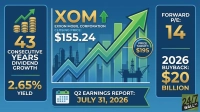
Operationally, that cash paid for everything at once. ExxonMobil returned $17.23 billion in dividends and completed $20.27 billion in share repurchases in 2025, while lifting capex 19.30% year over year to fund growth in Guyana, the Permian, and Golden Pass LNG. Exxon’s dividend has now been raised annually for 43 consecutive years, with management raising its payout in Q4 2025 by 4%.
Underneath the top line, the business is leaner than it was. Cumulative structural cost savings since 2019 reached $15.60 billion, against a $20 billion target by 2030. Advantaged assets (Permian, Guyana, LNG) accounted for 59% of 2025 production, up roughly 7 percentage points year over year. Full-year upstream production hit 4.7 million oil-equivalent barrels per day, the highest in more than 40 years.
Exxon’s Q1 2026 report showed the same engine still running. Adjusted EPS came in at $1.16 versus a $1.01 consensus, and underlying earnings ex-items were $8.77 billion against $7.58 billion a year earlier. Reported net income of $4.18 billion was distorted by $3.88 billion in unfavorable mark-to-market derivative timing and $706 million in Middle East supply-disruption losses.
Market Reaction
XOM stock closed at $137.09 on July 2, 2026, up 15.45% year to date and 27.36% over the trailing twelve months. Over five years the stock is up 160.87%. The last month has been softer, with shares off 8.34% as WTI slid from a June 3 print of $99.76 to $71.87 on June 29.
Bull Case
I think Exxon’s bull case rests on the durability of that cash engine at prices well below where it was minted. ExxonMobil has committed to $20 billion in buybacks in 2026, with cash capex guided to $27 billion to $29 billion. The company already put $4.9 billion of buybacks through in Q1 2026 alone.
Growth capacity is measurable. Guyana ran at a record above 900,000 gross barrels per day, Permian output hit a Q4 2025 record of 1.8 million boed, and Golden Pass LNG loaded its first Train 1 cargo in April 2026. CEO Darren Woods told analysts that Train 1 alone will lift US LNG exports by “about 5% relative to 2025 US exports” and, once all three trains are online, by roughly 15%.
Overall, I think the important thing to note is that this company’s balance sheet backs the plan, with debt to equity at 0.168, net debt to EBITDA of 0.548, and interest coverage of 56.28x.
Bottom Line
For long-term holders, ExxonMobil is delivering the two things retirement-focused investors care about: a 3.03% yield backed by 43 straight years of dividend growth, and a buyback program funded out of cash the business actually earned. Exxon’s Q2 2026 dividend of $1.03 per share was payable June 10, 2026 to holders of record on May 15, 2026.
With WTI back near $71.87 and a $170.29 average analyst target sitting above the current price, the next test is whether Q2 earnings show the underlying earnings line holding up while the derivative and Middle East items fade. That is where the cash flow story either extends, or stalls.
Contact [email protected] for any questions or corrections.
Chris MacDonald is a 24/7 Wall St. contributor and long-time contributor to other notable finance publications, including The Motley Fool and InvestorPlace. With an MBA in Finance, and more than a decade of experience in venture capital and the corporate finance world, Chris brings a long-term perspective to his analysis of equities and alternative assets.
His love of investing and focus on finding quality undervalued stocks is complemented by recent research into alternative assets as well. He takes a long-term approach to analyzing companies and cryptos, with a focus on directing the reader to the most sustainable and important catalysts for each respective potential investment.