





The 10-year Treasury yield sits at 4.23% today, and that number matters more than most retirees realize. It represents the baseline. That is, what you can earn with zero risk.
Any dividend ETF benchmarked against Treasurys would need to clear that bar in total return terms, or at least come close enough in yield that the equity upside justifies the tradeoff. The three funds below all have explicit dividend-quality methodologies. They are not just high-yield screens.
Each one filters for companies that can sustain and grow their payouts, which is exactly what a retirement portfolio needs over a 20- or 30-year horizon.
Why Dividend Quality Matters More Than Raw Yield
A 7% yield from a company that cuts its dividend in two years is worse than a 3% yield from one that raises it every year for a decade. That distinction is the entire logic behind quality-screened dividend ETFs. They sacrifice some headline yield in exchange for payout durability, and for retirees, that durability is the point.
The Federal Reserve has cut rates by 75 basis points since mid-2025, bringing the Fed Funds rate to 3.75%. That shift has made dividend-paying equities more competitive relative to cash alternatives, strengthening the case for holding these funds in a retirement account.
Schwab U.S. Dividend Equity ETF: The Quality-First Standard
Schwab U.S. Dividend Equity ETF (NYSEARCA:SCHD) is built around a specific quality screen. This ETF requires at least 10 consecutive years of dividend payments, then filters by cash flow to debt, return on equity, dividend yield, and five-year dividend growth rate. The result is a portfolio of companies that have demonstrated both the willingness and the financial capacity to keep paying. With $85.9 billion in assets and an expense ratio of just 0.06%, it is one of the most widely held and lowest-cost dividend funds available.
SCHD’s current yield of 3.3% sits modestly below the 10-year Treasury, but SCHD compensates with consistent price appreciation. Indeed, the fund is up 16% over the past year and has compounded to a 221% total price return over the past decade. That combination of income and growth has made SCHD widely held among income-focused investors rather than just an income vehicle.
The ETF’s sector mix leans heavily on energy at 23% and consumer staples at 19%, with healthcare adding another 16%. Names like Coca-Cola (NYSE:KO | KO Price Prediction), Chevron (NYSE:CVX), and Merck (NYSE:MRK) anchor the portfolio. One thing to understand about SCHD’s construction: it explicitly excludes REITs and holds zero utilities, which is unusual for a dividend fund. This methodology prioritizes financial quality over traditional income-sector concentration, so retirees who want utility or real estate exposure will need to find it elsewhere.
Vanguard High Dividend Yield ETF: Breadth and Scale
Vanguard High Dividend Yield ETF (NYSEARCA:VYM) takes a different approach. Rather than applying a multi-factor quality screen, it tracks companies forecast to pay above-average dividends over the next 12 months, sorted by yield and weighted by market cap. The fund holds more than 500 positions, making it the broadest diversified option of these three. At $92.3 billion in assets and an expense ratio of just 0.04%, it is the largest and cheapest fund on this list.
The yield of 2.3% is the lowest here, which reflects the market-cap weighting methodology. Broadcom’s (NASDAQ:AVGO) position at nearly 7% of the portfolio is the most notable feature of the current holdings. That single position drags the yield down somewhat because Broadcom’s payout is modest relative to its share price, but it also reflects the fund’s willingness to hold large, growing dividend payers rather than only mature, slow-growth income stocks.
Financials make up 20% of the fund, with JPMorgan (NYSE:JPM), Bank of America (NYSE:BAC), and Goldman Sachs (NYSE:GS) among the top holdings. That exposure gives VYM meaningful sensitivity to the interest rate environment. That’s a tailwind when rates fall, and a headwind when bank earnings compress. The diversification across 500-plus names cushions any single-sector pressure, which is part of why VYM has delivered solid long-term price appreciation alongside its income stream.
Over the past year, VYM has gained 19%, a return that reflects both the income stream and the fund’s broad market-cap exposure across dividend-paying equities. The tradeoff for this breadth is the lower yield, which means retirees focused on income distributions may find VYM’s lower yield requires pairing with higher-yielding holdings.
iShares Core High Dividend ETF: Concentrated Quality at a Higher Yield
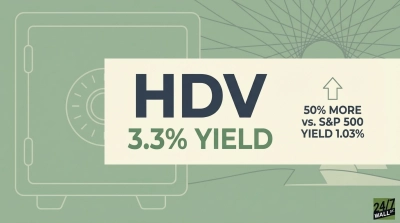
iShares Core High Dividend ETF (NYSEARCA:HDV) screens for financial health first, then selects the highest-yielding companies from that filtered universe. The result is a more concentrated portfolio of roughly 75 holdings with a current yield of 2.8%, sitting between SCHD and VYM in income terms. The expense ratio is 0.08%, still extremely low by any standard.
The sector concentration in HDV is the most pronounced of the three funds. Consumer staples represent 28% of the portfolio and energy accounts for another 26%. Exxon Mobil and Chevron together make up roughly 18% of the fund. That energy concentration has been a source of strength in recent years, but it also means HDV’s income stream carries more commodity price sensitivity than either SCHD or VYM. When oil prices fall sharply, energy companies can and do reduce dividends.
HDV also includes utilities at 8.5%, which distinguishes it from SCHD’s zero allocation to the sector. Duke Energy (NYSE:DUK) and Southern Company (NYSE:SO) appear in the top holdings, giving retirees some exposure to regulated, predictable utility income that the other two funds do not provide.
HDV’s 82% annual turnover rate is the most important structural consideration for retirees holding the fund in a taxable account. That churn is significantly higher than SCHD or VYM, generating more frequent taxable events that erode after-tax returns. The fund has gained 12% year to date and 72% over five years, returns that track closely with its peers despite the higher turnover cost, but retirees in taxable accounts should weigh that tax drag against the yield advantage before choosing HDV over its lower-turnover peers.
Choosing Between the Three
The right fund depends less on which has the best headline numbers and more on the specifics of a retiree’s situation.
Those holding funds in taxable accounts should weight HDV’s higher turnover heavily. Indeed, the tax drag can meaningfully erode the yield advantage that makes it attractive in the first place, making SCHD or VYM the more efficient choice outside of tax-sheltered accounts.
Retirees who need maximum income and want utility exposure will find HDV the only option of the three that provides it. Those who prioritize diversification and the lowest possible cost should look at VYM, accepting the lower yield in exchange for 500-plus holdings and the tightest expense ratio. SCHD suits investors who want a rigorous quality filter and are comfortable with zero utility or REIT exposure in exchange for a portfolio built around companies with long, verified dividend histories.
Contact [email protected] for any questions or corrections.











 Top Gaining Stocks
 Top Losing Stocks