Who Will Deliver Your Mail If Post Office Collapses?

Photo of Douglas A. McIntyre
By Douglas A. McIntyre Published

Quick Read

  • The Post Office Loses Billions Of Dollars

  • Do People Need Physical Mail At All

  • FedEx And UPS Would Handle Deliveries

  • If you're focused on picking the right stocks and ETFs you may be missing the bigger picture: retirement income. That is exactly what The Definitive Guide to Retirement Income was created to solve, and it's free today. Read more here
This post may contain links from our sponsors and affiliates, and Flywheel Publishing may receive compensation for actions taken through them.
Who Will Deliver Your Mail If Post Office Collapses?

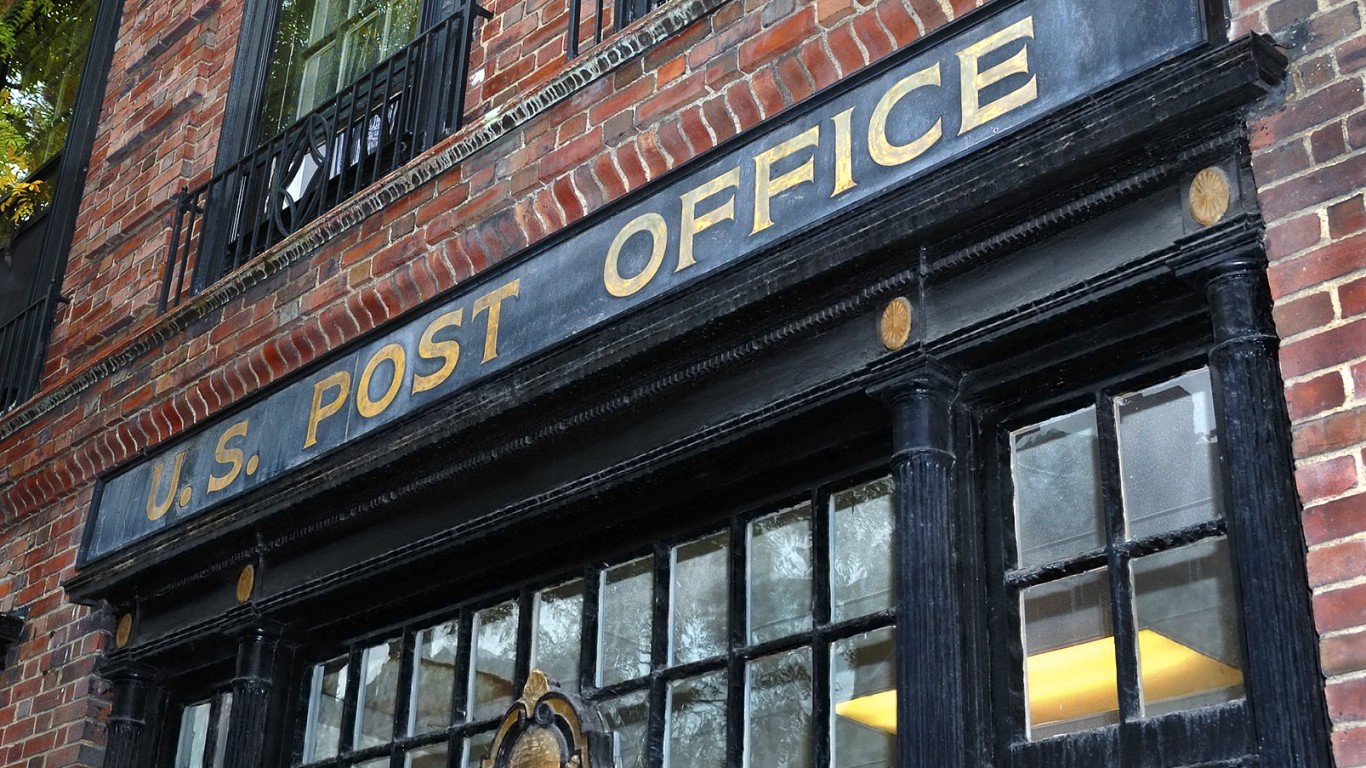
© U.S. Post Office, Haughton, LA IMG 3929 (CC BY-SA 3.0) by Billy Hathorn

For years, the cost of retirement fund payments has hung around the U.S. Postal Service like an albatross. According to Brookings, “As of September 30, 2024, the US Postal Service (USPS) FERS retirement fund balance is approximately $138 billion, which represents 76% of its actuarial liability. Total retirement-related costs for the USPS are significant, reaching $10.3 billion in 2025, with annual pension funding obligations exceeding $10 billion.”

U.S. Postmaster General David Steiner told the House Oversight subcommittee that handles the Post Office that it could run out of money by October if it has to make more retirement payments and related payments to the federal government.

Donald Trump has suggested the best way to solve the problem is to privatize the Post Office. In March 2025, he said, “It’s an idea a lot of people have had for a long time. We’re looking at it.”

The options Steiner gave the committee should have been adopted years ago. These include ending six-day delivery and cutting some of its 33,780 locations. These, incidentally, include offices in towns with under 3,000 residents.

The Postal Service would also need to cut its workforce of 640,000. That might cause a problem. There are 533,000 “career workers.” The American Postal Workers Union represents 200,000 Post Office workers. That means large layoffs could cause a fight. And, Congressmen are not fond of the idea that a Post Office in their districts might be closed.

So, what if the Post Office closes?

Among other things, it would not be affordable to deliver mail even five days a week. That would end. And, all of the locations could disappear. How many people use the Post Office regularly? How many visit a Post Office? On the other hand, how many people use email instead of mail? How many people use email attachments instead of sending documents via mail? How many companies accept payment online?

Some portion of the delivery service would likely be taken over by UPS (NYSE: UPS) and FedEx (NYSE: FDX)–at least the deliveries that are profitable.

It’s time to sunset the Post Office, which is now about two and a half centuries old. Who really needs the mail? Not enough people to have an organization that loses billions of dollars.


Photo of Douglas A. McIntyre
About the Author Douglas A. McIntyre →

Douglas A. McIntyre is the co-founder, chief executive officer and editor in chief of 24/7 Wall St. and 24/7 Tempo. He has held these jobs since 2006.

McIntyre has written thousands of articles for 24/7 Wall St. He is an expert on corporate finance, the automotive industry, media companies and international finance. He has edited articles on national demographics, sports, personal income and travel.

His work has been quoted or mentioned in The New York Times, The Wall Street Journal, Los Angeles Times, The Washington Post, NBC News, Time, The New Yorker, HuffPost USA Today, Business Insider, Yahoo, AOL, MarketWatch, The Atlantic, Bloomberg, New York Post, Chicago Tribune, Forbes, The Guardian and many other major publications. McIntyre has been a guest on CNBC, the BBC and television and radio stations across the country.

A magna cum laude graduate of Harvard College, McIntyre also was president of The Harvard Advocate. Founded in 1866, the Advocate is the oldest college publication in the United States.

TheStreet.com, Comps.com and Edgar Online are some of the public companies for which McIntyre served on the board of directors. He was a Vicinity Corporation board member when the company was sold to Microsoft in 2002. He served on the audit committees of some of these companies.

McIntyre has been the CEO of FutureSource, a provider of trading terminals and news to commodities and futures traders. He was president of Switchboard, the online phone directory company. He served as chairman and CEO of On2 Technologies, the video compression company that provided video compression software for Adobe’s Flash. Google bought On2 in 2009.

Featured Reads

Our top personal finance-related articles today. Your wallet will thank you later.

Continue Reading

Top Gaining Stocks

APA
APA Vol: 23,883,496
+$1.05
+2.76%
$39.11
Aon
AON Vol: 2,408,528
+$8.64
+2.73%
$325.63
TTD Vol: 24,213,212
+$0.60
+2.55%
$24.11
AJG Vol: 3,845,140
+$5.14
+2.45%
$214.82
PSKY Vol: 23,894,119
+$0.19
+2.12%
$9.15

Top Losing Stocks

SMCI Vol: 243,039,023
-$10.26
33.32%
$20.53
VST Vol: 11,108,700
-$21.35
12.76%
$146.02
CEG Vol: 6,237,209
-$34.48
10.90%
$281.99
MOS Vol: 21,771,381
-$2.61
9.96%
$23.59
NRG Vol: 4,160,964
-$15.60
9.67%
$145.80