Beat the S&P 500 Without the Magnificent 7 Risk
For decades, plain-vanilla index investing was the easiest way to build wealth without losing sleep. The S&P 500 had delivered roughly 10% average annual returns over the long haul, so simply buying a low-cost fund that tracked the index let…

This post may contain links from our sponsors and affiliates, and Flywheel Publishing may receive compensation for actions taken through them.

For decades, plain-vanilla index investing was the easiest way to build wealth without losing sleep. The S&P 500 had delivered roughly 10% average annual returns over the long haul, so simply buying a low-cost fund that tracked the index let investors capture those gains without the headache of picking individual stocks. Unfortunately, the Magnificent 7 broke the system.
For the past three years those seven mega-cap names carried the entire market to record highs as investors bid up shares with little regard for fundamentals. That era is now over. Microsoft (NASDAQ:MSFT | MSFT Price Prediction) is down 20% year-to-date, Amazon (NASDAQ:AMZN) 9%, and Nvidia (NASDAQ:NVDA) 6%. The Roundhill Magnificent 7 ETF (CBOE:MAGS) has fallen more than 10%.
Because the group still accounts for roughly 35% of the S&P 500’s total weight (down from around 40% last summer), every twitch in just one of those stocks now sways the entire index far more than any of the other 493 companies. Yet it is still possible to buy the broad market — and beat it.
The Market Has Flipped
The same force that drove the Magnificent 7 higher without regard for valuation is now driving them lower with equal disregard. What began as a rational bet on AI and cloud growth has morphed into a crowded trade unwinding in real time. The result is a potential vicious downturn for the cap-weighted S&P 500.
When a handful of stocks dominate the index, their decline drags everything down faster than a broad-based sell-off would. Investors who thought they were “owning the market” are actually riding a concentrated tech bet that is finally cracking.
The solution sounds almost contradictory: you can still profit by betting on the S&P 500 — you just have to stop being concentrated in the same seven stocks everyone else is buying. The perfect vehicle is the Invesco S&P 500 Equal Weight ETF (NYSEARCA:RSP).
Why Cap-Weighting Doesn’t Always Work
The standard S&P 500 — such as the State Street SPDR S&P 500 ETF (NYSEARCA:SPY) — is a market-cap-weighted index. The bigger the company, the larger its influence. That structure is wonderful when the giants are rising; it turbo-charges returns. But when the giants stumble — as they are right now — the index suffers outsized pain.
The Invesco ETF flips the script. It assigns roughly equal weight to each of the 500 stocks, so every name, from Apple (NASDAQ:AAPL) to a smaller industrial or health-care name, gets the same 0.2% slice of the portfolio. Switching from the cap-weighted S&P 500 to Invesco instantly slashes your exposure to the Magnificent 7 from 35% to about 1.4% total.
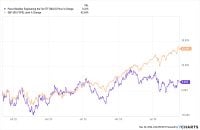
Year-to-date, while the S&P 500 is down nearly 4%, The Invesco S&P 500 Equal Weight ETF is slightly positive. Moreover, since its inception in 2003, it has returned approximately 650% versus 618% for the cap-weighted S&P 500. That edge comes from two sources: it automatically trims winners that become too large and it gives smaller, faster-growing companies inside the index a real voice.
Key Takeaways
The Invesco ETF carries a rock-bottom expense ratio of just 0.20%, making it nearly as cheap as the most popular S&P 500 trackers. Its equal-weighted strategy dramatically reduces reliance on mega-caps and gives smaller constituents — names like APA (NYSE:APA) or Ciena (NASDAQ:CIEN) equal footing with the giants.
Historically, this approach has delivered superior risk-adjusted returns, especially during market corrections when tech-heavy indices falter. You won’t escape losses in a true crash, but those losses are typically minimized because the damage is spread evenly rather than concentrated in the most over-owned names.
In an era when the Magnificent 7 no longer act as the market’s safety net, Invesco S&P 500 Equal Weight ETF offers a simple, low-cost way to stay invested in America’s 500 largest companies while sidestepping the concentration risk that has suddenly become the biggest threat to index returns.
Contact [email protected] for any questions or corrections.
After two decades of patrolling the dark corners of suburbia as a police officer, Rich Duprey hung up his badge and gun to begin writing full time about stocks and investing. For the past 20 years, he’s been cruising the markets looking for companies to lock up as long-term holdings in a portfolio while writing extensively on the broad sectors of consumer goods, technology, and industrials. Because his experience isn’t from the typical financial analyst track, Rich is able to break down complex topics into understandable and useful action points for the average investor. His writings have appeared on The Motley Fool, InvestorPlace, Yahoo! Finance, Money Morning, and, of course, 24/7 Wall St. He has been featured in both U.S. and international publications, including MarketWatch, Financial Times, Forbes, Fast Company, and USA Today.