Here’s Exactly What Social Security Retirees Need to Do to Qualify for the New Tax Deduction
The One Big Beautiful Bill Act, signed into law on July 4, 2025, introduced a new tax deduction that millions of seniors can now take advantage of. While it does not directly eliminate tax on Social Security benefits, it reduces…


The One Big Beautiful Bill Act, signed into law on July 4, 2025, introduced a new tax deduction that millions of retirees can take advantage of starting with their 2025 returns. The deduction does not directly eliminate the tax on Social Security benefits, but it reduces taxable income for many seniors enough that those benefits escape taxation entirely. Understanding who qualifies and how to claim it can translate into real savings at filing time.
Here is what you need to know about the new senior deduction, including eligibility rules, income limits, and how it interacts with Social Security income.
Who can claim the new retiree tax deduction?
The new tax deduction covers tax years 2025 through 2028. Any eligible senior can claim it, and you do not need to be actively collecting Social Security to qualify. All three of the following requirements must be met:
- Be age 65 or older by the last day of the tax year.
- Have a modified adjusted gross income below the phase-out threshold. The full deduction is available to single filers with MAGI up to $75,000 and to married joint filers with MAGI up to $150,000. Above those figures, the deduction shrinks at a rate of 6% for every $1,000 of income over the threshold, meaning it disappears entirely at $175,000 for single filers and at $250,000 for joint filers.
- Have a valid Social Security number and file a federal tax return. Married taxpayers must file jointly; the married-filing-separately status is not eligible.
The deduction is open to both itemizers and non-itemizers. Your choice of standard deduction or itemized deduction has no bearing on eligibility for this benefit. The IRS created Schedule 1-A specifically for reporting this and other deductions introduced by the law. Tax software applies the deduction automatically based on your age and income, so most filers will not need to complete the form by hand.
How does the new tax deduction work for retirees?
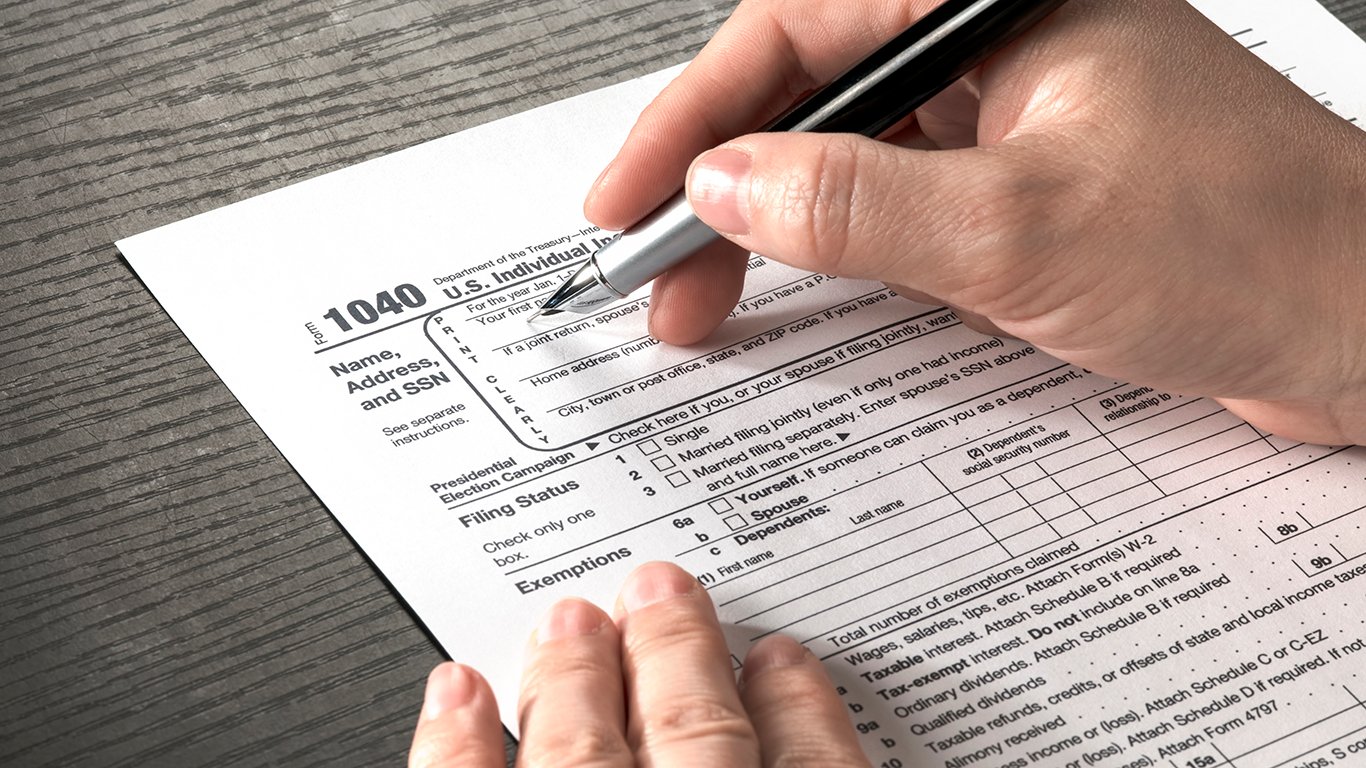
The new tax break allows seniors to claim a $6,000 deduction per qualifying person. Each spouse on a joint return who is at least 65 can claim $6,000 individually, producing a combined $12,000 deduction when both qualify. That benefit stacks on top of the regular standard deduction, any itemized deductions, and the separate additional standard deduction that seniors already receive under prior law. For 2025, a single non-itemizing senior starts with a $15,750 base standard deduction, adds $2,000 through the pre-existing senior provision, and then layers on the new $6,000 benefit, reaching a cumulative $23,750. A married couple where both spouses qualify can reach $46,700 in total deductions.
A deduction is not the same as a tax credit, and knowing the difference matters for setting realistic expectations. A credit cuts your tax bill dollar for dollar: a $6,000 credit against a $10,000 bill leaves $4,000 owed. A deduction works differently by shrinking the amount of income the IRS treats as taxable. If you would otherwise owe tax on $50,000 and you claim the new $6,000 deduction, you are taxed only on $44,000. Actual savings depend on your bracket. AARP estimates that a single filer in the 22% bracket earning up to $75,000 can save up to $1,320, while a qualifying joint filer can save up to $2,640.
The scale of the potential impact is significant. The White House Council of Economic Advisers estimates that about 33.9 million seniors may qualify for the new deduction, with an average increase in after-tax income of $670 per eligible taxpayer. The Joint Committee on Taxation projects the provision will reduce federal revenues by $91 billion over its four-year life. Even so, the Tax Policy Center notes that fewer than half of all older adults will benefit, because low-income seniors who already owe little or no federal income tax gain no practical advantage from an additional deduction. Because the deduction expires after 2028, retirees who qualify should treat this window as a defined planning opportunity rather than a permanent feature of the tax code. If Congress extends it, the Peter G. Peterson Foundation projects the cost could reach $220 billion through 2034.
How the deduction can shield Social Security from taxes
The indirect benefit for Social Security recipients is where this deduction becomes most valuable. The law originated from a campaign pledge to eliminate taxes on Social Security entirely, but because it was passed through the budget reconciliation process, lawmakers could not directly repeal the underlying Social Security taxation rules. The $6,000 senior deduction was the practical result, and for a large share of retirees it achieves the same end through a different path.
Federal taxes on Social Security benefits are triggered by a formula called combined income, which adds your adjusted gross income, any nontaxable interest, and half of your annual Social Security benefits. Single filers face taxes on up to 50% of their benefits when combined income falls between $25,000 and $34,000, and up to 85% of benefits can be taxed above $34,000. For married joint filers, the 50% threshold begins at $32,000 and the 85% threshold kicks in above $44,000. Those bracket amounts have never been adjusted for inflation since Congress set the first tier in 1983 and added the second in 1993. When the 1983 law took effect, roughly 10% of beneficiaries were subject to tax on their benefits. Today, close to half are caught by the thresholds, pulled in by four decades of cost-of-living adjustments applied to benefits but not to the income limits that trigger taxation.
A $6,000 or $12,000 reduction in taxable income through the new senior deduction pushes many retirees below those thresholds entirely. The Council of Economic Advisers estimates that 88% of seniors receiving Social Security benefits (about 51.4 million people) will owe no tax on those benefits under the new law, compared with 64% under prior law. That shift reflects roughly 14 million additional seniors whose Social Security income becomes effectively tax-free, not because the taxation rules themselves changed, but because their overall income falls beneath the line that triggers them.
There is a notable trade-off worth understanding. Revenue collected from taxing Social Security benefits flows directly back into the program’s trust fund. The Committee for a Responsible Federal Budget estimates that the expanded senior deduction and related tax cuts will reduce that revenue stream by roughly $30 billion per year. The 2026 Social Security Trustees Report, released on July 5, 2026, confirmed that the Old-Age and Survivors Insurance trust fund is now projected to be exhausted in the fourth quarter of 2032, one quarter earlier than the prior year’s estimate. At that point, continuing payroll-tax revenues would be sufficient to cover only about 78% of scheduled benefits, implying an automatic 22% benefit cut unless Congress acts. Seniors in states that separately tax Social Security income face an additional layer of complexity: eight states (Colorado, Connecticut, Minnesota, Montana, New Mexico, Rhode Island, Utah, and Vermont) apply their own taxes on benefits to varying degrees, and the federal deduction does not offset those state-level liabilities.
If you are eligible, claim the deduction on your federal return using Schedule 1-A, or let your tax software handle it automatically. For those uncertain whether they qualify given their income, investment activity, or required minimum distributions, a certified public accountant or tax professional can help map out the most advantageous approach before the 2028 expiration.
Editor’s note: This version updates the Social Security trust fund exhaustion date to reflect the 2026 Trustees Report (released July 5, 2026), which moved the projected OASI depletion date to the fourth quarter of 2032, one quarter earlier than previously estimated, and adds the detail that trust fund exhaustion at that point would trigger an automatic 22% cut to scheduled benefits.
Contact [email protected] for any questions or corrections.
Christy Bieber has been a personal finance and legal writer since 2008. She has a JD from UCLA School of Law and a BA in English, Media and Communications with a certification in business from the University of Rochester.
Christy has been published by a wide variety of sites, including WSJ Buy Side, Forbes, Kiplinger, Fox Business, Credit Karma, Insurify, and Annuity.org. In addition to writing for the web, she has also ghostwritten textbooks on business and law and served as a subject matter expert for course design.