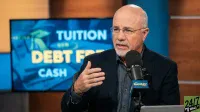
Ramsey Tells Divorcing Mom Earning $75K With $123K Debt: Sell Your Car, Triple Your Real Estate Income
D called into The Ramsey Show on March 25, 2026, carrying $123,000 in debt and a question about minimum payments. She had lost her father, her job, and her marriage within six months. She was rebuilding. But Dave Ramsey heard…


D called into The Ramsey Show on March 25, 2026, carrying $123,000 in debt and a question about minimum payments. She had lost her father, her job, and her marriage within six months. She was rebuilding. But Dave Ramsey heard something else in her story: a pattern of permission-giving that was costing her thousands of dollars she could not afford.
His response was direct: "You really can’t. The car is stupid, and so was the vacation. You gotta start calling stuff what it is."
That bluntness is worth examining carefully, because the math behind it is harder to argue with than the delivery.
What $123,000 in Debt Actually Looks Like on $75,000
D’s debt breaks down into three pieces: a $40,000 HELOC on a rental property, a $28,000 car loan, and $54,000 in credit card debt. The credit card balance is the most dangerous. The Federal Reserve’s benchmark rate sits at 3.75% today, but credit card rates operate in a different universe, typically running 20% or higher even as the Fed has eased. That $54,000 balance is compounding against her every month she carries it.
She defended her $27,000 car by saying she could afford the house and the car if she did not have the credit card debt. Ramsey’s reply cut through the logic: "But you have the credit card debt." The conditional does not exist. The full picture does.
The Car Sale: Why $25,000 Matters More Than the Monthly Payment
Ramsey’s instruction was precise: stop paying the credit cards for two months, sell the car, and buy a $2,000 car instead. The car is worth $27,000 against a $28,000 loan, meaning she is $1,000 underwater. Selling it does not wipe the loan clean, but it removes the payment and frees up cash flow immediately.
The real gain is the gap between a $2,000 car and a $27,000 car. That $25,000 in freed equity, combined with two months of suspended credit card minimums, becomes the first debt snowball payment. On a $54,000 credit card balance at 20% interest, eliminating it years faster saves tens of thousands in interest charges. The math is straightforward. The behavior change is the hard part.
The national personal savings rate stood at 4.0% in the fourth quarter of 2025, a sharp drop from 6.2% the prior year. D’s situation mirrors a broader pattern: Americans are carrying more debt as inflation erodes purchasing power. The Consumer Price Index reached 327.5 in February 2026, up from 319.8 a year earlier, and sustained price increases punish households that carry high-rate debt.
The Income Advice Is Where the Real Opportunity Lives
Ramsey’s sharper insight was about her income, not her car. D works three jobs: $42,000 negotiating leases, $25,000 selling real estate over eight years, and bartending on weekends. Ramsey told her to quit bartending entirely and go all-in on real estate: "You need to go make $150,000 selling houses. Now you specialize in money. I specialize in selling houses for money."
This is the advice worth acting on. Eight years in real estate producing $25,000 annually suggests she has been treating it as a side activity. Real estate agent income scales with volume and referrals, both of which require time and focus that bartending consumes. Housing starts reached 1.49 million annualized units in January 2026, the strongest reading in the prior twelve months, signaling an active market with real transaction volume available to agents who pursue it.
Doubling down on real estate while eliminating weekend bartending shifts reallocates hours toward an activity with compounding income potential.
Who This Advice Fits and What to Do Next
Ramsey’s framework works best for someone with a stable income, a sellable asset, and a high-rate debt problem. D fits all three. The HELOC on the rental property carries different math since it is secured debt tied to an income-producing asset, and that conversation deserves its own analysis with a fee-only advisor. The credit cards do not.
The practical steps: sell the car, buy transportation under $5,000, redirect the freed cash flow to the highest-rate credit card balance first, and treat real estate as the primary income engine rather than the third job. Ramsey put it plainly: "Because you’ve been through this tremendous heartbreak, you’ve given yourself permission to do things you shouldn’t have done." The permission to recover starts with calling the numbers what they are.
Contact [email protected] for any questions or corrections.
Austin Smith is a financial publisher with over two decades of experience as an investor, analyst, and advisor. He covers stocks, ETFs, Artificial intelligence and personal finance for 24/7 Wall St. Previously, he spent over a decade at The Motley Fool as a senior editor for Fool.com, portfolio advisor for Millionacres, and launched The Ascent to help reader take control of their personal finances.
His work has been featured on Fool.com, NPR, CNBC, USA Today, Yahoo Finance, MSN, AOL, Marketwatch, and many other publications. He is as an advisor to private companies, and co-hosts The AI Investor Podcast with Eric Bleeker.
When not looking for investment opportunities, he can be found skiing, running, or playing soccer with his children. Learn more about Austin's investment approach here.