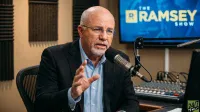
Dave Ramsey Tells Unmarried Mom With $25,000 She’s One Breakup Away From Being Homeless
A stay-at-home mother called The Ramsey Show on March 31, 2026 with what she framed as an investing question. It turned out to be a financial emergency she hadn’t fully named yet. She has been with her partner for eight…


A stay-at-home mother called The Ramsey Show on March 31, 2026 with what she framed as an investing question. It turned out to be a financial emergency she had not fully named yet.
She has been with her partner for eight years, has two children ages 3 and 6, and has built up $25,000 in savings while earning about $500 monthly from side hustles. Her partner covers all household expenses at $4,000 per month, owns the home where they live with his brother, and stands to inherit two buildings. She wanted to know how to put her savings to work and whether she should stop worrying about not being married.
Dave Ramsey did not answer the investing question. He answered the real one.
What Ramsey Actually Said
“If he up and dies or up and leaves, you’re screwed,” Ramsey said. “You’re like a homeless single mom. No, that’s not funny at all. That’s terrifying.”
“It’s an undercurrent in your house that you’re not valuable enough to marry, but you’re valuable enough to have kids with,” he told her directly. Co-host George Kamel added: “You have got to start digging into what would have to be true for me to work a full-time job that would take care of me and the babies.”
Ramsey’s verdict holds up. The $25,000 question is a distraction from a structural financial crisis concealed inside what looks like a stable household. The call fits a well-worn pattern on the show: in June 2026, Ramsey issued a nearly identical warning to a woman who had been paying off her boyfriend’s $15,000 in debt, telling her she was “so vulnerable and so unaware” of her own exposure.
The Math Behind “Homeless Single Mom”
The caller’s financial position, stripped of her partner, is genuinely precarious. She brings in $500 a month from side work while the household runs on $4,000 a month in expenses paid entirely by her partner. Her $25,000 in savings covers roughly six months of that household budget, and far less if she needed to rent independently.
She has no legal claim to the home, no entitlement to his inheritance, and no spousal rights to any of his assets if the relationship dissolves. He has made clear he does not want to marry, calling it “just a piece of paper.” For him, that framing is cost-free. For her, it could cost everything if the relationship unravels.
The national per capita disposable income reached $66,871 for full-year 2025, according to the Bureau of Economic Analysis. Her current income of roughly $6,000 per year puts her at a small fraction of that figure. The unemployment rate held at 4.1% through August 2026, so the job market has not collapsed, but entry-level opportunities for someone re-entering the workforce after years as a primary caregiver are genuinely limited.
Her $25,000 is not a financial cushion. At her current income level, it is a runway measured in months, not years.
Why the “Piece of Paper” Framing Is Financially Dangerous
Marriage creates legal and financial protections that cohabitation simply does not replicate. A spouse carries inheritance rights, potential access to Social Security survivor benefits, and legal standing in medical emergencies. A long-term unmarried partner has none of those protections by default, regardless of the length of the relationship or how many children are involved.
The caller’s instinct that she is “not entitled to anything” is legally accurate in most states. Her partner owns the home jointly with his brother and stands to inherit two additional buildings. She occupies that home without holding any ownership stake. If the relationship ends, she has no legal claim to remain, no claim to the equity, and no claim to any future inheritance.
Ramsey put it plainly: “You’re being held hostage financially. You feel vulnerable, you feel disrespected, and that’s in the air of your house and it’s translating into your daughter’s body.” Financial dependency without legal protection is exposure, not stability. That calculus does not change whether the relationship holds for another eight months or another eight years.
What She Should Actually Do With $25,000
The money’s best use right now is optionality, not investment returns:
- Build income first. George Kamel’s question is the right starting point: what would a full-time job covering her and her children’s needs actually require? Map out the income target, the childcare costs, and the gap between them. That number tells her how far $25,000 stretches as a transition fund.
- Understand the legal picture. A family law attorney consultation, typically $200 to $400 for an initial hour, can clarify what rights she has in her state regarding the children, any potential palimony claims, and what documentation she should be keeping now.
- Keep the savings liquid. A high-yield savings account keeps the money accessible. Locking $25,000 into investments with a three- to five-year horizon makes no sense when her situation could demand access within months.
- Treat the relationship conversation as a financial negotiation. If marriage is permanently off the table, a cohabitation agreement or updated estate documents from her partner are the practical infrastructure that “just a piece of paper” actually represents.
Consumer sentiment data underscores how unsettled the broader economic environment has become for households in exactly her position. The University of Michigan Consumer Sentiment Index closed June 2026 at 49.5, rebounding from May’s all-time record low of 44.8, a reading more pessimistic than any in the survey’s history stretching back to 1952. The final July reading climbed to 55.2, a five-month high. August then reversed course, closing at a final reading of 51.7 as persistent inflation fears weighed on households. The preliminary September 2026 reading fell further to 47.8, a second consecutive monthly decline and the weakest reading since May’s record trough, with year-ahead inflation expectations jumping to 4.6% as fuel prices and trade tensions intensified. For this caller, that ambient anxiety is not abstract. The right question is not where to invest $25,000 but what it would take to become financially independent of a relationship that currently holds all the legal and financial cards.
Editor’s note: This pass corrects the final August 2026 University of Michigan Consumer Sentiment reading from 51.0 to 51.7 (revised from the preliminary), adds the preliminary September 2026 reading of 47.8, and updates the unemployment rate reference to August 2026, when the rate remained at 4.1% per the Bureau of Labor Statistics Employment Situation report released September 4, 2026.
Contact [email protected] for any questions or corrections.
Austin Smith is a financial publisher with over two decades of experience as an investor, analyst, and advisor. He covers stocks, ETFs, Artificial intelligence and personal finance for 24/7 Wall St. Previously, he spent over a decade at The Motley Fool as a senior editor for Fool.com, portfolio advisor for Millionacres, and launched The Ascent to help reader take control of their personal finances.
His work has been featured on Fool.com, NPR, CNBC, USA Today, Yahoo Finance, MSN, AOL, Marketwatch, and many other publications. He is as an advisor to private companies, and co-hosts The AI Investor Podcast with Eric Bleeker.
When not looking for investment opportunities, he can be found skiing, running, or playing soccer with his children. Learn more about Austin's investment approach here.