CEO Jensen Huang Says NVIDIA Was ‘Top of the List NOT to Make It.’ Here’s the Lesson He Learned
NVIDIA (NASDAQ:NVDA | NVDA Price Prediction) is worth nearly $4.8 trillion today. But Jensen Huang, the company’s co-founder and CEO, is quick to remind people that NVIDIA almost didn’t make it. Fast-forward to today, and NVIDIA’s disciplined approach of investing…

This post may contain links from our sponsors and affiliates, and Flywheel Publishing may receive compensation for actions taken through them.
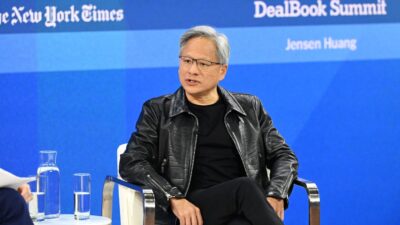
NVIDIA (NASDAQ:NVDA | NVDA Price Prediction) is worth nearly $4.8 trillion today. But Jensen Huang, the company’s co-founder and CEO, is quick to remind people that NVIDIA almost didn’t make it.
Fast-forward to today, and NVIDIA’s disciplined approach of investing in all foundation model companies and avoiding direct competition with partners has produced tangible results: The stock has gained 1,212% over the past five years.
But in a candid conversation on the Dwarkesh Podcast, Huang reflected on the company’s earliest years with a level of honesty that is rare from executives running the most valuable chip company in history. “We created an architecture that was precisely wrong. It’s not a little bit wrong. It was an impossible thing for developers to support. It was never gonna make it.”
NVIDIA at the Bottom of the Survival List
NVIDIA’s early 3D graphics architecture was fundamentally flawed, and the company competed against roughly 60 other graphics firms at the time. Huang said that if you had asked anyone back then which company was going to survive, NVIDIA would have been at the top of the list not to make it.
That near-death experience shaped everything that followed.
The Philosophy That Came Out of It
The lesson Huang took was a deep humility about picking winners. His philosophy today: “Don’t pick winners. Either let them all take care of themselves or take care of all of them.” When it comes to investing in foundation model companies, Huang put it this way: “When I invest in one of them, I invest in all of them.”
That thinking extends to how NVIDIA allocates its engineering effort. Huang described the operating approach as “do as much as needed, as little as possible” (focusing on work that would not get done otherwise). That means building tools like CUDA (the software layer that lets developers program NVIDIA GPUs) and NVLink (the high-speed interconnect that links chips together at scale). NVIDIA deliberately avoids competing where others can succeed.
That philosophy showed up in concrete form as recently as March 31, 2026, when NVIDIA announced a $2 billion investment in Marvell to integrate Marvell’s custom chips into the NVLink Fusion platform. Rather than building competing silicon, NVIDIA brought a partner deeper into its ecosystem.
The Apparent Tension in NVIDIA’s Ecosystem Strategy
The Dwarkesh host pushed back on one apparent tension: NVIDIA says it does not prioritize new AI clouds, yet companies like CoreWeave, Enscale, and Nebius “wouldn’t exist” without NVIDIA’s support. Huang’s answer was direct: supporting those clouds was necessary ecosystem work, not competition.
For investors, the numbers validate the approach. Full-year FY2026 revenue reached $215.94 billion, up 65% year over year, with net income of $120.07 billion. Data Center revenue alone hit $62.31 billion in Q4, up 75% year over year. The stock has gained 107% over the past year and more than 1,212% over the past five years.
NVIDIA’s ecosystem-first, non-competitive philosophy is a deliberate choice rooted in the hard memory of nearly being the company that did not survive.
Contact [email protected] for any questions or corrections.
Joel South covers large-cap stocks, dividend investing, and major market trends, with a focus on earnings analysis, valuation, and turning complex data into actionable insights for investors.
He brings more than 15 years of experience as an investor and financial journalist, including 12 years at The Motley Fool, where he served as an investment analyst, Bureau Chief, and later led the Fool.com investing news desk. He has also co-hosted an investing podcast and appeared across TV and radio discussing market trends.