Price Prediction and Forecast: Can CAT Shares Hit $1000 By 2027?
Caterpillar (NYSE:CAT | CAT Price Prediction) is undergoing a significant rerate in the industrial sector. The stock is up 151.61% over the past year and 48.24% year to date, fueled by a record backlog and an emerging role as the…

This post may contain links from our sponsors and affiliates, and Flywheel Publishing may receive compensation for actions taken through them.

Caterpillar (NYSE:CAT | CAT Price Prediction) is undergoing a significant rerate in the industrial sector. The stock is up 151.61% over the past year and 48.24% year to date, fueled by a record backlog and an emerging role as the picks-and-shovels supplier to the AI data center buildout.
CEO Joe Creed stated on the Q1 call: “Our largest customers in the broader data center industry have significantly increased their expectations for capital spending. That has translated to accelerated order rates for us.” Can CAT push through $1,000 by 2027? Here’s the analysis.
What’s Holding Caterpillar Back Right Now
The near-term issue is digestion. CAT pulled back 4.28% over the past week after touching a 52-week high of $931.35. Group President Denise Johnson sold 12,595 shares for $11.4 million on May 14, part of a broader insider activity pattern. Tariffs present another headwind.
Management expects $2.2 billion to $2.4 billion in tariff costs for 2026, compressing Resource Industries margins by roughly 500 basis points in Q1. With beta at 1.625, CAT moves harder than the market in both directions, and at 11.63% over the past month it has run hot. None of this breaks the thesis; it explains why momentum stalled.
Wall Street Is Bullish, But Anchored to Today’s Earnings
The Street consensus price target sits at $913.29, implying almost no upside from here. The ratings breakdown shows 1 Strong Buy, 14 Buy, 10 Hold, and 3 Sell. That is constructive but cautious, underweighting the backlog story.
Caterpillar’s total backlog hit a record $63 billion, up 79% year over year, and large reciprocating engine backlog has grown more than 3.5x since January 2024. Analysts project EPS to rise 27% this year to $24.21. With orders booked into 2028 and management guiding low double-digit revenue growth, $913 looks like a placeholder.
The Path to $1,000 Per Share
Reaching $1,000 from today’s price of $887.10 requires a gain of 12.7%. The harder question is whether the multiple holds. With forward EPS of roughly $23.69, a price of $1,000 implies a forward P/E of 42x. The current forward multiple is 37x, meaning the target requires about 4.7x additional multiple expansion or EPS that pushes meaningfully above the $24 consensus.
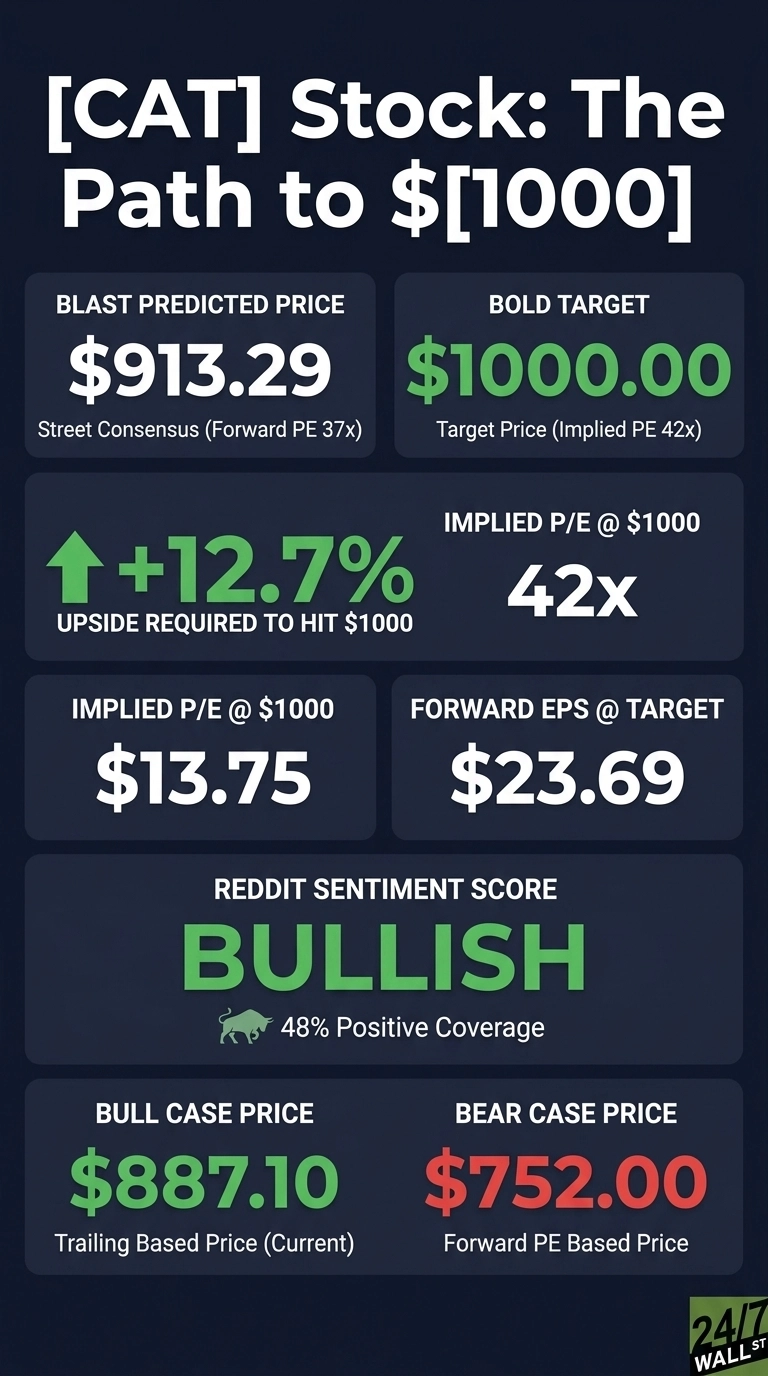
The EPS path is more credible than the multiple path. Q1 2026 EPS of $5.47 beat by 19.69%, and CAT has beaten in 9 of the last 12 quarters. Power Generation sales jumped 48% in Q1, and Creed targets Power Generation sales more than 3x the 2024 baseline by 2030.
The company deployed $5.7 billion to shareholders in Q1 alone, shrinking the share count and lifting per-share earnings mechanically. Risks include sharper tariff escalation or a data center capex pause.
Where Caterpillar Trades Today vs Its Earnings Power
At $887.10, CAT trades at a forward P/E of roughly 38x against TTM EPS of $20.08. That is rich for a cyclical industrial, but Caterpillar is no longer just a cyclical industrial.
Shares sit near the upper end of a 52-week range of $332.64 to $931.35, and over the past decade the stock has returned 1,156.69%. If Power & Energy continues to compound at 20%-plus, the earnings denominator catches up to the multiple.
Can Caterpillar Really Hit $1,000? My Verdict
Reaching $1,000 by 2027 requires a 12.7% gain and either steady multiple support around 42x or EPS that runs ahead of the $24.21 consensus. It is realistic.
Three things need to go right: continued data center order acceleration, tariff costs landing at the low end of the $2.2 to $2.4 billion range, and the buyback running at the current pace. A China slowdown that bleeds into mining capex would derail it. We’ve outlined the blueprint for how Caterpillar could reach $1,000 in 2027.
Contact [email protected] for any questions or corrections.
Vandita Jadeja is a financial publisher with over a decade of experience writing about financial topics, including investment, savings, retirement, insurance and banking. Vandita is a Chartered Accountant who loves to debunk financial concepts for readers.
Her work has appeared on sites that include The Motley Fool, InvestorPlace, and Benzinga. She covers investing and focuses on stock picks and price prediction for 24/7 Wall St.
When not looking for the next stock investment opportunity, she can be found traveling, reading, chasing sunsets and enjoying her iced latte.