Exxon Got Kicked Out of the Dow in 2020. It Has Since Beaten the S&P 500 by Nearly Double
Ten years ago, Exxon Mobil (NYSE:XOM | XOM Price Prediction) was an aging supermajor coasting on legacy assets and a sleepy dividend. The decade that followed was brutal before it got good. CEO Darren Woods kicked off a transformation in…

This post may contain links from our sponsors and affiliates, and Flywheel Publishing may receive compensation for actions taken through them.
Ten years ago, Exxon Mobil (NYSE:XOM | XOM Price Prediction) was an aging supermajor coasting on legacy assets and a sleepy dividend. The decade that followed was brutal before it got good. CEO Darren Woods kicked off a transformation in 2018 built around advantaged barrels, cost cuts, and capital discipline. Then came the pandemic, which gutted crude demand and got the stock booted from the Dow Jones Industrial Average in August 2020.
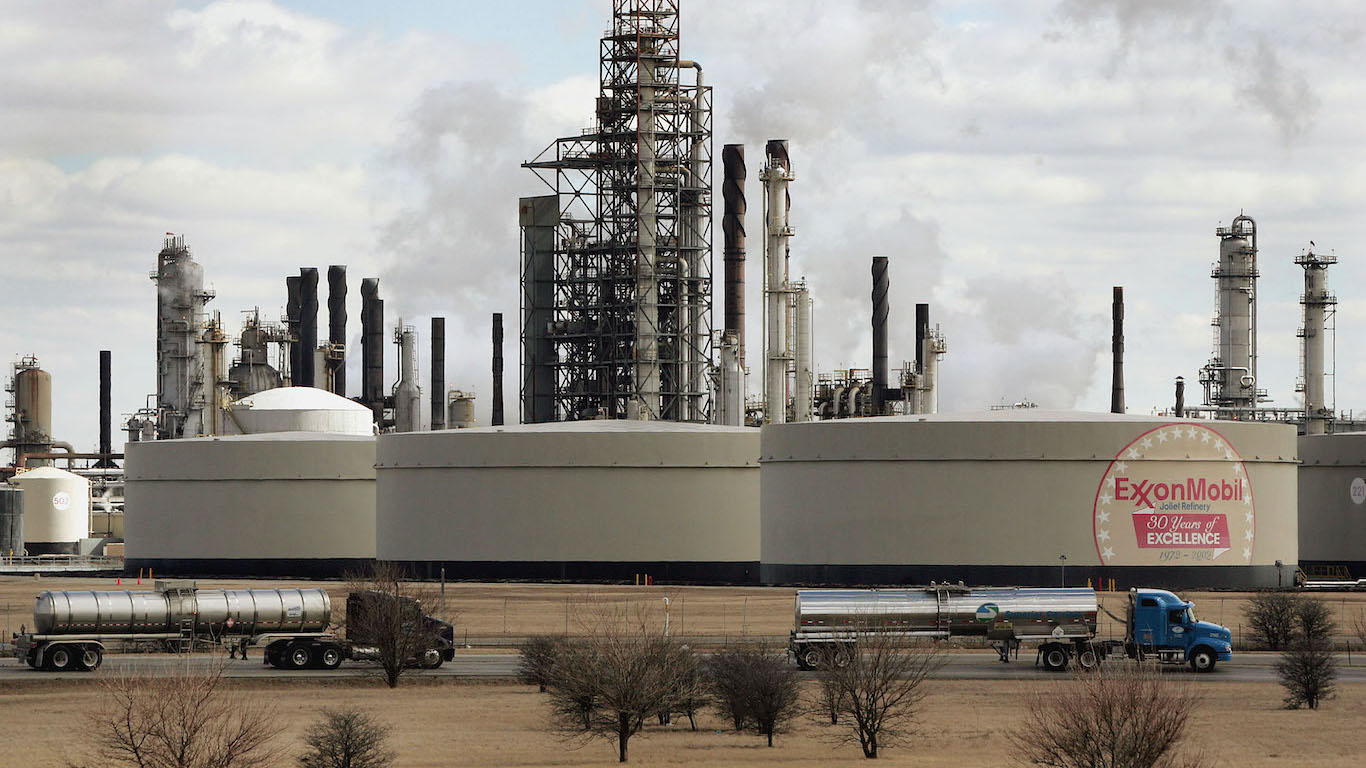
The comeback was loud. Russia’s invasion of Ukraine sent crude soaring, and Exxon posted record profits in 2022. The $60 billion Pioneer Natural Resources deal closed in May 2024, supercharging the Permian footprint, while Guyana’s Stabroek block ramped relentlessly. By 2025, Exxon was pumping a record 4.7 million oil-equivalent barrels per day, and advantaged assets hit 59% of production.
Your $1,000 Trailed the Market, but Got Paid Doing It
Here is what the math looks like across three horizons, using split- and dividend-adjusted prices.
1-Year Return
- Initial Investment: $1,000
- Current Value: $1,533.30
- Total Return: 53.33%
- S&P 500 (same period): $1,270.40 (27.04%)
5-Year Return
- Initial Investment: $1,000
- Current Value: $2,974.10
- Total Return: 197.41%
- Annualized Return: 24.36%
- S&P 500 (same period): $1,791.50 (79.15%)
10-Year Return
- Initial Investment: $1,000
- Current Value: $2,628.10
- Total Return: 162.81%
- Annualized Return: 10.14%
- S&P 500 (same period): $3,582.20 (258.22%)
Honest take: over a decade, XOM lost to the S&P 500 by a wide margin. Anyone holding from June 2016 had to white-knuckle through the 2020 collapse, when WTI briefly cratered to $16.55 in April 2020. The 1- and 5-year windows tell the opposite story, with XOM crushing the index thanks to the energy crisis, Pioneer, and Woods’ cost program. Timing was everything.
Income softened the lag. Exxon has stretched 43 consecutive years of dividend growth, and the payout has climbed from roughly $0.69 a quarter in 2015 to $1.03 today.
I’d Buy It on Discipline, Skip It if Crude Rolls Over
I’d put $1,000 into Exxon today if I believed Woods can keep grinding toward the $20 billion structural cost savings target by 2030 while Guyana and the Permian carry the volume story. A 15x forward P/E, a 2.73% yield, and a $20 billion buyback is a tough setup to hate.
I’d avoid it if I think crude rolls over. WTI at $95.96 already sits in the 82nd percentile of its 12-month range, free cash flow fell 61.74% year over year in Q1, and the 40% effective tax rate is real money. On balance, the setup leans constructive here, but only as the income sleeve of a portfolio.
Contact [email protected] for any questions or corrections.
Alex Sirois is a financial writer with experience spanning both retail and institutional investing. He has written for InvestorPlace and held roles at BNY Mellon and Bernstein, giving him a perspective that bridges Main Street portfolios and Wall Street analysis.
Alex holds an MBA from George Washington University and has built his career across multiple industries, including e-commerce, education, and translation — a breadth of experience that informs how he breaks down complex financial topics for everyday investors. His writing is conversational, actionable, and grounded in long-term, buy-and-hold investing principles.
At 247 Wall St., Alex focuses on delivering analysis that is both accessible and useful, with a clear emphasis on helping readers make more informed decisions with their money.