Companies Are Cutting Jobs for AI — But Not the Billions Paid to Investors
Since ChatGPT burst onto the scene in late November 2022, artificial intelligence has transformed from a buzzword into one of the biggest capital allocation shifts in corporate history. Hyperscalers and Big Tech leaders have committed hundreds of billions of dollars…

This post may contain links from our sponsors and affiliates, and Flywheel Publishing may receive compensation for actions taken through them.

Since ChatGPT burst onto the scene in late November 2022, artificial intelligence has transformed from a buzzword into one of the biggest capital allocation shifts in corporate history. Hyperscalers and Big Tech leaders have committed hundreds of billions of dollars to data centers, GPUs, and AI infrastructure.
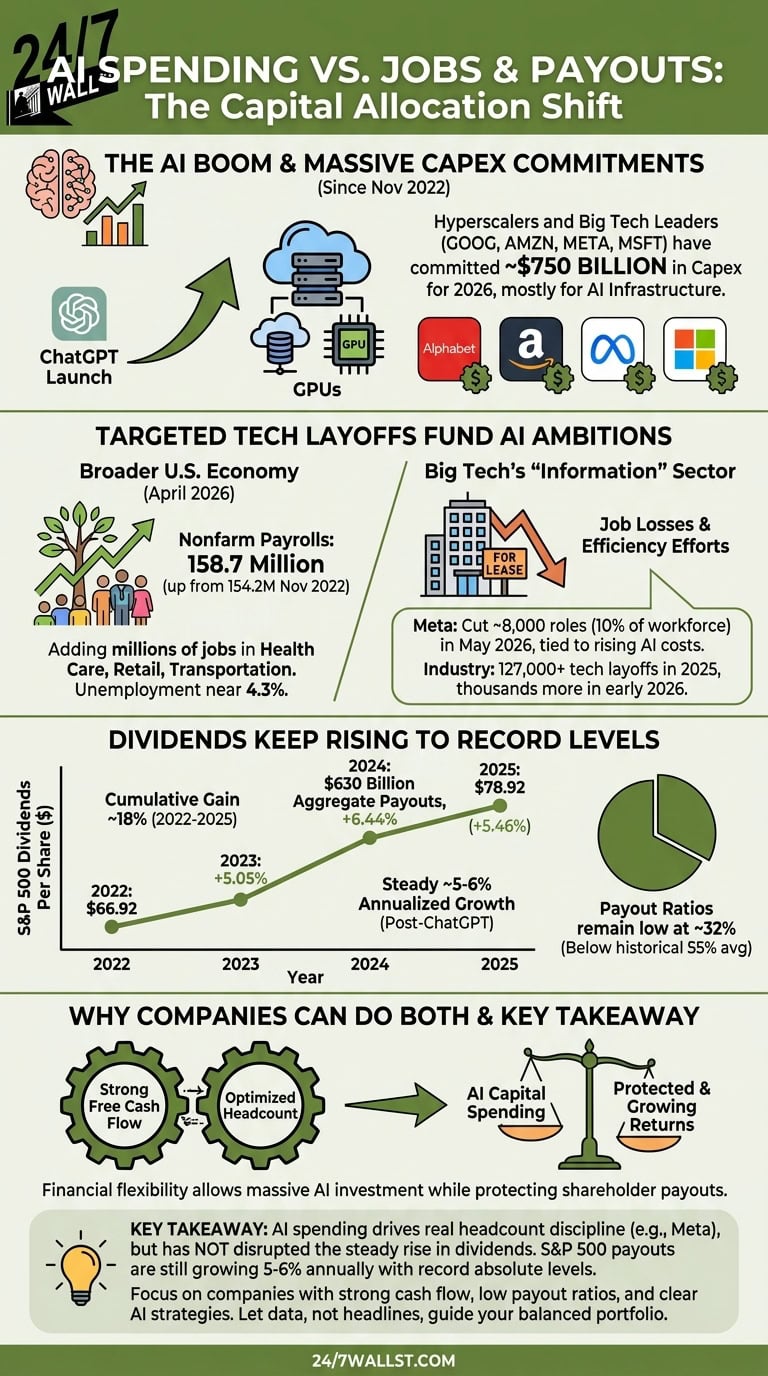
The Big Four hyperscalers — Alphabet (NASDAQ:GOOG | GOOG Price Prediction), Amazon (NASDAQ:AMZN), Meta Platforms (NASDAQ:META), and Microsoft (NASDAQ:MSFT) — have committed to spending around $750 billion in capital expenditures in 2026 mostly for AI infrastructure.
Headlines, meanwhile, tell a darker story of deep job cuts. Meta eliminated roughly 8,000 roles in May 2026 — about 10% of its workforce — and left thousands more positions unfilled. Other tech giants have announced their own rounds of layoffs. It’s easy for everyday investors to wonder: Are companies sacrificing workers to bankroll AI, and will that eventually hit the dividends and buybacks that so many retirement portfolios rely on? The answer, surprisingly, is more reassuring than the headlines suggest.
U.S. companies have continued delivering steady dividend growth and record shareholder payouts even as they tighten payrolls in targeted areas. Let’s break down what the numbers actually show and what it means for your portfolio.
Targeted Tech Layoffs Fund AI Ambitions
U.S. nonfarm payrolls stood at 158.7 million in April, up from roughly 154.2 million around November 2022, according to the Bureau of Labor Statistics (BLS). The broader economy added millions of jobs, led by health care, retail, and transportation, with unemployment near 4.3%.
Inside Big Tech, the picture differs sharply. The “information” sector lost jobs, such as Meta’s latest round of firings. CEO Mark Zuckerberg directly tied these moves to rising AI costs. Industry trackers counted more than 127,000 tech layoffs in 2025, with thousands more in early 2026 — many explicitly linked to AI efficiency efforts and resource reallocation.
Dividends Keep Rising to Record Levels
While companies — particularly Big Tech — cut jobs, shareholder payouts show no signs of sacrifice. S&P 500 dividends per share reached $78.92 in 2025, up from $66.92 in 2022 — a cumulative gain of roughly 18%.
Pre-ChatGPT (three years prior, roughly 2019–2022):
- 2019: +8.36%
- 2020: +0.07% (pandemic dip)
- 2021: +3.63%
- 2022: +10.80%
- Rough average ~5% to 6% annualized over the period, with a rebound in 2022.
Post-ChatGPT (2023-2025)
- 2023: +5.05%
- 2024: 6.44%
- 2025: 5.46%
- Steady ~5% to 6% annualized growth, consistent with (or slightly above) long-term historical averages
Aggregate dividends hit records, too. S&P 500 companies paid out roughly $630 billion in 2024, with further growth in 2025. Payout ratios also remained low at around 32%, well below the historical average of 55%.
This financial flexibility lets companies fund massive AI capital spending while protecting — and growing — returns to investors.
Why Companies Can Do Both
Strong free cash flow from core businesses gives tech leaders room to optimize headcount — often by trimming middle management or non-core roles — while protecting dividends and buybacks. Meta, for example, continues returning capital even as it redirects resources toward AI. As many non-tech sectors continue hiring, the pain stays concentrated.
That said, risks remain. If AI productivity gains lag or spending spirals without revenue offsets, pressure could mount. Tech layoffs remain a fraction of total U.S. employment, and displaced workers often land in new roles. History shows capital reallocation like this fuels later booms.
Key Takeaway
AI spending drives real headcount discipline at companies like Meta, but it has not disrupted the steady rise in dividends. S&P 500 payouts are still growing 5% to 6% annually with record absolute levels.
Savvy investors should favor companies that combine strong free cash flow, low payout ratios, and clear AI strategies. They look best positioned to deliver on both innovation and reliable income. Keep your portfolio balanced, watch the cash flow statements, and let the data — not the headlines — guide you.
In any case, the billions paid to investors continue to flow.
Contact [email protected] for any questions or corrections.
After two decades of patrolling the dark corners of suburbia as a police officer, Rich Duprey hung up his badge and gun to begin writing full time about stocks and investing. For the past 20 years he’s been cruising the markets looking for companies to lock up as long-term holdings in a portfolio while writing extensively on the broad sectors of consumer goods, technology, and industrials. Because his experience isn’t from the typical financial analyst track, Rich is able to break down complex topics into understandable and useful action points for the average investor. His writings have appeared on The Motley Fool, InvestorPlace, Yahoo! Finance, and Money Morning. He has been featured in both U.S. and international publications, including MarketWatch, Financial Times, Forbes, Fast Company, and USA Today.