Trump’s 2026 Bull Market is Really Just an Nvidia Rally
The stock market keeps climbing in 2026, and if you only glanced at the headlines, you’d think the U.S. economy was firing on all cylinders. S&P 500 futures pushed above 7,540 for the first time ever over the Memorial Day…

This post may contain links from our sponsors and affiliates, and Flywheel Publishing may receive compensation for actions taken through them.
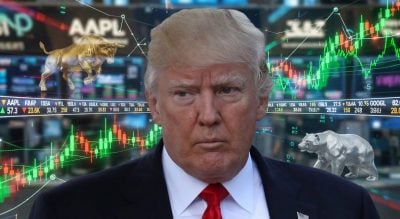
The stock market keeps climbing in 2026, and if you only glanced at the headlines, you’d think the U.S. economy was firing on all cylinders. S&P 500 futures pushed above 7,540 for the first time ever over the Memorial Day weekend, while the index itself is up roughly 9% year to date. President Donald Trump has pointed to those gains repeatedly as proof his economic agenda is working.
But is this really a broad-based bull market or the sign the economy is healthy, or something entirely different? When you peel back the layers, the answer becomes surprisingly clear.
Nvidia Is Becoming the Market
The biggest reason the S&P 500 keeps grinding upward is simple: Nvidia (NASDAQ:NVDA | NVDA Price Prediction) has become too large to ignore.
Carrying a market valuation of more than $5.2 trillion, the AI chipmaker is the largest publicly traded company in the world. And because the S&P 500 is weighted by market capitalization, the largest companies exert the biggest pull on the index’s direction.
That distinction matters far more than many investors realize. Here’s what the numbers show through 2026 so far:
| Group | Average Return YTD |
| Largest 10 S&P 500 stocks | +7.8% |
| Smallest 10 S&P 500 stocks | -23.1% |
In other words, a large swath of stocks are actually falling this year by significant percentages even as the index keeps hitting records. Only 57% of the 503 stocks in the S&P are in the green this year, and many just barely so. Just 197 of them are beating the index’s average, meaning 61% of the components are underperforming the market.
That’s not what a healthy broad-based rally usually looks like.
Let’s put Nvidia’s influence into perspective. Nvidia stock is up more than 15% year to date. Meanwhile, Sandisk (NASDAQ:SNDK) — despite soaring 522% this year — carries a market value of just $298 billion. Nvidia’s gains therefore move the index far more than smaller companies posting much larger percentage returns.
The math is staggering: Nvidia alone accounts for roughly 20% of the S&P 500’s entire 9% gain this year. One stock is responsible for one-fifth of the market’s advance.
The Rally Beneath the Rally
What makes this dynamic even more interesting is that Nvidia wasn’t acting like a market rocket ship for most of the past year.
Since August 2025, shares largely traded sideways in a relatively narrow range as investors questioned whether the AI spending boom could continue indefinitely. Then, over the past several weeks, the stock finally broke out again.
That breakout came even after Nvidia delivered another blockbuster quarterly earnings report that, oddly enough, still triggered some profit-taking afterward. According to the company’s latest earnings release, data center revenue continued expanding at a pace few companies in history have ever maintained.
Granted, Nvidia’s fundamentals remain difficult to argue against. The company still dominates AI accelerators, hyperscale data center spending remains elevated, and demand for GPUs continues outrunning supply in many markets.
But investors should recognize what’s happening under the surface.
This increasingly resembles the “Magnificent Seven” rally investors have watched since 2023 — where a tiny group of mega-cap technology stocks generated an outsized percentage of the market’s gains while many sectors lagged behind.
Meanwhile, several economic indicators continue flashing warning signs. Recent inflation data from the Bureau of Labor Statistics showed price pressures remaining sticky, while higher fuel costs tied to geopolitical tensions continue squeezing consumers. Consumer confidence readings have also weakened in recent months.
That said, none of those concerns matter much when trillions of dollars continue pouring into AI infrastructure spending. At least for now.
Key Takeaway
In short, investors need to stop thinking of 2026 as a classic “stock market rally.” It’s increasingly an Nvidia rally — or, more broadly, a Big Tech rally concentrated in a handful of trillion-dollar companies.
The S&P 500’s structure amplifies that effect because the largest stocks carry the greatest weight. Nvidia doesn’t need every company to rise alongside it. It’s large enough to drag the index higher almost by itself.
That doesn’t mean investors should panic. But it does mean sharp investors need to understand what they actually own when buying index funds at today’s levels. Because if Nvidia stumbles, the market may discover this rally wasn’t nearly as diversified as the headlines suggested.
Contact [email protected] for any questions or corrections.
After two decades of patrolling the dark corners of suburbia as a police officer, Rich Duprey hung up his badge and gun to begin writing full time about stocks and investing. For the past 20 years he’s been cruising the markets looking for companies to lock up as long-term holdings in a portfolio while writing extensively on the broad sectors of consumer goods, technology, and industrials. Because his experience isn’t from the typical financial analyst track, Rich is able to break down complex topics into understandable and useful action points for the average investor. His writings have appeared on The Motley Fool, InvestorPlace, Yahoo! Finance, and Money Morning. He has been featured in both U.S. and international publications, including MarketWatch, Financial Times, Forbes, Fast Company, and USA Today.